

BlackRock Net Worth 2026: Market Value, $14T+ AUM, Revenue and Ownership
Aug 14, 2026 | By Devin Jacobs
 Follow us
 Follow us
BlackRock is one of the biggest names in global finance. The company manages investments for individuals, businesses, governments, pension funds, and institutions across markets around the world. Its scale can be difficult to understand because the money it manages for clients is not the same thing as the money BlackRock itself owns.
That distinction matters when talking about the company’s financial value. BlackRock’s market capitalization is estimated at around $171 billion in the 2026 figures provided in the source material, while its assets under management (AUM) are more than $14 trillion. The $14 trillion-plus figure represents client money that BlackRock manages, not the company’s personal wealth.
In this article, we will see what BlackRock is really worth, how it makes money, and who owns the company. Let’s break it down in simple terms.
BlackRock Net Worth in 2026
Based on the figures provided, BlackRock’s estimated market value is around $171 billion in 2026.
However, calling this figure the company’s “net worth” can be misleading. For a publicly traded company such as BlackRock, market capitalization is a more appropriate measure of how much the stock market values the business.
Here’s a quick look:
| Financial Measure | Approximate 2026 Figure |
| BlackRock market capitalization | $171 billion |
| Assets under management (AUM) | $14+ trillion |
| TTM P/E ratio | 26–27x |
| Forward P/E estimate | Around 18x |
| NYSE ticker | BLK |
The important point is that $14 trillion-plus in AUM does not mean BlackRock owns $14 trillion. Those are assets entrusted to BlackRock by clients for investment management.
BlackRock Net Worth vs Assets Under Management
This is probably the most important distinction to understand.
Imagine someone hires BlackRock to manage $1 million for their retirement. That $1 million becomes part of BlackRock’s AUM, but it doesn’t suddenly become BlackRock’s own money.

The same principle applies to the company’s enormous AUM figure.
Market capitalization reflects the value investors place on BlackRock as a publicly traded company. AUM represents the investments BlackRock manages on behalf of clients.
In other words:
- Market capitalization: How much the stock market values BlackRock.
- AUM: How much client money BlackRock manages.
- Revenue and earnings: What the company generates from its business operations.
This is why a company can manage trillions of dollars while having a market value that is only a fraction of that amount.
How BlackRock Became So Large
BlackRock’s story began in 1988, when Larry Fink and a group of partners launched the company.
The business initially focused heavily on investment management and risk management. Rather than simply trying to pick winning investments, BlackRock built its reputation around helping large investors understand and manage financial risk.
The company went public in 1999, trading on the New York Stock Exchange under the ticker BLK.
Its growth accelerated through major acquisitions. Two particularly important deals were:
- Merrill Lynch Investment Managers in 2006
- Barclays Global Investors in 2009
The Barclays Global Investors acquisition was particularly significant because it strengthened BlackRock’s position in index investing and exchange-traded funds.
Over time, BlackRock grew from an investment-management startup into a global financial services giant with a presence across numerous markets.
Who Owns BlackRock?
BlackRock isn’t privately owned by one individual.
Because it is publicly traded, ownership is spread among institutional investors, public shareholders, and company insiders.
The source material identifies major institutional investors such as:
- Vanguard
- State Street
- Capital Group
The exact percentages can change as investors buy and sell shares, so ownership figures should be treated as estimates rather than permanent numbers.
One interesting detail is that Vanguard, one of BlackRock’s biggest competitors in asset management, is also a major BlackRock shareholder.
That might sound strange at first, but large investment companies frequently hold shares in other publicly traded businesses through funds and investment portfolios.
Larry Fink and BlackRock
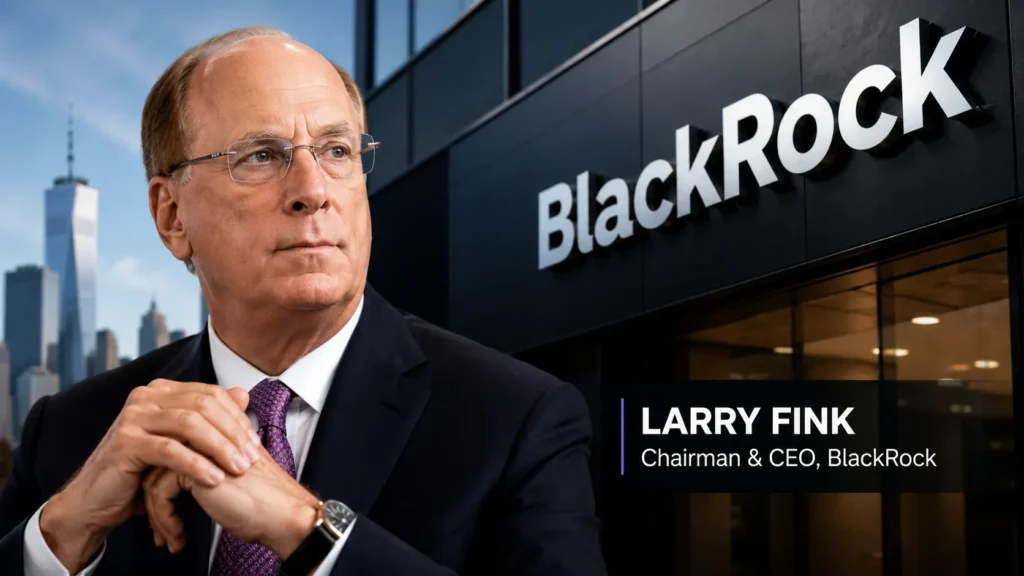
When people talk about BlackRock, one name comes up repeatedly: Larry Fink.
He was appointed CEO in 1988 and has remained one of its most influential leaders. Under his leadership, BlackRock expanded dramatically and became a major force in investment management.
RECOMMENDED FOR YOU


Taylor Breesey’s Face: Exploring the Mystery Behind the Anonymous Social Media Star
Devin Jacobs
Apr 9, 2026

Jujutsu Infinite Codes: A Complete Guide to Rewards, Gameplay Boosts & Latest Updates
Devin Jacobs
Nov 17, 2025
His influence extends beyond simply running a financial company. BlackRock has become an important participant in discussions surrounding markets, corporate governance, sustainability, investment risk, and financial policy.
The source material estimates Fink’s personal wealth at around $1.3 billion, although personal net-worth estimates can vary depending on stock prices and other assets.
It’s also worth remembering that Larry Fink does not personally own BlackRock. He is an important shareholder and leader, but the company is owned by its shareholders collectively.
BlackRock’s Main Sources of Revenue
BlackRock doesn’t make money by simply owning the trillions of dollars it manages.
Instead, the company earns revenue primarily by providing investment and financial services.
Some of its important business areas include:
Asset Management
BlackRock manages money for a wide range of clients. These include individuals, pension plans, institutions, governments, and other organizations.
The company earns fees for managing these investments.
iShares ETFs
BlackRock’s iShares business is one of the best-known parts of the company.
Exchange-traded funds allow investors to buy diversified portfolios through a single investment product. iShares offers ETFs covering stocks, bonds, sectors, countries, commodities, and other investment strategies.
The popularity of ETFs has helped make this an important part of BlackRock’s business.
Institutional Investment Management
BlackRock also manages portfolios for large organizations. These clients may have billions of dollars to invest and require sophisticated portfolio construction, risk analysis, and reporting.
Technology and Risk Management
BlackRock isn’t only an investment manager. Its technology business is also an important part of its identity.
The company’s Aladdin platform provides portfolio management, risk analytics, and other investment-related technology services.
This technology helps institutional investors understand potential risks and monitor portfolios across different markets.
BlackRock’s $14 Trillion+ AUM Explained
BlackRock’s enormous AUM figure is one of the main reasons the company attracts so much attention.
The source material places BlackRock’s assets under management at more than $14 trillion in 2026.
That money can be invested across areas such as:
- Stocks
- Bonds
- Exchange-traded funds
- Retirement investments
- Institutional portfolios
- Government-related investment programs
- Private-market investments
BlackRock’s Aladdin Platform
One of BlackRock’s biggest competitive advantages is its technology.
Aladdin is a portfolio management and risk-analysis platform designed to help investors evaluate portfolios, understand risk, and make more informed investment decisions.
For a company dealing with trillions of dollars in assets, technology is essential.
Managing thousands of securities across different countries and asset classes manually would be extremely difficult. Systems such as Aladdin allow investors and institutions to analyze enormous amounts of information more efficiently.
This technology business also gives BlackRock another source of influence beyond traditional fund management.
BlackRock’s Investment Strategy
BlackRock manages money across many different strategies rather than relying on a single investment approach.
Its business includes both active investment management and passive investment strategies.
Passive investing is particularly important because BlackRock operates one of the world’s largest ETF businesses through iShares.
The basic idea behind passive investing is straightforward: instead of constantly trying to beat the market, a fund can track an index such as the S&P 500.
BlackRock also manages actively managed funds where professional investment teams make decisions about individual securities and portfolio allocations.
This combination allows the company to serve investors with very different goals.
BlackRock vs Vanguard
BlackRock and Vanguard are often mentioned together because both are giants in global asset management.
| Feature | BlackRock | Vanguard |
| Ownership structure | Publicly traded | Client-owned structure |
| AUM | $14+ trillion, based on source | $12 trillion, based on source |
| Major strength | ETFs, active management and technology | Passive/index investing |
| Famous investment platform | iShares | Vanguard funds and ETFs |
| Technology | Aladdin | Vanguard’s own investment technology |
The two companies compete for investors, particularly in low-cost funds and ETFs.
At the same time, both companies are major players in global financial markets.
Why BlackRock Has So Much Influence
BlackRock’s influence comes largely from scale.
When a company manages trillions of dollars, its investment decisions and shareholder activities naturally attract attention.
However, that influence needs to be understood carefully.
BlackRock doesn’t simply decide what happens to every dollar under its management. Funds operate according to their individual mandates, and the ultimate economic interests belong to the clients and investors who own those funds.
Still, the company’s size gives it a significant role in financial markets.
Corporate Voting
As a major asset manager, BlackRock may vote shares on behalf of funds and their investors.
Those votes can involve issues such as:
- Board elections
- Executive compensation
- Corporate governance
- Shareholder proposals
- Environmental and sustainability policies
This is one reason BlackRock’s activities receive so much attention from companies and policymakers.
Government and Institutional Relationships
BlackRock has also worked with government and financial institutions, particularly during periods of market stress.
Its expertise in financial markets and risk management has made the company an important participant in certain government-related programs and advisory assignments.
That history has contributed to BlackRock’s reputation as one of the most influential financial firms in the world.
BlackRock and the 2008 Financial Crisis
The 2008 financial crisis was an important chapter in BlackRock’s history.
During the crisis, the company was involved in analyzing and managing distressed financial assets and worked with major institutions during a period of extraordinary market instability.
The source material says BlackRock was entrusted with approximately $130 billion in troubled assets during the crisis.
The episode helped demonstrate the firm’s expertise in handling complicated portfolios and reinforced its relationship with major financial institutions.
It also contributed to the discussion around how much influence a company of BlackRock’s size should have during financial emergencies.
Criticism and Controversies
BlackRock’s enormous size has inevitably brought criticism.
Some of the debate focuses on whether such a large asset manager has too much influence over corporations and financial markets.
The company has also faced criticism over its approach to ESG investing, with different political and investor groups disagreeing over how aggressively financial institutions should consider environmental and social factors.
These issues don’t necessarily change BlackRock’s overall financial position, but they demonstrate the level of scrutiny that comes with operating at such a large scale.
Is BlackRock’s Market Value the Same as Its Net Worth?
No. This is an important point for anyone researching BlackRock's net worth.
A company’s market capitalization and accounting net worth are not identical concepts.
Market capitalization is calculated by multiplying the company’s share price by the number of shares outstanding.
Accounting net worth, or shareholders’ equity, is based on the company’s assets minus liabilities.
For a simple online explanation, market capitalization is often used as a practical way to describe what a publicly traded company is “worth” in the eyes of investors. But technically, it isn’t the same as accounting net worth.
That distinction becomes even more important with BlackRock because of its enormous AUM.
BlackRock Net Worth 2026
If you’re looking for a straightforward figure, the source material places BlackRock’s 2026 market capitalization at approximately $171 billion.
At the same time, the company manages more than $14 trillion in assets for clients.
So the easiest way to understand the numbers is:
BlackRock’s estimated market value: ~$171 billion
BlackRock’s assets under management: $14+ trillion
The second number is much larger because it represents money belonging to clients and investors, not money that BlackRock itself owns.
What Makes BlackRock So Valuable?
BlackRock’s value isn’t based on one investment or one fund.
Its strength comes from the combination of several businesses and advantages:
- A massive global client base
- More than $14 trillion in assets under management
- The iShares ETF franchise
- Institutional investment management
- A strong technology platform through Aladdin
- Global market expertise
- A long operating history
- Relationships with major institutions
- A broad range of investment products
The company has essentially built an ecosystem around managing money and helping investors understand financial risk.
Conclusion
BlackRock's financial narrative is much simpler to comprehend. According to the data presented, the corporation managed over $14 trillion in customer assets in 2026.
That huge gap is not a contradiction. It simply shows how asset management works: BlackRock manages enormous amounts of money without personally owning all of it.
Its growth from a financial startup founded in 1988 to one of the world’s most influential asset managers has been driven by investment expertise, acquisitions, ETFs, institutional relationships, and technology such as Aladdin.
Recommended Stories for You

Devin Jacobs Jul 7, 2026

Devin Jacobs May 18, 2026

Devin Jacobs May 25, 2026

Devin Jacobs Mar 25, 2026

42 Dugg Height: Understanding the Rapper’s Stature and Influence in the Music Industry
Devin Jacobs May 25, 2026

Devin Jacobs Mar 19, 2026
Trending Stories

Ramtin Abdo: Deep Dive into His Business Success and Private Life

Bfanni8986: Understanding the Story Behind a Unique Online Identity and Comparison with Other Platforms

How a Collaborative CRM System Improves Communication and Efficiency?

Billy Carson Net Worth and Biography

Abraham Quiros Villalba: Inspiring Journey of a Forward-Thinking Visionary Innovator

What Is QueekMag com? A Complete Guide to Its Content and Features

Is Faspeinfo the Right Place to Find Answers, Study Guides and Educational Materials?

PrecoWeb Com Review: Everything You Need to Know in 2026

