


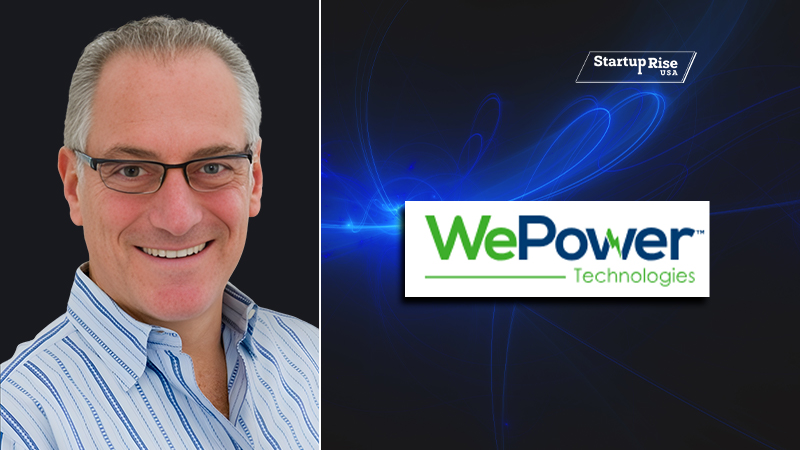
The Spark: Batteries Aren’t the Future
For years, Lawrence “Larry” Richenstein observed a growing problem: as more devices connected to the Internet of Things (IoT), the reliance on batteries for countless sensors and transmitters was becoming a major bottleneck—leading to maintenance overhead, limited lifespans, and environmental waste. He asked: What if these devices could be powered by motion or energy harvesting, rather than replacing batteries?
In 2019, he founded WePower Technologies with the mission of developing energy-harvesting generators (EHGs) to enable wireless devices to operate without conventional batteries.
A Founding Journey Rooted in Hardware
Larry’s background is deep in the wireless hardware industry: according to company filings, he previously founded or co-founded companies including Lonestar Technologies, Long Hall Technologies, and Unwired Technology.
He also served in leadership roles at the Consumer Technology Association, including Chair of the Automotive Electronics Division and Board member, giving him both credibility and connections across consumer and industrial electronics.
This experience uniquely positioned him to spot the battery problem in IoT and to design a hardware-first solution with real product potential.
The Vision & Mission
WePower Technologies describes its mission clearly:
“To engineer reliable, scalable, sustainable energy-harvesting solutions that power the IoT… eliminating wasteful batteries.”
Their core value proposition is that batteries are heavy, have a finite lifespan, are costly to maintain, and are increasingly unsustainable—the alternative: motion or ambient energy harvesting via electromagnetic induction that can generate sufficient power for a broad array of wireless devices.
As Larry puts it:
“For the IoT to reach its potential, we need a better way to power the data-gathering and transmitting devices that support it. Batteries are expensive and wasteful at scale…”
Read also- Accelerating Life-Science Innovation: The Story of Collate
Building the Technology: Energy Harvesting Generators
Under Larry’s leadership, WePower developed its Gemns™ line of energy-harvesting generators (EHGs). These modules harness motion (vibration, oscillation) through electromagnetic induction—leveraging permanent magnets and optimized mechanical design to generate significantly more output than prior art.
Key technical milestones:
- The company claims to have boosted output from prior levels (~0.1 mJ) to ~3 mJ in specific modules—enough to power wireless sensors across industrial, smart-home, smart-building, and automotive applications.
- The patented technologies (e.g., US11973391B2) show Richenstein and WePower integrating novel magnet/slider mechanisms to translate motion into usable electrical output.
- The solutions target protocol-agnostic wireless devices, including Bluetooth, LoRa, Matter, Thread, and standard ISM sensors, broadening applicability.
Early Milestones & Validation
- In December 2022, the company announced that it would make its CES 2023 debut, highlighting its energy-harvesting modules as a battery-free solution for IoT.
- In January 2025, WePower’s presence at CES 2025 drew “massive interest” from lighting companies, security firms, elevator makers, and other industries seeking alternative power sources, demonstrating the market readiness.
- Their IP portfolio, patents, and product demos signal serious engineering progress, not just a concept.
Leadership & Strategy
Larry uses his background in hardware entrepreneurship to drive both technological innovation and strategic partnerships. Some threads:
- He emphasises eliminating batteries rather than just replacing them with another form of energy—a mindset shift in hardware design.
- He has aligned WePower to multiple verticals: industrial IoT, smart buildings, automotive, aerospace—thus ensuring the technology is not niche but broad.
- He builds credibility by showing product prototypes and demos (e.g., the Gemns modules), which is crucial in deep-tech hardware markets where trust and performance matter.
Challenges & Turning Points
As with any deep-tech hardware venture, WePower faces significant hurdles—Larry and his team have navigated them with clarity:
- Scale & production: Building reliable energy-harvesting modules that work across diverse environmental conditions (motion, vibration, temperature, form-factor) is non-trivial.
- Integration into devices: Convincing OEMs and product companies to alter their designs, replace batteries, and trust an alternative power source is a behavioural and engineering challenge. Larry noted that major companies are only now beginning to recognise the opportunity.
- Unit economics: Batteries are cheap and entrenched; energy-harvesting modules must demonstrate cost, reliability, and performance that justify design change and long-term ROI.
- Time to market & adoption: Hardware development cycles are long; Will the technology reach sufficient volume and adoption before alternatives emerge?
- Regulation & certification: For industrial, automotive, or aerospace use-cases, certifications and proof of reliability are rigorous. WePower has to meet these.
A turning point appears to have been their CES presentations and increasing OEM interest—as highlighted in January 2025. The momentum suggests the waiting phase may be over, and the adoption phase may be starting.
Why Larry’s Story Matters
The story of Larry Richenstein’s journey is representative of the deep-tech hardware entrepreneuring of the 2020s:
- Founder-led domain expertise: He didn’t pivot into IoT from a generic tech background; he built on his decades in wireless electronics and hardware startups.
- Mission-driven hardware innovation: The problem of battery waste, maintenance, and environmental cost is both technical and societal—and Larry framed it as such.
- Bridging hardware + system integration + business strategy: Many hardware startups fail because they build tech but not productised systems. Larry has aligned product, manufacturing, partnerships, and messaging.
- Global scale, not niche: By targeting multiple verticals and positioning their modules as broadly applicable, WePower avoids the “one device only” trap and aims for scalable industrial relevance.
- Timing & market readiness: With IoT growth accelerating and battery constraints becoming more visible, Larry positioned WePower at the right time to ride the wave of “battery-free” demand.
The Road Ahead: Vision & Next Steps
Looking forward, under Larry’s leadership, WePower appears set to:
- Productize at scale: Transition from prototyped demos to fully engineered modules, licensing agreements, OEM integrations, and volume production.
- Expand verticals: Accelerate into lighting (battery-free wall-switches), smart homes, smart buildings, industrial sensors, automotive sensors—all sectors mentioned in the CES 2025 interest.
- Licensing/partnership model: Rather than only selling modules, the model could shift to licensing their technology (Gemns) to OEMs who build devices. Larry’s comments at CES suggest that major brands are negotiating licensing deals.
- Sustainability narrative: As concerns about battery waste and rare-earth metals grow, WePower’s narrative of eliminating batteries could become a key selling point and regulatory driver (e.g., EU battery phase-out timelines).
Deep IP moat & manufacturing scale: Patents and manufacturing capability will be crucial for long-term success.

