


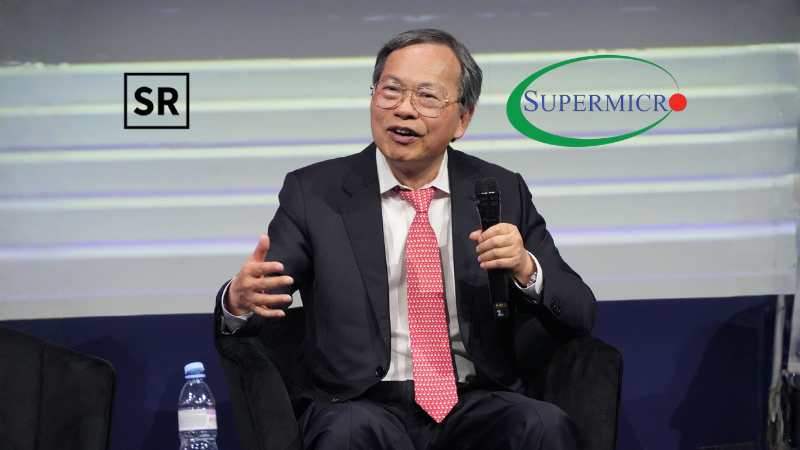
The U.S. has charged a co-founder of Super Micro Computer Inc. with illegally sending billions of dollars’ worth of Nvidia-powered servers to China, marking its biggest crackdown on the alleged smuggling of restricted AI technology to the country.
Read More:Claros Raises $30M in Seed Funding
U.S. prosecutors have charged Yih-Shyan “Wally” Liaw with illegally sending U.S.-made servers equipped with advanced Nvidia chips to China, in violation of export control rules. Liaw and two others linked to Super Micro allegedly sold the servers to a Southeast Asian company and arranged for them to be sent to Chinese customers.
The news caused Super Micro’s stock to drop sharply, wiping out more than $6 billion in value. The company said Liaw resigned from its board immediately.
According to the indictment, the group tried to avoid detection by auditors from both the company and the U.S. government. They allegedly falsified records and even used “dummy” servers, swapping serial numbers using a hair dryer. Two others were also charged: Ruei-Tsang “Steven” Chang, a general manager in Super Micro’s Taiwan office, and Ting-Wei “Willy” Sun, an outside contractor who allegedly helped carry out the scheme.
Super Micro’s shares fell 33% to $20.53 in New York, its biggest one-day drop since October 2018. The company also said DeAnna Luna has been appointed acting chief compliance officer; she previously managed export licensing at Intel before joining Super Micro in 2024.
The indictment of an executive at Super Micro — a Fortune 500 company and a key partner of Nvidia — marks a major step up in efforts by officials under Donald Trump to more strictly enforce chip export rules first introduced in 2022. It follows several smaller smuggling cases last year and an investigation into Nvidia’s largest Southeast Asian customer.
The case shows that U.S. authorities are continuing to tighten enforcement of export controls, even as some limited sales of similar Nvidia chips to China are being allowed. However, companies still need government approval to sell AI chips to China.
The indictment does not accuse Nvidia of wrongdoing. CEO Jensen Huang has said there is “no evidence” of illegal chip diversion. Still, the case comes at a sensitive time, as lawmakers are already pushing for stricter rules to stop smuggling and limit new export approvals. This development could increase that pressure.
Officials are also considering expanding licensing requirements to more countries to reduce the risk of smuggling.
NVIDIA said it is working closely with customers and the government to comply with export rules, adding that illegal diversion of restricted technology to China is ineffective because the company does not support such systems, and enforcement is strong.
Super Micro is a major maker of AI servers using Nvidia’s advanced chips and competes with companies like Foxconn Technology Group. It generates about 9% of Nvidia’s revenue, according to Bloomberg data. The indictment also says Super Micro earns a significant portion of its own revenue from a Southeast Asian company involved in the alleged scheme, referred to as.”
Prosecutors said the defendants’ relationship with the Southeast Asian firm began in 2024. It started when Super Micro co-founder Liaw and Taiwan-based manager Chang agreed with a Company-1 executive to arrange shipments to Chinese customers, who were not allowed to buy Nvidia AI chips directly.
According to the indictment, the servers were often built in the U.S., sent to Company-1 in Southeast Asia, and then redirected to China through a network of third-party brokers.
The business was highly profitable. In the fourth quarter of Super Micro’s 2024 fiscal year, Company 1 became the company’s eleventh most profitable customer worldwide, prosecutors said. However, the rapid growth raised internal concerns prompting Super Micro to pause shipments to Company 1 and launch an audit in late 2024.
In December, Super Micro co-founder Liaw began arranging shipments of Nvidia’s latest B200 chips and asked a partner company how many they could handle. He also connected them with a third contractor involved in the scheme.
In early 2025, the Joe Biden administration introduced strict export rules requiring approval for the shipment of AI chips to many countries. Liaw reportedly pushed to speed up shipments before the rules took effect.
Despite some pauses, the partner company bought about $510 million in servers powered by Nvidia chips—part of roughly $2.5 billion in total sales linked to the case.
To avoid detection, the group allegedly used “dummy” servers during audits. U.S. officials later suspected illegal shipments to China and launched an investigation.
Read More:Eclypsium Raises $25M in Funding

