
AI Job Market: How Artificial Intelligence Is Changing the Future of Work
Aug 21, 2026 | By Devin Jacobs
 Follow us
 Follow us
Artificial intelligence has moved far beyond being a futuristic idea. It is already sitting inside the tools people use at work every day.
A marketer can ask AI to turn research into a campaign outline. A customer-service employee can let a chatbot handle routine questions. A financial analyst can use AI to spot unusual patterns in a huge dataset. A software developer can use AI to write or review code.
And that naturally raises a bigger question:
What happens to jobs when AI becomes better, faster, and more capable?
It is tempting to think about the future as a simple battle between humans and machines. But the reality is much more complicated.
AI will certainly automate some work. At the same time, it will change existing jobs, create new positions, and give people tools that allow them to do things that previously took much longer.
In other words, the AI job market isn’t simply about jobs disappearing. It is about work itself being redesigned.
That shift is already happening, and understanding it can help students, employees, employers, and job seekers make smarter decisions about what comes next.
What Is the AI Job Market?
The AI job market refers to the changing employment landscape created by the adoption of artificial intelligence.
It includes two things happening at the same time.
First, companies are using AI to automate repetitive, predictable, and data-heavy tasks. Second, businesses are creating new positions that require people to build, manage, supervise, and apply AI systems.
That means the future of work is unlikely to be a simple story of “AI takes jobs and humans lose them.”
Instead, many jobs are being redesigned.
For example, a customer-support employee may previously have answered dozens of routine questions every day. An AI chatbot can now deal with many of those basic requests. The human employee, however, may spend more time handling complicated complaints, solving unusual problems, and building relationships with customers.
The job hasn’t necessarily disappeared. The work inside the job has changed.
How Is AI Changing the Workplace?
Walk into almost any modern workplace, and you’ll find some form of AI being used, even if employees don’t always think of it as “AI.”
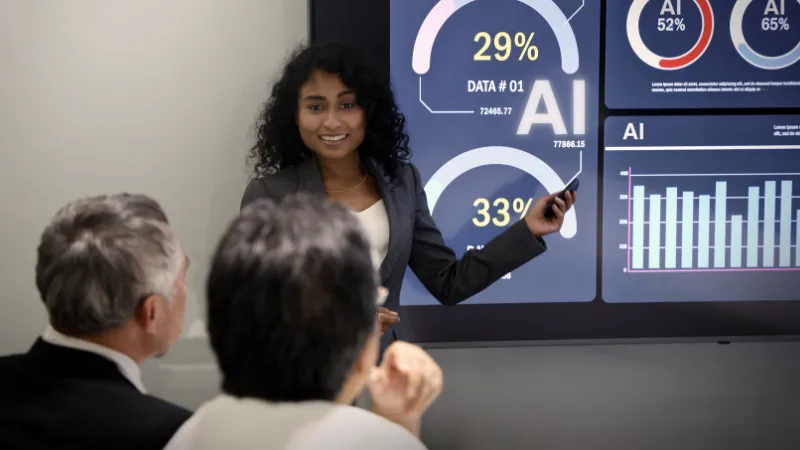
Businesses are using artificial intelligence to:
- Automate repetitive administrative work
- Analyze large amounts of data
- Write and summarize documents
- Respond to basic customer questions
- Detect fraud
- Predict demand
- Personalize marketing
- Support recruitment
- Generate software code
- Improve business forecasting
- Assist with research and decision-making
The biggest change is that AI can now perform tasks that previously required considerable human time.
That creates an interesting situation for employees.
Instead of spending eight hours completing routine tasks, a worker might spend two hours reviewing AI-generated work and use the remaining time for analysis, creativity, communication, or strategy.
That can be a major productivity boost.
But it also means workers need to learn how their roles are changing.
Will AI Replace Jobs?
This is probably the question people ask most often.
Yes, AI will replace some jobs and reduce the need for certain types of work. But that isn’t the whole story.
Jobs built around repetitive, predictable activities are generally more exposed to automation.
Think about data entry. If a person spends most of their day transferring information from one system to another, software can increasingly perform that task.
The same applies to some forms of basic customer service, routine document processing, simple bookkeeping, and repetitive administrative work.
But most jobs aren’t made up of a single task.
Take accounting as an example.
AI can help categorize transactions, identify unusual activity, prepare reports, and automate calculations. However, companies still want people for various purposes, such as understanding the financial situation, making decisions, accepting accountability and many more things.
Which Jobs Are Most at Risk From AI?
AI tends to perform particularly well when work is repetitive, predictable, and based on clearly defined rules.
Here are some roles which AI will automate:
- Data entry jobs
- Telemarketing
- customer-support
- Administrative processing jobs
- Certain transcription roles
- Repetitive content production
- Basic document-review work
- Some entry-level analytical tasks
What New Jobs Is AI Creating?
Here’s the part of the AI conversation that sometimes gets overlooked.
Every major technological shift destroys some types of work while creating demand for other types of work.
AI is doing the same thing.
Companies need people who can build AI systems, manage them, test them, explain them, and make sure they are being used responsibly.
Let’s see. Some growing and emerging roles include:
Machine Learning Engineers
They build and maintain systems that help computers to learn from data.
Data Scientists
They work with big datasets to uncover the patterns and insights that can help organizations make better decisions.
AI Product Managers
They connect technical AI capabilities with real customer and business needs.
AI Governance Specialists
As companies become more dependent on AI, they need people who understand issues such as privacy, regulation, risk, transparency, and responsible AI use.
AI Trainers and Evaluators
AI systems need people to test their responses, identify weaknesses, and improve their performance.
Automation Specialists
These professionals look for repetitive business processes that can be improved through automation.
AI Consultants
Companies that don’t have large internal AI teams may bring in specialists to help them decide where and how AI should be introduced.
And importantly, not every AI-related career requires you to become a programmer.
The Rise of AI-Hybrid Careers
One of the most interesting developments in the job market is the rise of hybrid roles.
These are jobs where someone combines knowledge of a traditional profession with AI or technology skills.
For example:
- AI + marketing
- AI + finance
- AI + healthcare
- AI + education
- AI + law
- AI + human resources
- AI + design
- AI + cybersecurity
Consider a marketing professional.
They don’t necessarily need to become a machine-learning engineer. But if they understand AI-powered analytics, automation, content tools, and customer personalization, they can potentially work more efficiently than someone who doesn’t understand those technologies.
The same idea applies to almost every profession.
Industry expertise plus AI literacy can be a powerful combination.
What Skills Will Matter Most in the AI Job Market?
Learning how to use one particular AI tool isn’t enough.

Technology changes too quickly.
A better strategy is to build skills that remain useful even when individual tools change.
Technical Skills
Depending on your career, these may include:
- Data analysis
- Python
- SQL
- Machine learning fundamentals
- Data visualization
- Automation
- AI tools
- Cloud technology
- Cybersecurity
- Digital analytics
You don’t have to learn everything.
A finance professional may benefit more from data analytics and AI-powered financial tools than from spending months learning advanced machine learning.
Human Skills
Then there are the skills machines still struggle to replicate effectively.
It includes:
- Critical thinking
- Communication
- Creativity
- Leadership
- Problem-solving
- Collaboration
- Emotional intelligence
- Adaptability
- Ethical judgment
These skills become even more important when AI is involved.
Why Human Judgment Still Matters
Imagine an AI system analyzing thousands of customer complaints.
It might identify the most common problems within seconds.
That’s useful.
But what should the company do about those problems?
Should it change the product? Refund customers? Contact a supplier? Change its pricing? Apologize publicly?
Those decisions involve context, business priorities, ethics, and judgment.
That’s where humans remain important.
The future isn’t necessarily about humans competing with AI on the things computers are already good at.
It’s about people learning to focus their energy on the things humans are particularly good at while allowing technology to handle more routine work.
Which Jobs Are Less Likely to Be Fully Automated?
No occupation is completely protected from technological change. However, some types of work are more difficult to automate because they depend heavily on human interaction, complex physical skills, creativity, or judgment.
These works include:
- Nurses and caregivers
- Teachers
- Therapists
- Skilled tradespeople
- Healthcare professionals
- Entrepreneurs
- Creative professionals
- Negotiators
- Managers and leaders
- Jobs requiring complex physical dexterity
Even these workers will probably use AI.
How Can Students Prepare for an AI-Driven Job Market?
Students entering the workforce today have an unusual challenge.
The careers they will have in ten or twenty years may not look exactly like the careers available now.
So instead of chasing a single “future-proof” profession, students should focus on becoming adaptable.
Start with the basics.
Learn what AI can do. Understand its limitations. Experiment with different tools. Build projects. Complete internships. Work on real-world problems.
Most importantly, combine AI with another area of knowledge.
For example:
Business + AI
Healthcare + AI
Marketing + AI
Finance + AI
Design + AI
That combination can be more useful than simply knowing how to operate an AI chatbot.
How Can Working Professionals Stay Relevant?
You don’t need to throw away your existing career just because AI is becoming more powerful.
Start by looking at your current job.
Write down everything you do during a normal week.
Then divide those tasks into three groups:
Tasks AI can probably automate
Tasks AI can assist with
Tasks that require strong human judgment
This simple exercise can tell you a lot.
If AI can handle 20% of your routine work, that doesn’t automatically mean your job is 20% less valuable.
It could mean you now have more time to take on higher-value responsibilities.
For example, instead of spending Friday afternoon preparing a report manually, you might use AI to help generate the first version and spend that time explaining the results to your manager or client.
That’s a better use of your time.
What Will the AI Job Market Look Like by 2030?
Nobody can predict the 2030 job market perfectly. However, some trends seem increasingly likely.
AI Will Become Part of Everyday Work
AI will probably become less of a separate technology and more of a normal feature inside workplace software.
Hybrid Jobs Will Become More Common
Professionals will increasingly combine industry expertise with AI capabilities.
Routine Work Will Face More Automation
Jobs centered heavily on repetitive digital tasks will continue to experience pressure.
AI Literacy Will Become a Basic Workplace Skill
Just as employees today are expected to understand basic digital tools, many workers will eventually be expected to understand how to work effectively with AI.
Reskilling Will Become Normal
People may change their responsibilities and skill sets several times during their careers.
The biggest advantage may belong to people who are comfortable learning again and again.
What Are the Biggest Risks of AI in the Workplace?
AI brings enormous opportunities, but it also creates legitimate concerns.

RECOMMENDED FOR YOU


Do the Cadillac LYRIQ’s Driving Modes Affect Range and Battery Usage?
Devin Jacobs
May 26, 2026

Supplement Management Thespoonathletic: Complete Guide to Smart Athletic Nutrition
Devin Jacobs
May 12, 2026
Job Displacement
Some employees may lose roles as businesses automate certain processes.
Inequality
Workers with valuable technical or specialized skills may benefit more quickly than those whose work is heavily exposed to automation.
Privacy
AI systems often depend on large amounts of data, raising questions about how employee and customer information is collected and used.
Bias
AI systems can reproduce biases found in their training data or in the processes used to build them.
Overdependence on AI
An AI-generated answer can sound convincing and still be wrong.
That is particularly dangerous in areas such as healthcare, finance, law, education, and hiring.
Human oversight isn’t becoming unnecessary.
In many situations, it is becoming more important.
How to Future-Proof Your Career
There is no perfect formula for future-proofing a career. But you can make yourself considerably more adaptable.
Here are a few practical steps:
1. Become Comfortable With AI
You don’t need to become an expert overnight. Start by understanding what common AI tools can and cannot do.
2. Learn to Work With Data
Data literacy is becoming useful across almost every profession.
3. Improve Your Skills
Improve your skills such as communication skills, leadership, etc.
4. Build Real Experience
Don’t rely entirely on certificates. Create projects and demonstrate what you can actually do.
5. Understand Your Industry
AI skills are much more valuable when combined with genuine knowledge of a particular industry.
6. Keep Experimenting
Technology will continue to change. Curiosity may become one of the most valuable career traits of all.
Conclusion
The AI job market is changing faster than many people expected.
Some jobs will disappear. Some will become smaller. Others will change so much that their traditional descriptions may no longer make sense. At the same time, entirely new opportunities will emerge.
That can sound frightening, particularly if you’re a student deciding what to study or a professional wondering whether your current career will still exist several years from now.
Every major technological shift has changed the way people work. The people who adapt usually have more opportunities than those who simply try to resist the change.
AI is no different. You don’t need to become an AI engineer to remain relevant. You need to understand how AI is changing your particular field, learn how to use the technology where it makes sense, and continue developing the human abilities that technology can’t easily replace.
FAQs
Will AI replace jobs in the future?
What new jobs are being created by AI?
Is AI creating more jobs than it is destroying?
Are entry-level jobs at greater risk because of AI?
How is AI changing the way companies hire employees?
Will traditional job titles become less important because of AI?
What is the best way to prepare for AI-related career changes?
Will AI make human skills more important?
Is AI a threat or an opportunity for workers?
What is the future of work with AI?
Recommended Stories for You

Devin Jacobs Mar 24, 2026

Devin Jacobs Jan 22, 2026

Devin Jacobs Jul 15, 2026

Devin Jacobs Mar 5, 2026

Devin Jacobs Sep 3, 2026

Devin Jacobs May 14, 2026
Trending Stories
Snapchat Planets Meaning, Order and How They Actually Works

Snapjotz.com: Ultimate Platform for Simplified Content Creation and Seamless Team Collaboration

Thejavasea.me Leak of AIO-TLP370: What It Means for the Future of Cybersecurity

SERVPRO: Fast and Reliable Disaster Recovery Solutions

TheSindi.com: Growing Digital Platform for Informative Content
Amazon Vine Login: How It Works, Membership Levels, Costs and Troubleshooting Guide

Dan Hayhurst: Inside the Life of Pamela Anderson’s Former Husband

Shark Tank Season 17: Release Date and New Guest Sharks

