

Anthropic Business Model: How Does Anthropic Make Money?
Aug 22, 2026 | By Devin Jacobs
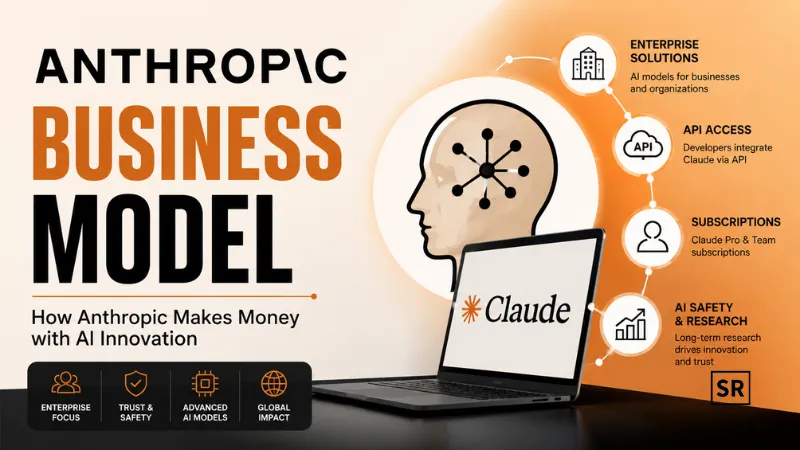
Artificial intelligence has moved from an experimental technology to a serious business tool, and Anthropic is one of the companies at the center of that shift.
 Follow us
 Follow us
Best known for developing Claude, Anthropic has built its business around creating advanced AI systems and making them useful to individuals, developers, and organizations. But building powerful AI models is expensive. Training, computing infrastructure, research, safety work, and engineering all require significant investment.
So, how does Anthropic make money? The simple answer is through paid access to its AI models and products, enterprise services, and commercial partnerships. The bigger picture is more interesting: Anthropic’s business model combines recurring software revenue with usage-based AI consumption.
What Is Anthropic’s Business Model?
Anthropic operates primarily as an AI technology and software company.
RECOMMENDED FOR YOU

Fintechzoom.com CAC 40: Real-Time Index Updates, Sector Analysis & Complete Market Guide
Devin Jacobs
May 20, 2026

Is Faspeinfo the Right Place to Find Answers, Study Guides and Educational Materials?
Devin Jacobs
May 30, 2026

How Does the whatutalkingboutwillis Blog Blend Curiosity and Conversation?
Devin Jacobs
May 28, 2026
Its core product is AI technology that businesses and developers can use to perform tasks such as generating and analyzing text, writing and reviewing code, processing information, and automating parts of their workflows.
The basic model looks like this:
Anthropic develops AI → customers access the technology → customers pay for that access → Anthropic reinvests revenue into better AI models and infrastructure.
This creates a cycle in which better technology can attract more users, while growing usage can generate more revenue to fund further research and development.
Anthropic’s business model is therefore built around four major ideas:
- AI model development
- Paid access to AI technology
- Enterprise and commercial relationships
- Heavy investment in research and development
How Does Anthropic Make Money?
Anthropic’s revenue model can be understood through several connected streams.
1. AI Product and Model Access
The most important part of Anthropic’s commercial strategy is making its AI technology available to paying users.
Claude can be used as an AI assistant, while developers and businesses can integrate Anthropic’s models into their own applications and workflows.
This creates a software-style revenue opportunity. Instead of selling a physical product once, Anthropic can generate recurring revenue as customers continue using its AI services.
For developers, the model is particularly interesting because AI usage can be connected directly to an application’s activity. A company might use AI to summarize documents, assist programmers, analyze customer conversations, or power an internal knowledge system.
The more valuable the AI becomes to the workflow, the more reason customers have to keep using it.
2. Enterprise Customers
Businesses represent another important part of Anthropic’s model.
Large organizations often need more than access to a chatbot. They may require AI capabilities that can be incorporated into internal systems, employee workflows, customer service operations, software development, research, and data analysis.
This makes enterprise AI attractive because the customer relationship can become much deeper than an ordinary consumer subscription.
An enterprise customer may use AI across hundreds or thousands of employees, creating significantly more potential usage than an individual account.
For Anthropic, that means the opportunity is not simply to sell an AI assistant. It is to become part of a company’s technology stack.
3. Usage-Based Revenue
AI businesses have a major difference from traditional software companies: customers consume computing resources when they use the product.
Every request requires processing power. That makes usage-based pricing a natural part of the AI business model.
Developers and companies can integrate models into their applications and pay according to how much AI they actually use. This allows a small application to start with relatively limited consumption while a successful application can generate substantially larger usage over time.
For Anthropic, this creates an attractive relationship between customer growth and revenue.
If customers build successful products around Claude, their AI consumption can increase as their own businesses grow.
4. Strategic Partnerships
Partnerships are another important part of Anthropic’s growth strategy.
AI companies need enormous amounts of computing infrastructure, distribution, and access to customers. Strategic relationships with major technology companies can therefore be extremely valuable.
Partnerships can help Anthropic expand its technological capabilities while also making its AI models available through broader business ecosystems.
This is important because building a world-class AI model is only one part of the challenge. The company also needs infrastructure capable of serving that model at scale.
A strong partner can help solve part of that problem.
5. Research and Development as a Business Investment
R&D is not a side activity at Anthropic. It sits at the heart of the business.
The company operates in an industry where technology can change extremely quickly. A model that is considered cutting-edge today can face serious competition tomorrow.
That means Anthropic needs to continuously improve its models.
Money generated from customers can therefore be reinvested into:
- AI research
- Model training
- Computing infrastructure
- Engineering
- Product development
- AI safety research
- New commercial applications
This creates a continuous investment cycle.
Revenue → R&D and infrastructure → better AI → stronger products → more customers and usage → more revenue.
That cycle is central to understanding Anthropic’s business model.
Why Partnerships Matter So Much to Anthropic
AI companies face a unique challenge: developing the technology requires enormous amounts of computing power.
Unlike a traditional software startup that can potentially serve thousands of customers from a relatively small infrastructure footprint, advanced AI models can require substantial computing resources every time customers use them.
Strategic partnerships can therefore help Anthropic gain access to infrastructure, technology, distribution, and enterprise customers.
Partnerships can also reduce the amount of time required to build everything internally.
In business-model terms, Anthropic does not have to own every part of the AI ecosystem to participate in its economics.
It can focus on what it does best, developing advanced AI systems while working with other companies for complementary resources.
The Role of Customer Satisfaction
AI products are becoming increasingly competitive. Users have plenty of alternatives, so product quality matters.
Anthropic’s ability to retain customers depends heavily on whether its AI is actually useful.
For businesses, that means factors such as:
- Accuracy
- Reliability
- Speed
- Security
- Ease of integration
- Consistent performance
- Useful enterprise features
If an AI system becomes embedded into an organization’s daily workflow, switching to another provider can become inconvenient and costly.
That creates the possibility of long-term customer relationships.
In other words, customer satisfaction is not simply a branding issue. It can directly affect recurring revenue.
Anthropic’s Business Model Canvas
| Business Model Element | Anthropic |
| Key Product | Claude and related AI technologies |
| Primary Customers | Consumers, developers, startups and enterprises |
| Revenue Sources | Paid AI access, subscriptions and usage-based services |
| Key Resources | AI models, researchers, engineers, computing infrastructure and intellectual property |
| Key Activities | AI research, model training, product development and safety research |
| Key Partners | Technology, cloud and distribution partners |
| Customer Relationship | Self-service products plus business and enterprise relationships |
| Main Costs | Computing, research, infrastructure, talent and product development |
| Competitive Advantage | Advanced AI capabilities, research expertise and strong commercial partnerships |
What Makes Anthropic’s Model Different?
The biggest difference between Anthropic and a conventional software company is the cost structure.
Traditional software can often have relatively low marginal costs. AI is different because every interaction with a powerful model requires computing resources.
That means Anthropic has to balance two things at the same time:
Make the models powerful enough that customers find them valuable, while keeping the cost of serving those models economically sustainable.
This makes infrastructure efficiency extremely important. It also explains why scale matters so much.
As more customers use the platform, Anthropic can potentially generate more revenue, but it must simultaneously manage the computing costs associated with that increased usage.
The Importance of R&D
Anthropic’s long-term success depends heavily on staying competitive technologically.
The AI industry moves quickly. New models, new architectures, new competitors, and new applications can emerge in a short period.
Consequently, research is not something Anthropic can stop doing after launching a successful product.
The company needs to keep improving. That makes R&D both a major cost and one of its most important investments.
Anthropic’s Competitive Advantage
Anthropic’s business model benefits from several potential advantages.
Strong AI Research
Advanced AI requires highly specialized researchers and engineers. Building that expertise takes considerable time and resources.
Growing AI Adoption
As businesses become more comfortable using AI, the addressable market for enterprise AI continues to expand.
Recurring Usage
AI can generate recurring revenue because customers may continue paying as long as the technology remains useful.
Ecosystem Partnerships
Strategic technology and infrastructure relationships can expand Anthropic’s reach without requiring it to build every part of the ecosystem itself.
Product Integration
When AI becomes part of a company’s everyday workflow, it can become more difficult to replace.
Challenges in Anthropic’s Business Model
The model is promising, but it is not without challenges.
The biggest issue is cost. Advanced AI requires expensive computing infrastructure, and the company must continuously spend money on research and model development.
Competition is another major challenge. Anthropic competes in a rapidly changing market where other companies are also investing billions in AI.
There are also questions around regulation, privacy, copyright, AI safety, and responsible deployment.
Finally, customers can have multiple AI providers to choose from. That means Anthropic must continuously demonstrate why its technology deserves continued spending.
What Can Businesses Learn From Anthropic?
Anthropic’s model offers several useful lessons beyond artificial intelligence.
First, build recurring revenue.
A business becomes more predictable when customers continue paying for an ongoing service.
Second, make the product part of the customer’s workflow.
The more useful a product becomes in everyday operations, the stronger customer retention can become.
Third, use partnerships strategically.
You do not necessarily need to build every capability yourself.
Fourth, reinvest in the core product.
Anthropic’s industry moves quickly, so continuous improvement is essential. The same principle applies to almost any technology business.
Finally, solve an expensive problem.
Businesses are generally more willing to pay when a product can save time, reduce costs, improve productivity, or create new revenue opportunities.
Conclusion
Anthropic’s business model is ultimately built around a straightforward idea: develop powerful AI technology and turn access to that technology into recurring commercial revenue.
The company combines AI products, developer access, enterprise relationships, partnerships, and continuous research to build its commercial ecosystem.
What makes the model particularly interesting is the relationship between technology and economics. Anthropic has to keep improving its AI while also finding efficient ways to deliver increasingly powerful models at scale.
For businesses studying the AI industry, that may be the biggest lesson. The winning model is not simply about creating an impressive AI model. It is about turning that technology into something customers repeatedly use, pay for, and eventually build their own businesses around.
How does Anthropic make money?
What is Anthropic’s main source of revenue?
Does Anthropic make money from AI services?
How does Anthropic benefit from enterprise customers?
Is Anthropic’s business model based only on selling AI software?
How does customer satisfaction affect Anthropic’s revenue?
Why are partnerships important to Anthropic’s business model?
What role does AI play in Anthropic’s profitability?
Can Anthropic’s business model be considered scalable?
What is the biggest strength of Anthropic’s business model?
Recommended Stories for You

Devin Jacobs Mar 6, 2026

Devin Jacobs Mar 25, 2026

Devin Jacobs Apr 14, 2026

Devin Jacobs Jun 30, 2026

Devin Jacobs Apr 3, 2026

Devin Jacobs Mar 10, 2026
Trending Stories

Best Smart Glasses Brands in 2026: Top AI, AR and XR Companies

Home Equity Loan Explained: How Loan Against Property Works in India

Abraham Quiros Villalba: Inspiring Journey of a Forward-Thinking Visionary Innovator

What Is QueekMag com? A Complete Guide to Its Content and Features

Billy Carson Net Worth and Biography
Is Faspeinfo the Right Place to Find Answers, Study Guides and Educational Materials?

How to Start an Online Bookstore in 2026

Latest FeedBuzzard com: Features, Benefits & Review

