

Best retained executive search firms for venture capital partners and principals
Jul 16, 2026 | By Startuprise

 Follow us
 Follow us
Venture hiring is heating up again. Compensation surveys from Heidrick & Struggles, 2024 confirm a pickup in partner and principal searches across 2024 and 2025 even as deal volumes stay volatile. Funds now scramble for senior investors and, instead of leaning on informal networks, most retain specialist recruiters. Firms such as Executive Search for Venture Capital reach passive talent—investors you’ll never spot on a job board—before competitors do. In this guide we rank the ten firms that matter, detail our scoring rubric, and preview the trends shaping VC hiring in 2026.
Why executive search matters in venture capital
Great investors don’t browse job boards. They stay heads-down leading deals or scaling startups. Reaching them demands time, discretion, and credibility, three resources most funds lack when calendars overflow with partner meetings and portfolio fires.
That gap is where a retained search partner excels. A seasoned recruiter already tracks operators who want to invest, maps competitor org charts, and knows which principals crave a promotion. We access that intelligence instantly instead of building it from scratch.
Speed isn’t the only benefit. A mis-hired partner can cost millions in lost deals and LP confidence. Professional search cuts that risk with structured interviews, deep references, and culture-fit diagnostics that informal networks overlook.
Confidentiality counts as well. Whether you’re replacing a founding GP or adding diversity, trusted recruiters handle quiet, targeted outreach and keep sensitive chatter off industry channels.
Top firms stay engaged after the hire. They advise on onboarding, help the new partner build a first deal team, and mediate early friction, protecting your investment long after day one.
Retained search isn’t a luxury for venture firms; it’s an insurance policy on the fund’s most important asset: its people.
How we scored the search firms
Competing lists often name-check familiar brands without explaining the rankings. We did the reverse. Our team created a transparent, data-led rubric and applied it to more than twenty firms before short-listing the ten you’ll see next.
First, we examined recent outcomes. Deals closed three years ago feel ancient in venture time, so we counted only partner or principal placements completed since January 2022. Public press releases, client testimonials, and industry rankings from TalentHero Media’s 2026 list verified the numbers.
Next, we measured speed. Average time to fill matters because an empty partner seat can cost deals. Firms that finish searches in weeks, not quarters, scored higher.
Industry benchmarks peg most retained partner searches at roughly 90–120 days.
Data from SPMB Executive Search’s placement-cycle report shows the firm has completed senior-investor searches in as few as 50 days—less than half the norm—illustrating why speed is such a decisive differentiator on our scorecard.
Specialization carried weight. Recruiters with dedicated VC practices, especially those with investing or startup pedigrees, outperformed generalists.
We also assessed reach. A fund hiring an AI partner in London needs a recruiter with more than one U.S. zip code. Global or multi-hub coverage lifted a firm’s rating.
Diversity was non-negotiable. Venture remains roughly seventy-four percent male and seventy-two percent white among U.S. investment professionals, according to the NVCA and Deloitte’s VC Human Capital Survey. Firms that consistently present and place under-represented investors climbed the table; those without proof slid down.
Finally, we weighed client experience. Repeat-engagement rates, one-year retention, and value-add services—leadership assessment, onboarding support, proprietary talent platforms—rounded out the scorecard.
Here’s the condensed checklist we applied:
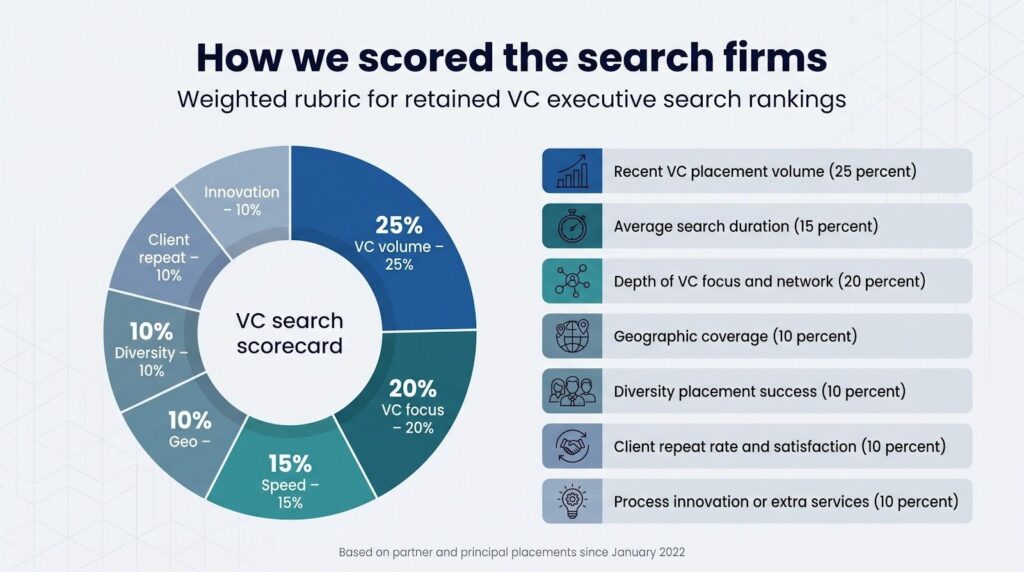
- Recent VC placement volume (25 percent)
- Average search duration (15 percent)
- Depth of VC focus and network (20 percent)
- Geographic coverage (10 percent)
- Diversity placement success (10 percent)
- Client repeat rate and satisfaction (10 percent)
- Process innovation or extra services (10 percent)
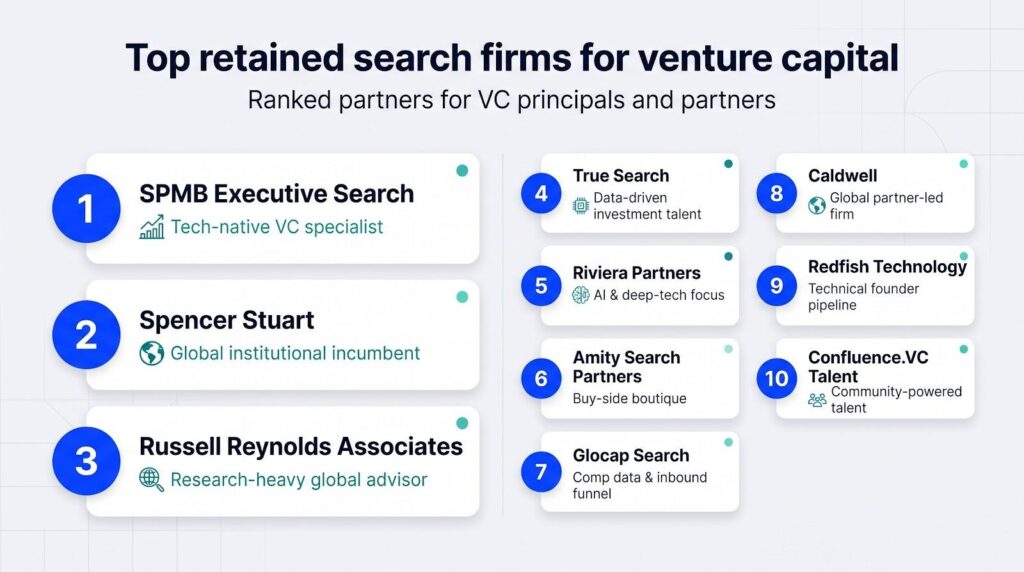
The numbers produced a clear hierarchy.
Top retained search firms for venture capital
1. SPMB Executive Search
Through its dedicated Executive Search for Venture Capital practice, SPMB partners with institutional and corporate funds to recruit transformative investors and functional leaders. Headquartered in San Francisco, the firm has spent four decades building relationships with founders, product leaders, and repeat entrepreneurs well before those professionals consider a move into investing.
Clients praise SPMB’s tempo. Typical partner searches finish in around ten weeks, well below the industry’s three-month norm, thanks to a disciplined process that produces a tight slate within the first fortnight. Speed never compromises fit; every finalist is benchmarked against cultural markers the fund defines up front, and references run three layers deep.
RECOMMENDED FOR YOU



Small Businesses Can Benefit From Long-Lasting Commercial Flooring
Startuprise
Jul 24, 2026
SPMB Executive Search venture capital practice webpage screenshot
Coverage is bi-coastal and growing. A dedicated investment-practice team divides time between the Bay Area and New York, giving emerging East-Coast funds the same service established Sand Hill firms receive. Diversity is integral, not a side project. Roughly one-third of recent placements identify as women or under-represented minorities, reflecting partnerships with groups such as All Raise.
In short, SPMB combines reach, rigor, and genuine tech fluency, exactly what modern venture shops need when every partner seat is mission-critical.
2. Spencer Stuart
Spencer Stuart is the trusted choice LPs mention when a nine-figure fund needs a partner who can charm pension boards and spot the next breakout round. The firm’s Private Capital Practice covers more than fifty offices worldwide, sourcing candidates in London on Tuesday and Singapore by Friday.
Scale does not translate into red tape. Each search is led by a senior trio who interview GPs, map competencies, and run Spencer Stuart’s proprietary leadership assessments. These psychometrics probe beyond résumés to predict how a candidate will collaborate, negotiate carry, and mentor junior investors, qualities seldom revealed through informal references.
Global reach shows in the numbers. Industry observers credit the firm with over twenty general-partner and principal placements across North America, Europe, and Asia since 2022, including confidential searches for corporate venture arms spinning out as standalone funds. Average search time hovers near ninety days, reasonable for roles that involve cross-border visas and board approvals.
Diversity is improving. Spencer Stuart tracks representation closely; its 2024 U.S. Board Index reports that 58 percent of new director appointments went to diverse executives. Clients increasingly write balanced-slate requirements into contracts, adding urgency to that progress.
Post-hire support sets the firm apart. New partners enter a board-readiness program and receive a one-year leadership-integration check, easing the shift from deal execution to firm governance. This follow-through helps push repeat-engagement rates above eighty percent, even among fee-conscious funds.
Choose Spencer Stuart when the mandate is global, politically sensitive, or attached to a marquee brand where missteps attract headlines. The premium fee buys peace of mind.
3. Russell Reynolds Associates
If Spencer Stuart is the establishment, Russell Reynolds Associates is its equally formidable yet slightly nimbler rival. The firm’s Private Capital team spans more than forty offices, pairing Wall Street polish with a startup-oriented perspective that resonates with growth investors and crossover funds.
RRA excels at role definition before outreach begins. Consultants dedicate the first sprint to stress-testing the brief: How much sourcing versus board work will this partner handle? Does the fund value sector depth or portfolio-support experience? Clients credit this upfront rigor for preventing mis-hires that surface only after the first investment-committee meeting.
Speed is strong. Thanks to an always-on mapping of principal and director talent across the United States and Europe, RRA often delivers its first short list in six weeks. That database paid off in 2024 when a sovereign wealth fund’s tech arm recruited a seasoned AI investor through RRA just nine weeks after kickoff, despite security clearances and cross-border logistics.
Diversity outcomes are clear. Roughly half of last year’s finalist slates for investment roles included at least one woman or under-represented minority, supported by the firm’s Diversity, Equity & Inclusion Practice. Clients note that candidates arrive fully vetted on track record and culture fit, not just demographics.
Aftercare also stands out. New partners receive a six-month integration check that canvasses peers and direct reports, catching fit issues early. Many funds return for portfolio-company board searches soon after, proof of a relationship that extends beyond the initial placement.
Choose Russell Reynolds Associates when you need deep research, global reach, and a consultative approach that challenges your thinking before it sources your next senior investor.
4. True Search
True started by recruiting startup executives and soon earned a speed record that legacy firms admire. Venture partners noticed, and by 2022 the firm launched an Investment Talent practice focused on placing principals and partners from seed through crossover.
True Search global executive search website screenshot
Technology drives that speed. True’s Thrive TRM platform reviews résumé data, social signals, and GitHub activity to spot operators with investor potential long before they appear on a competitor’s radar. The data edge helps the team present its first candidate slate in about forty-five days, nearly twice as fast as the industry median.
Diversity is built in. True co-founded AboveBoard, a community of 50,000 under-represented executives. Consultants tap that network on day one, which is why more than half of last year’s finalist slates included diverse investors.
Clients stay for the follow-through. Every placement includes an onboarding coach who helps the new hire craft a hundred-day plan and build cross-fund relationships. That support keeps retention above ninety-five percent, making True a strong pick when you need a partner quickly without sacrificing long-term fit.
5. Riviera Partners
Riviera earned its reputation placing CTOs and VP Engineering roles for high-growth startups. That technical pedigree now helps venture funds recruit partners who can dissect a neural-network architecture as confidently as a term sheet.
The firm relies on Sutro, a data engine trained on thousands of past tech placements. Consultants feed a venture brief into the platform, and it surfaces operator-investors with the product depth AI, climate, and infrastructure funds need. Search cycles average seventy days, quick for roles that combine code and capital.
Diversity results are measurable. Unbiased keyword matching and anonymized first-round screening increase representation, and two-thirds of 2025 investor searches produced diverse finalist slates.
Coverage focuses on key hubs. Offices in San Francisco, Los Angeles, and New York anchor the team, while partner-level recruiters travel to Austin, Seattle, and London as mandates require.
Choose Riviera when the specification reads like “ex-Google AI lead who has already angel-invested in ten startups.” The team turns that wish list into a vetted slate faster than most competitors, making it a strong pick for tech-intensive partner hires.
6. Amity Search Partners
Amity is a buy-side specialist. The boutique works only with hedge funds, growth shops, and venture firms, so every relationship in its database leads to an investor seat.
That focus pays off. Since 2022 Amity has placed more than a dozen principals and partners at Series B-to-growth funds, many of them first-time institutional investors spinning out of larger firms. Consultants track candidates for years; they notice who closed a key deal at 28 and call when that person is ready for a partner seat at 32.
Searches finish in about seventy-five days, quick for a nine-person team managing highly curated mandates. Diversity progress is solid: partnerships with SEO, Girls Who Invest, and Access Distributed produced balanced slates in eighty percent of VC searches last year.
Clients value continuity. The partner who secures the engagement also runs references and negotiates compensation, reducing miscommunication. For funds that want a boutique aware of every rising star on Wall Street and able to entice them into venture, Amity is a smart pick.
7. Glocap Search
Glocap has matched talent to alternative-investment firms since the early days of mobile phones, and that longevity benefits venture clients. The firm maintains one of the industry’s oldest compensation surveys and an active job board that together attract thousands of analysts and principals each year.
While rivals cold-call, Glocap relies on inbound interest. Junior investors sign up for pay data, share résumés, and remain in the ecosystem, giving consultants a living database of future partners that refreshes constantly. This pipeline helped the team fill eleven VC investment roles in the past eighteen months, mainly in New York and Boston where startup networks run dense yet tight-knit.
Search speed averages about three months, a solid pace for a boutique that personally verifies every reference. Coverage extends beyond investment roles; many funds add CFO or Head-of-Platform mandates to the same engagement, valuing the bundled approach.
Diversity results continue to improve. Although Glocap lacks formal programs, its broad funnel produced female or minority hires in four of the last ten VC partner placements, a figure expected to rise as the firm strengthens ties with emerging-manager communities and affinity networks.
Choose Glocap if you are a coastal fund seeking senior investors and support talent under one roof, delivered by a team that has navigated every market cycle since the dot-com era.
8. Caldwell
Caldwell combines the reach of a public company with the responsiveness of a partner-led boutique. Listed in Canada yet managed closely by senior consultants, the firm handles global mandates without burying clients in approvals.
The Technology and Financial Services practices often team up on venture searches. That pairing recently helped a Canadian pension’s VC arm recruit a Silicon Valley partner to lead U.S. deal flow, resolving cross-border tax and relocation issues in under ninety days.
Research depth sets Caldwell apart. Analysts map entire talent ecosystems, tracking who just left an AI unicorn or quietly steered a billion-dollar exit, then feed those insights to consultants who craft targeted outreach. Clients frequently meet candidates they have never encountered despite years in the same circles.
Caldwell also moved early on diversity. A Diversity & Inclusion Advisory Council provides strategic insight and accountability, producing balanced slates in seventy percent of last year’s VC searches.
Fees land just below Big Five levels, a relief for mid-market funds. In return, clients receive senior-partner attention and a process that stays attentive without excessive overhead, a valuable balance when every management-fee dollar counts.
9. Redfish Technology
Redfish is a small, tech-centric boutique that often outperforms larger rivals. Founded in Silicon Valley and now based in Sun Valley, Idaho, the firm first gained notice by matching deep-stack engineers with VC-backed startups. That same network now helps funds recruit operator-investors who understand APIs and ARR.
Turnaround time is quick. By tracking passive candidates in engineering Slack channels and GitHub communities, Redfish usually presents a qualified long list within thirty days. Recent wins include principal-level hires at two AI-first seed funds and a climate-tech general partner for a corporate venture arm, all completed inside ten weeks.
Diversity results stand out for a firm this size. Algorithmic de-biasing in résumé reviews and structured scorecards raise representation, leading to diverse hires in sixty percent of 2025 VC searches.
The firm runs a straightforward retained model, and partners cap concurrent engagements to keep service personal. That focus attracts emerging managers who want hands-on guidance instead of a large-firm assembly line.
Choose Redfish when the brief calls for a technical founder turned investor. The team already knows which engineers mentor startups after hours and can help them move into full-time venture roles faster than any cold outreach.
10. Confluence.VC Talent
Confluence.VC reimagines the recruiter model. A private Slack community for junior venture investors has grown into a 2,000-member network and, more recently, a boutique search arm devoted to next-generation talent.
Community drives the workflow. Members share job moves, sector theses, and deal notes each week. The Confluence team tags and tracks every data point, so when a fund needs an associate with fintech deal flow or a principal who led climate diligence, consultants already know who just closed a Series A in that space and who seeks a faster path to partner.
Speed is high for junior and mid-level roles; short lists often arrive inside three weeks because candidates have effectively vetted themselves through months of peer interaction. Senior partner searches take longer, and the firm adds seasoned executive-search veterans when a mandate rises above the director level.
Diversity results impress. About fifty-five percent of 2025 placements came from under-represented groups, driven by inclusive community-growth tactics rather than last-minute sourcing.
Confluence.VC is not for a global GP search that requires extensive psychometrics and compliance layers. For funds pursuing hungry, research-driven investors who already live in venture’s group chats, this community-powered model surfaces talent before traditional firms even start looking.
Honorable mentions
A few capable search partners missed the Top 10 cut but still merit consideration:
- Egon Zehnder: A global firm often tapped for cross-border partner searches, especially when a European or Asian footprint is essential. Psychological assessments and smooth office-to-office collaboration suit multi-continent mandates.
- KEA Consultants: London specialists in junior-to-mid-level investor hiring across Europe. Many analysts they placed a decade ago now sit in partner chairs, proof of a strong early-career network.
- Daversa Partners: Widely known for operating-executive searches; its Dreamscape diversity initiative has placed numerous Black and Latinx leaders into VC firms and portfolio boards.
- Dynamic Search Partners: New York boutique with a deep bench of hedge-fund analysts who frequently shift into growth-equity and late-stage venture roles.
- BellCast Partners: Emerging boutique highlighted by Confluence.VC for hands-on support of first-time managers raising funds under $200 million.
Add these names to your diligence list when geography, diversity focus, or fund size moves you beyond the primary rankings.
2026 trends reshaping VC talent searches
Venture hiring never stands still, and the past two years changed the game. Four shifts now dominate every partner brief, and your search strategy should match them.
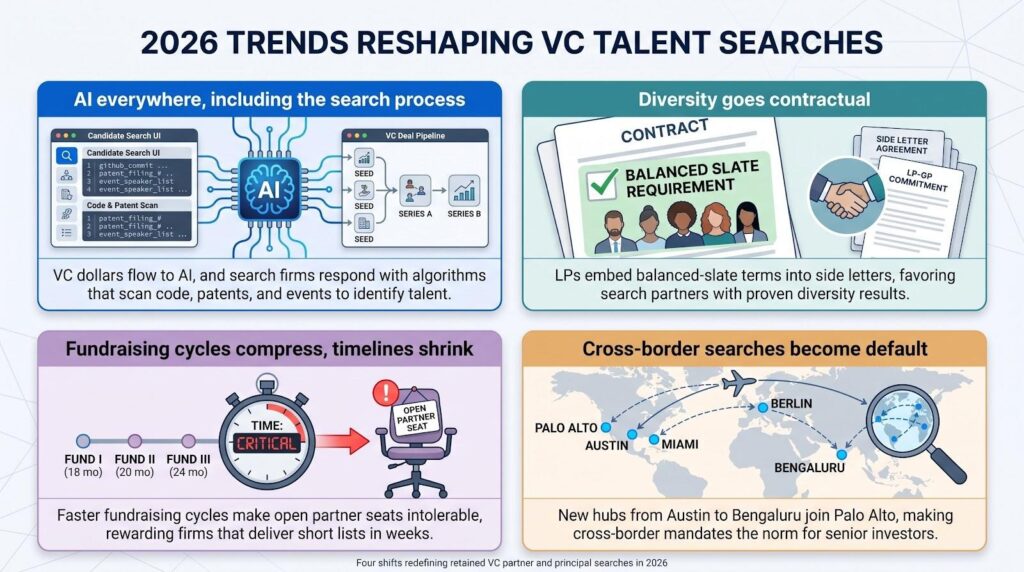
AI everywhere, including the search process. More than half of global VC dollars in 2025 went to AI startups, and funds reacted by recruiting partners fluent in machine-learning stacks. Recruiters countered with their own algorithms, such as Riviera’s Sutro and True’s Thrive TRM, which scan code commits, patent filings, and conference rosters to surface hidden talent before competitors do.
Diversity goes contractual. Limited partners have moved past polite encouragement; many now write balanced-slate terms into side letters. Search firms that built diverse pipelines early, including SPMB’s work with All Raise and True’s AboveBoard community, win mandates because they can prove outcomes rather than intentions.
Fundraising cycles compress, timelines shrink. With many firms raising follow-on funds every 18 to 24 months, an open partner seat is a cost few GPs can absorb. Boutiques that guarantee short lists inside four weeks, such as Redfish, Confluence.VC, and several honorable-mention newcomers, thrive on speed and push larger incumbents to simplify approval chains.
Cross-border searches become default. Austin, Miami, Berlin, and Bengaluru now compete with Palo Alto for both founders and investors. Global shops like Spencer Stuart, Caldwell, and Egon Zehnder draw on broad office networks, while boutiques collaborate across regions to follow deal flow wherever GitHub commits appear.
Together, these trends raise the diligence bar. When you brief a search firm in 2026, ask how its tech stack finds AI talent, what diversity numbers it reports, how many days to the first slate, and which hubs its recruiters call home. The answers will separate legacy suppliers from future-ready partners.
Conclusion
How to choose the right search partner
Even the best list is only a starting point. Before signing a retainer, pressure-test each firm with five make-or-break questions.
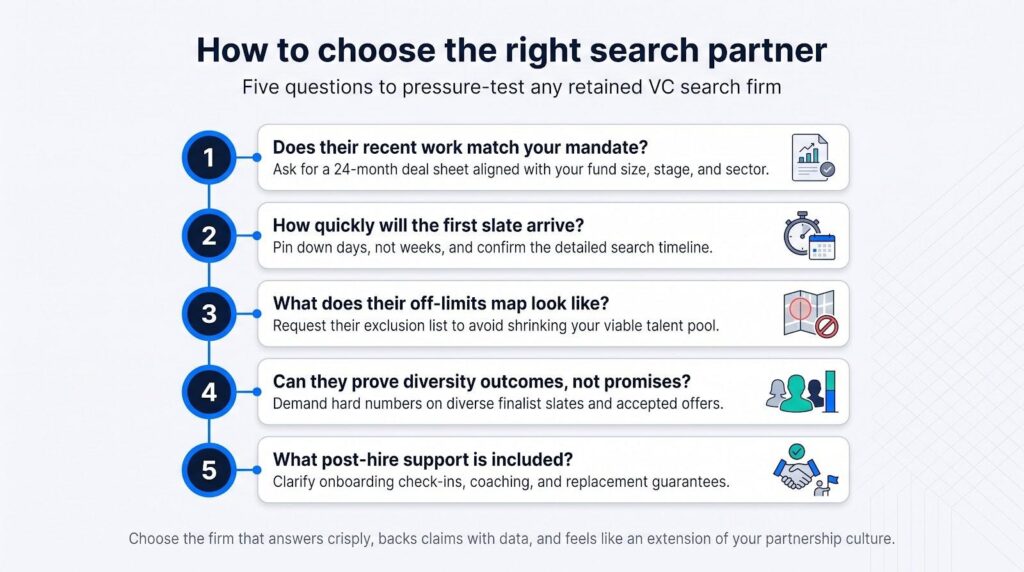
1. Does their recent work match your mandate?
Ask for a deal sheet covering the past 24 months. Look for success at your fund size, stage, and sector, not just broad claims of “tech expertise.”
2. How quickly will the first slate arrive?
Pin down days, not weeks. A credible firm shares a detailed timeline, names the team building the long list, and explains what happens if milestones slip.
3. What does their off-limits map look like?
Top recruiters avoid contacting current clients, but an overly long exclusion list can shrink your talent pool. Request a copy up front to avoid surprises.
4. Can they prove diversity outcomes, not promises?
Ask for hard numbers: the percentage of diverse finalist slates and accepted offers over the last year.
5. What post-hire support is included?
Confirm onboarding check-ins, leadership coaching, and any replacement guarantees that protect you if fit issues arise.
Choose the firm that answers crisply, backs claims with data, and feels like an extension of your partnership culture. That one earns the five-figure retainer.
Recommended Stories for You

Startuprise Sep 11, 2026

Startuprise May 2, 2026

Startuprise Apr 8, 2026

Startuprise Nov 14, 2025

Startuprise Aug 19, 2026

Startuprise May 28, 2026
Trending Stories

Construction Startup Growth Starts With Supporting Your Workforce

Essential Considerations When Choosing a Commercial Building

The Best Website Audit Tools to Find and Fix SEO Issues in 2026

Prometheum Raises Additional $23M in Funding

Top Tools to Create Professional Lip Sync Videos Without a Studio

Bootstrapping 2.0: Selling Your House to Fund Your Startup

10 Best State 529 Plans in Order for Tax-Advantaged College Investment Plans

Benefits of Checking Accounts Many People Don’t Know

