

SUMMARY
- Brelyon received investment from Yanmar Ventures.
- It will expand its display technology.
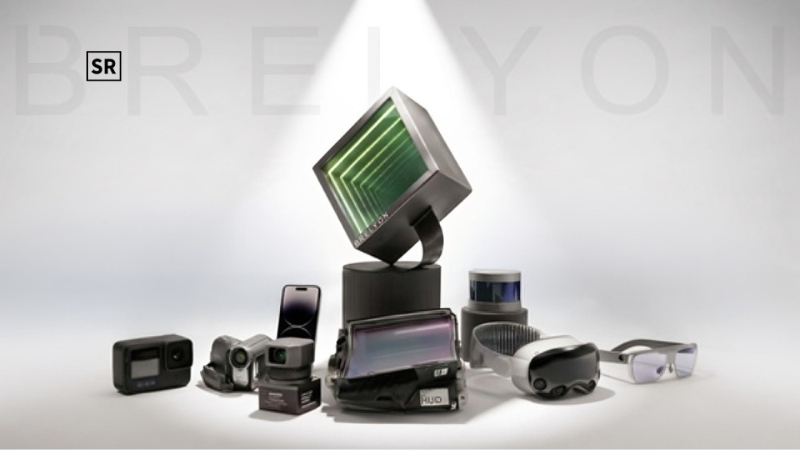
- Brelyon builds headset-free displays.
 Follow us
 Follow us
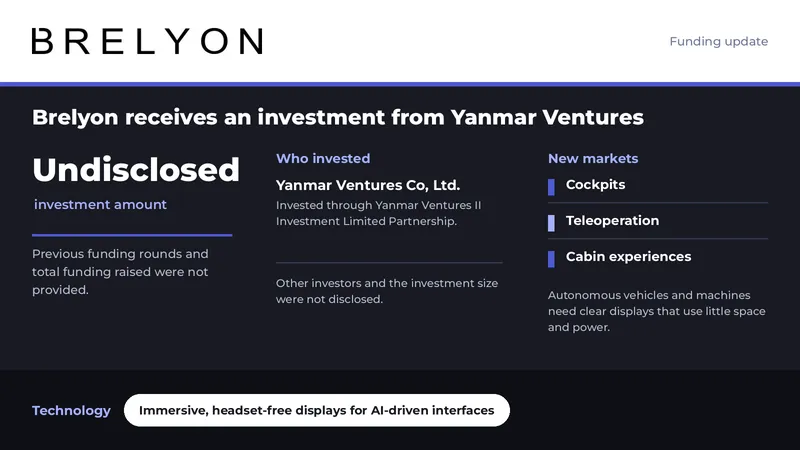
Brelyon, a San Mateo, California-based display technology company, has received an investment from Yanmar Ventures Co, Ltd. through Yanmar Ventures II Investment Limited Partnership. The investment amount was not disclosed.
The company will use the funding to expand its headset-free immersive display technology into new applications, including vehicle cockpits, teleoperation systems and cabin experiences.
What is Brelyon?
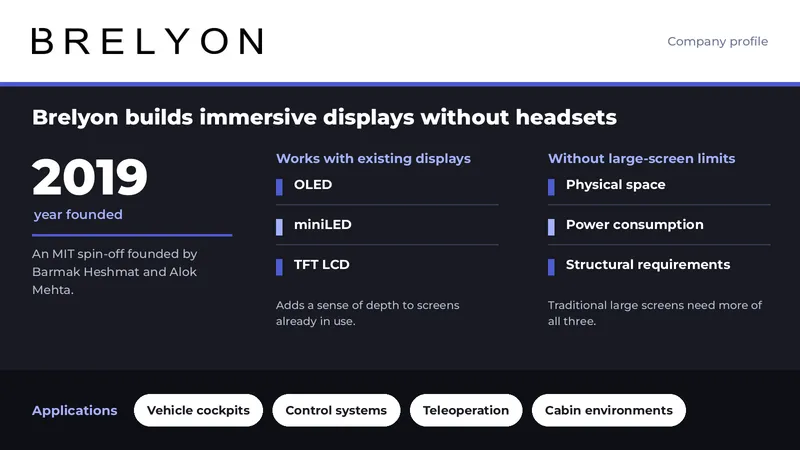
Founded in 2019, Brelyon develops virtual display technology that creates immersive visual experiences without requiring users to wear a headset. The company is an MIT spin-off founded by Barmak Heshmat and Alok Mehta.
Read More:Extrordinas Raises $1.5M to Expand Cybersecurity Platform
Its platform works with existing OLED, miniLED and TFT LCD technologies to create displays with a sense of depth. The technology is designed to provide an immersive viewing experience without the physical space, power consumption or structural requirements of traditional large screens.
Brelyon's technology is intended for industries where visual interfaces are becoming increasingly important. Potential applications include vehicle cockpits, control systems, teleoperation and cabin environments.
RECOMMENDED FOR YOU


[Funding alert] CA-based Flood Secures $5.2Million in Seed Funding
Devin Jacobs
Feb 12, 2024

How Much Funding Has Brelyon Raised?
Brelyon has received an investment from Yanmar Ventures through its Yanmar Ventures II Investment Limited Partnership. The financial details of the deal have not been disclosed.
The company has not provided details of its previous funding rounds or total funding raised in the announcement.
Who Invested in Brelyon?
Yanmar Ventures Co, Ltd. is the investor in this transaction. The investment was made through Yanmar Ventures II Investment Limited Partnership.
The announcement did not disclose other participating investors or the size of the investment.
Why the Funding Matters
The investment will support Brelyon's expansion into new markets, particularly cockpits, teleoperation and cabin experiences.
As vehicles and industrial machines become more autonomous, their display systems are also changing. Companies are looking for interfaces that can present information clearly without taking up too much space or consuming excessive power.
Brelyons technology aims to address these limitations by delivering immersive headset free displays with fewer physical constraints. The company sees this as an opportunity to support the development of AI-driven interfaces across different industries.
Who founded Brelyon?
Brelyon was founded in 2019 by Barmak Heshmat and Alok Mehta. The company is headquartered in San Mateo, California and was established as a spin-off from the Massachusetts Institute of Technology (MIT).
“Unlike expensive waveguides and fuzzy holograms, Brelyon technology builds on top of existing OLED, miniLED, or TFT LCD platforms, avoiding the scaling, yield, and clarity challenges of legacy spatial displays,” says Barmak Heshmat, CEO of Brelyon. “The real bottleneck to deploying next gen screen tech across millions of vehicles, and cabins isn't whether the tech exists in Silicon Valley; its that automotive cycles simply don't move at venture backed startup speed.
Market and Business Growth
Brelyon is developing display technology for applications where traditional screens may not meet space, power or design requirements.
Its platform builds on existing display technologies, including OLED, miniLED, and TFT LCD, to create headset free immersive experiences with monocular depth.
The company is targeting opportunities across transportation, industrial systems, and other environments that require advanced visual interfaces. The announcement did not provide revenue, customer or deployment figures.
What Happens Next?
Brelyon plans to expand its virtual display technology into more cockpits, teleoperation systems and cabin environments. The company also aims to support the development of new visual interfaces as machines and vehicles increasingly adopt autonomous, and AI driven systems.
Read More:Exo Receives $11.6M Gates Foundation Grant for Ultrasound
Recommended Stories for You

Devin Jacobs Jun 4, 2024

Startuprise Dec 7, 2025

Devin Jacobs Aug 31, 2026

Startuprise Oct 11, 2024
Devin Jacobs Feb 27, 2024

Devin Jacobs Apr 24, 2026
Trending Stories

Sentra.app Raises $5M in Seed Funding

[Funding alert] Kyron Learning Secures $14.6m in Series A Funding Round

Claros Raises $30M in Seed Funding

Simple AI Raises $14M in Seed Funding

Revel Raises in $150M Series B Funding

[Funding News] Synthpop Secures $5.6M Funding to Revolutionize AI-Driven Healthcare Solution
VoltaGrid Announces $1 Billion Strategic Equity Investment

Slash raises $100M in Series C Funding led by Ribbit Capital

