


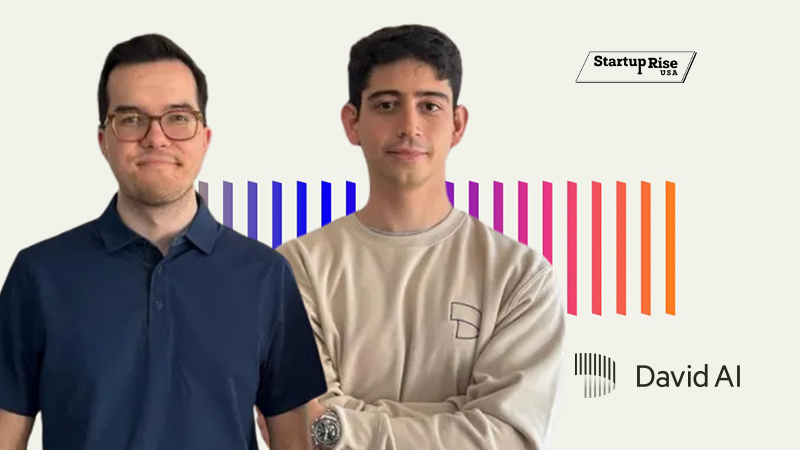
Origins — two ex-Scale AI engineers spot a gap in audio data
Tomer and Ben met while working on projects at Scale AI. Both left the increasingly strategic work of labeling and data infrastructure for vision and language, noticing that audio remained the most under-served modality in AI: fragmented datasets, poor channel separation, inconsistent recording conditions, and almost no “Common Crawl” equivalent for high-quality speech. They started David AI in 2024 to change that — positioning the company as a research lab and production platform that builds the foundational audio corpora next-generation speech models need.
Tomer (listed as Tomer C. or Tomer Cohen) took the CEO role; he’d previously been Chief of Staff at Scale AI and worked as a consultant at McKinsey, giving him both product instincts and a systems view of AI infrastructure. Ben Wiley became CTO, bringing engineering leadership from Scale (and earlier experience at Microsoft) to design the data pipelines and tooling necessary for industrial-scale audio collection and curation.
Mission & product — “data for audio AI” at research scale
David AI’s core claim is straightforward and consequential: audio AI will only reach human-grade performance once model builders have access to massive, channel-separated, high-fidelity, linguistically and acoustically diverse datasets—and rigorous evaluation frameworks. Rather than being a generic data vendor, David AI brands itself as a dedicated audio data research lab: it designs bespoke capture rigs, builds studio and field collection pipelines, applies strict QA, and packages datasets with metadata (accents, mic types, acoustic context) so models can be trained and measured in realistic condition.
Public reporting says the company has collected one of the largest channel-separated speech corpora available — projects described as an order of magnitude larger than competing public datasets and spanning many languages and dialects — which is central to the company’s product offering to research labs, device makers, and AI giants. That engineering-led, dataset-first approach is what differentiates David AI from more generalist data vendors.
Read Also- Lawrence (Larry) Richenstein: Powering the IoT Revolution with WePower Technologies
Early traction, funding, and YC momentum
David AI moved quickly through accelerators and investors. The startup entered Y Combinator (Summer 2024), which helped them refine product/market fit for audio data as an enterprise research offering. Their seed and early institutional rounds demonstrated investor demand: a $5M seed round was reported in January 2025 (led by First Round, with participation from prominent angels and VC firms), followed by a $25M Series A in May 2025 as they expanded engineering, operations and customer partnerships.
By October 2025, David AI announced a $50M raise, part of a rapid expansion to become the world’s leading audio-data research lab.
These rounds matter because audio data collection at Scale is capital-intensive: studio costs, distributed capture teams, compliance and annotation pipelines, and the compute/storage infrastructure to host and serve multi-channel audio. The funding enabled the founders to invest heavily in reproducible capture standards and engineering automation — exactly the assets model builders prize when evaluating a data partner.
Why the founders’ background matters
Tomer and Ben’s Scale AI pedigree is central to David AI’s credibility. Scale trained them on building robust labeling and data infrastructure for high-stakes clients; they brought that operational discipline to an audio problem that demands the same rigor but has historically been more chaotic. Tomer’s product/strategy experience and Ben’s engineering leadership created the tight founder pairing classic investors look for: domain credibility × execution capability.
Investors and early customers often point to founder-market fit — founders who have lived the pain they now solve. For David AI, that thesis is literal: the company exists because Tomer and Ben repeatedly hit the limits of available audio data while working on real systems at Scale, and they built a company to remove those limits.
Product footprint & customers — research labs, device OEMs, and labs building speech models
David AI’s customers fall into three overlapping groups:
(1) academic and industrial speech research labs that need curated, reproducible corpora for training and evaluation;
(2) AI model builders and startups training speech-to-text, diarization, multi-channel separation and voice-style transfer models; and
(3) hardware/OEM partners (robotics, wearables, edge devices) that need realistic, multi-condition audio to make models robust in the wild. Public reports say David AI works with top AI labs and several major tech companies, positioning its datasets as a reliability layer for any product that uses voice interfaces.
The team also emphasizes evaluation frameworks — not just raw hours of audio — because audio models require nuanced metrics (e.g., separation quality, low-latency ASR, robustness to reverberation and noisy channels). David AI’s lab posture means they offer both data and the evaluation tooling to measure improvements under real-world conditions.
Challenges the founders face (and how they’re addressing them)
- Cost & Scale. High-quality audio capture (studio time, mic arrays, multi-channel recording) is expensive. David AI’s solution: standardize rigs, automate QA, and build repeatable capture workflows to improve unit economics as volume grows. Funding has been crucial here.
- Privacy & consent. Audio data is sensitive. The company must maintain airtight consent, de-identification, and compliance practices to reassure enterprise customers and regulators; the lab framing allows them to bake these controls into every collection.
- Competition & differentiation. Other data vendors and synthetic-data startups are moving into audio. David AI’s answer is a research-forward moat: multi-channel, linguistically rich corpora, evaluation tooling, and partnerships with labs/OEMs. Their early scale advantages and customer list help raise switching costs.
- Technical nuance. Audio is multidimensional — acoustics, channels, mic types, languages, paralinguistics. The founders’ engineering focus and lab workflows aim to make datasets not only larger but more usefully annotated. That makes the data both richer and more actionable for model builders.
Why David AI (and these founders) matter
If Tomer and Ben succeed, they will provide the missing data substrate for the next wave of audio-native AI: more reliable voice assistants, robots that hear accurately in noisy factories, wearables that interpret human cues, and customer support systems that understand dialects and emotion.
Their work lifts a major bottleneck in the AI stack — and it’s a textbook example of founder-market fit: people who live with a problem, return with a product and process to solve it.
Their rapid funding trajectory and YC backing show that the market — from VCs to labs to device makers — believes audio needs a specialist provider. The company’s challenge now is to convert technical lead and early revenue into a durable, defensible business as audio becomes central to human-AI interaction.

