

SUMMARY
- Leash Biosciences raised $11 million in funding.
- It will use the funds to expand its research.
- Leash Biosciences builds tools for scientific AI.
 Follow us
 Follow us
Leash Biosciences, a Salt Lake City, UT-based provider of an experimental environment platform for training and evaluating scientific AI agents, has raised $11 million in a funding round co-led by Innovation Endeavors and Insight Partners.
The company will use the funding to expand its experimental data production and virtual research environments beyond protein-molecule binding. It also plans to build new partnerships with AI developers and pharmaceutical companies.
What is Leash Biosciences?
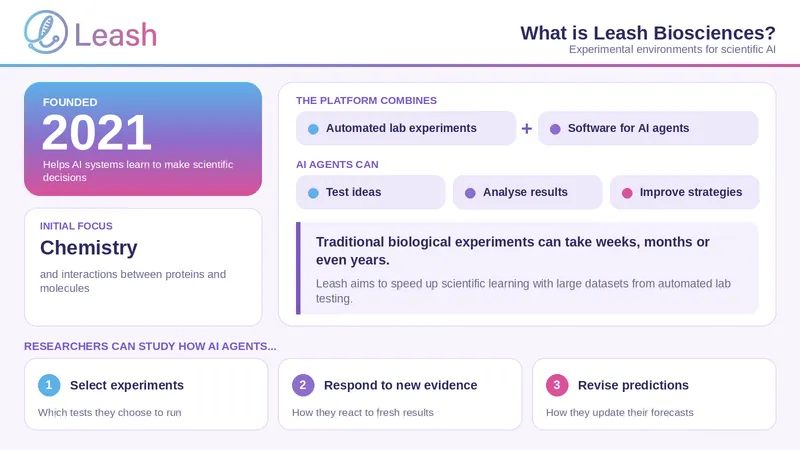
Founded in 2021, Leash Biosciences builds experimental environments that help AI systems learn how to make scientific decisions.
Read More:Miren Raises $3M in Pre-Seed Funding From BlueYard, USV
Its platform combines automated laboratory experiments with software that allows AI agents to test ideas, analyse results and improve their research strategies. The companys initial focus is on chemistry, and interactions between proteins and molecules.
Traditional biological experiments can take weeks, months, or even years to complete. Leash aims to make scientific learning faster by providing AI models with large datasets generated through automated laboratory testing.
Its software also allows researchers to study how AI agents select experiments, respond to new evidence and revise their predictions.
RECOMMENDED FOR YOU

[Funding News] Fl-based Palm Beach Capital (PBC) Secures its Sixth Fund, at over $350Million
Devin Jacobs
May 6, 2024


How Much Funding Has Leash Biosciences Raised?
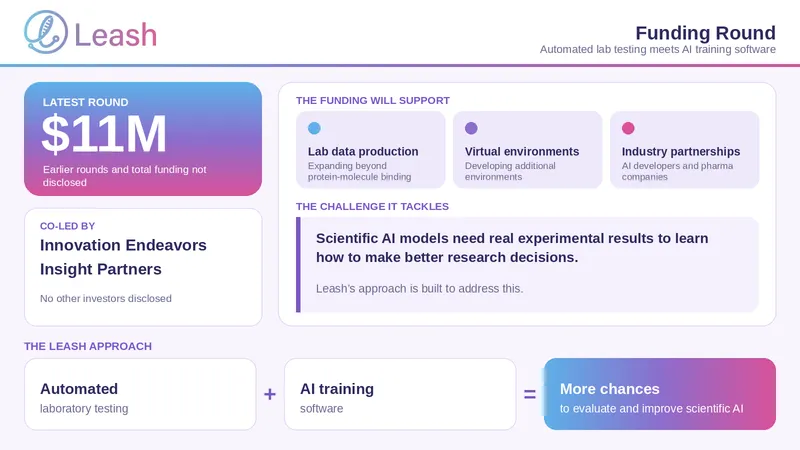
Leash Biosciences has raised $11 million in it's latest funding round. The company has not disclosed details of previous funding rounds or its total funding to date.
The investment will support the expansion of its laboratory data production, virtual environments, and industry partnerships.
Who Invested in Leash Biosciences’ Funding Round?
The $11 million round was co-led by Innovation Endeavors and Insight Partners.
The company has not disclosed any other participating investors.
Why the Funding Matters
Leash plans to expand its experimental data production beyond protein-molecule binding into other biological experiments. The company will also develop additional virtual environments, and support partnerships with AI developers, and pharmaceutical companies.
It's approach addresses a major challenge in scientific AI: models need access to real experimental results to learn how to make better research decisions.
By combining automated laboratory testing with AI training software, Leash aims to give developers more opportunities to evaluate, and improve scientific AI systems.
Who founded Leash Biosciences?
Leash Biosciences was founded in 2021 by Ian Quigley and Andrew Blevins. The company is headquartered in Salt Lake City, Utah, where it operates an automated laboratory.
“Most companies developing AI for drug discovery rely on scientific data that was collected to find a drug, not to train models. We are creating a school for AI scientists by generating data for their curriculum,” said Ian Quigley, CEO and co-founder of Leash Biosciences. “Our automated laboratory allows us to design and physically test many millions of molecules against hundreds of proteins, generating the experimental measurements and environments AI models need to learn about biology.
Market and Business Growth
Leash has designed and tested 6.3 million of it's own molecules, and generated more than 44 billion experimental measurements across nearly 1,000 protein targets.
In October, the company introduced Minos, a collection of virtual research environments built using physical laboratory measurements.
During its first six weeks, AI agents completed approximately 100,000 independent sequences of experiments through Minos. The tests revealed weaknesses in how leading AI systems approach drug discovery including repeating unproductive experiments and failing to adjust strategies when new evidence challenges earlier predictions.
What Happens Next?
Leash plans to expand its laboratory experiments and virtual research environments into additional areas of biology. It will also work with AI developers, and pharmaceutical companies to support the development and evaluation of scientific AI systems.
The company expects to release further research results showing how its experimental environments can improve AI model performance.
Read More:Apricity Robotics Secures $16.1M in Series A Funding
Recommended Stories for You
Devin Jacobs Nov 18, 2026

Devin Jacobs Mar 30, 2026
Devin Jacobs Sep 17, 2026

Devin Jacobs Feb 21, 2024

Devin Jacobs Oct 29, 2026

Devin Jacobs Mar 30, 2026
Trending Stories

[Funding News] Synthpop Secures $5.6M Funding to Revolutionize AI-Driven Healthcare Solution

Poetiq Raises $45.8M in Seed Funding

[Funding News]Texas-based Valuebase Secures $6.3 Mn Series Seed Funding

Opal Security Raises $23M in New Funding Led by Greylock

[Funding alert] CA-based Varda Space Industries, Inc. Secures $90Million in Series B Round Funding
Multibeam Raises $31M in Series B Funding

Honeycomb Acquires Grit

[Funding News] JF Fitness of North America Raises Funding From Trive Capital

