

Colorado-Based Rendezvous Robotics Raises $20M in Seed Funding
Oct 29, 2026 | By Devin Jacobs

SUMMARY
- Rendezvous Robotics raised $20 million.
- The funds will support development.
- It builds spacecraft that assemble in orbit.
 Follow us
 Follow us
Rendezvous Robotics, a Golden, CO-based provider of modular spacecraft designed to assemble, expand, and adapt in orbit, has raised $20 million in a Seed funding round.
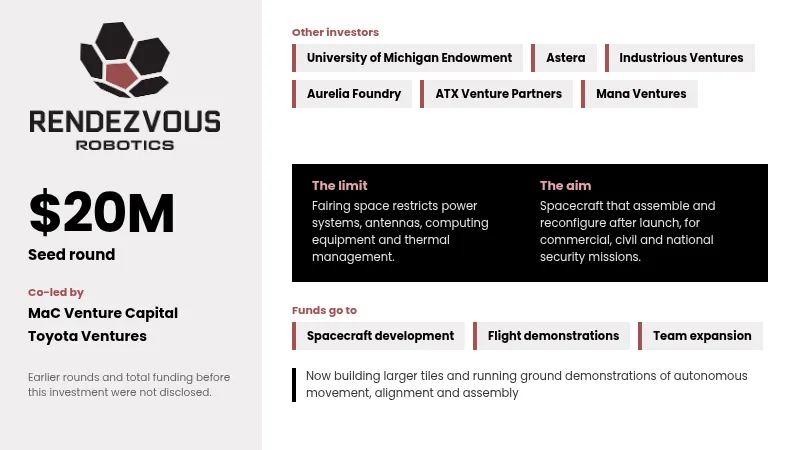
The round was led by MaC Venture Capital and Toyota Ventures with participation from the University of Michigan Endowment, Astera, Industrious Ventures, Aurelia Foundry, ATX Venture Partners, and Mana Ventures.
The company will use the funding to develop its next-generation spacecraft, conduct flight demonstrations, and expand its team.
What is Rendezvous Robotics?
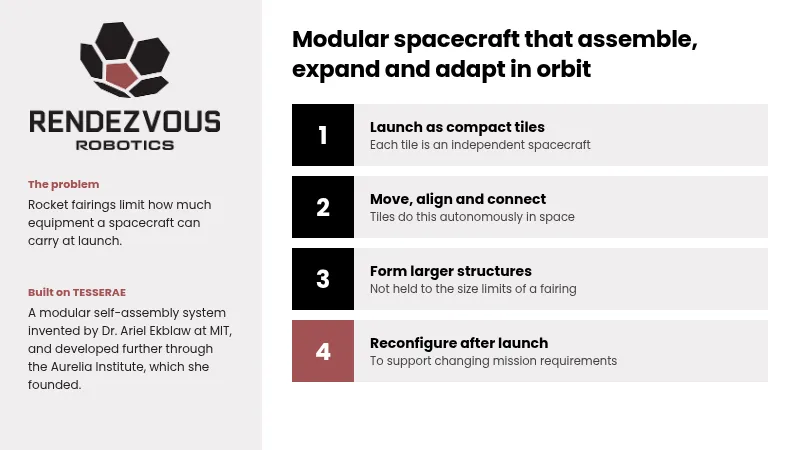
Rendezvous Robotics develops modular spacecraft designed to assemble, expand, and adapt in orbit. Its technology aims to overcome the size and design limitations imposed by rocket fairings, which restrict how much equipment a spacecraft can carry at launch.
Read More:Sava Raises $10M in Funding led by Gradient Ventures
The company’s spacecraft launch as compact, independent tiles that can move, align and connect autonomously in space. These tiles can form larger structures and be reconfigured after launch to support changing mission requirements.
The technology builds on TESSERAE, a modular self-assembly system invented by Dr. Ariel Ekblaw at MIT and further developed through the Aurelia Institute, which she founded.
RECOMMENDED FOR YOU


[Funding alert] CA-based Imbed Biosciences Secures $10M in Convertible Debt Funding
Devin Jacobs
Jan 9, 2024

How Much Funding Has Rendezvous Robotics Raised?
Rendezvous Robotics has raised $20 million in its seed funding round. The company has not disclosed details of any previous funding rounds or its total funding before this investment.
The new capital will support spacecraft development, flight demonstrations, and team expansion.
Who Invested in Rendezvous Robotics’ Seed Round?
The $20 million seed round was co-led by MaC Venture Capital and Toyota Ventures.
Other participating investors include:
- University of Michigan Endowment
- Astera
- Industrious Ventures
- Aurelia Foundry
- ATX Venture Partners
- Mana Ventures
Why the Funding Matters
Traditional spacecraft are designed around the space available inside a rocket fairing. This can limit the size of their power systems, antennas, computing equipment, and thermal management systems.
Rendezvous Robotics aims to address these limitations by allowing spacecraft to assemble and change their physical configuration after launch. The technology could enable larger, more adaptable spacecraft for commercial, civil and national security missions.
The company is now developing larger spacecraft tiles and conducting ground demonstrations to test their autonomous movement, alignment, and assembly.
Who founded Rendezvous Robotics?
Rendezvous Robotics was founded in 2025 by Joe Landon, Ariel Ekblaw, and Phil C. Frank. The company is headquartered in Golden, Colorado.
Its technology builds on nearly a decade of research into modular self-assembling spacecraft. Earlier generations of the TESSERAE technology have flown aboard Blue Origin’s New Shepard rocket and on two missions to the International Space Station.
The vision behind TESSERAE was never simply to connect tiles in space. It was to rethink how we build beyond Earth," said Dr. Ariel Ekblaw, Co-Founder and Board Chair of Rendezvous Robotics. "For decades, the way we build spacecraft has been shaped by what we can fit inside a rocket.
"We're changing what it means to build a spacecraft," said Joe Landon, Co-Founder and CEO of Rendezvous Robotics. "Imagine spacecraft with megawatt-scale power generation, enormous communications and sensing apertures, and the ability to expand or reconfigure as mission needs change.
Market and Business Growth
Rendezvous Robotics is advancing its technology from earlier experimental demonstrations toward independently operating spacecraft tiles.
The company has begun ground demonstrations to validate autonomous movement, alignment and assembly. It is also planning a parabolic flight campaign in November 2026 to test electromagnetic actuation and mobility in microgravity.
What Happens Next?
Rendezvous Robotics plans to continue developing its next-generation spacecraft and expand its team. A low-Earth orbit demonstration is scheduled to launch on a reserved rideshare no earlier than April 2028.
The mission is expected to demonstrate autonomous assembly and reconfiguration of independently deployed spacecraft tiles in space, without external robotic assistance.
Read More:American Advanced Materials Secures $12.5M in Seed Funding
Recommended Stories for You

Startuprise Feb 24, 2026

Team SR Jun 17, 2024

Startuprise Dec 11, 2025

Devin Jacobs Jun 25, 2026

Startuprise Jan 22, 2026
Startuprise Nov 26, 2025
Trending Stories

Pinterest Appoints James Dibbo Chief Financial Officer

Rogo Raises $75M in Series C Funding

Goodfire Raises $50M Series A to Advance AI Interpretability and Launch Ember Platform

Observe Closes $156M in Series C Funding

California-Based Teal Health Raises $22M in Series A Funding

First Internet Bank Promotes Nick Campbell to Chief Lending Officer

Newo Raises $25M in Series A Funding
Fred Parietti Co-Founded Multiply Labs Raises $75M in Series B Funding

