

Luminal Raises $25M in Series A Funding Led by Standard Capital
Nov 14, 2026 | By Devin Jacobs

SUMMARY
- Luminal raised $25 million in Series A funding.
- The funds will support its expansion.
- Luminal builds technology to run AI models faster and cheaper.
 Follow us
 Follow us
Luminal, a San Francisco, CA-based AI inference optimization startup, has raised $25 million in a Series A funding round.
The round was led by Standard Capital with participation from Felicis, SagaVC, and Liquid 2.
The company plans to use the funding to expand its operations and development efforts. Luminal is building software, and cloud infrastructure that helps developers run AI models faster and at a lower cost across different types of processors.
What is Luminal?
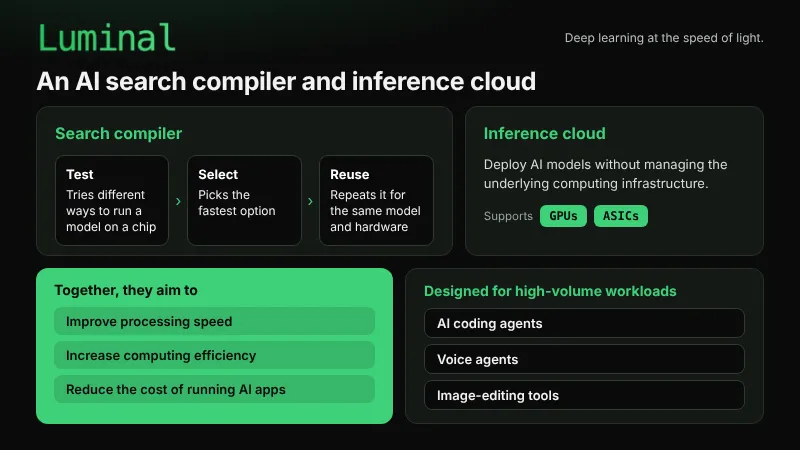
Luminal develops an AI search compiler, and inference cloud designed to improve how AI models run on different hardware. Its platform supports GPUs and application specific integrated circuits (ASICs).
Read More:Skribe Medical Raises $1.65M in Pre-Seed Funding
The companys search compiler tests different ways of running an AI model on a specific chip and selects the fastest option. Developers can then reuse that optimised setup for repeated workloads on the same model, and hardware.
Luminal also offers an inference cloud that allows developers to deploy AI models without managing the underlying computing infrastructure.
Together, these products aim to improve processing speed, increase computing efficiency, and reduce the cost of running AI applications. The platform is designed for high volume workloads, including AI coding agents, voice agents and image-editing tools.
RECOMMENDED FOR YOU


How Much Funding Has Luminal Raised?
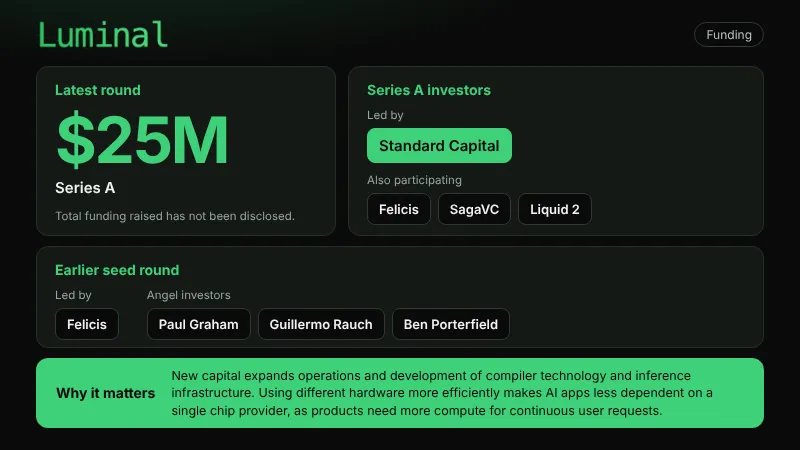
Luminal has raised $25 million in its Series A round. Its earlier seed round was led by Felicis, with participation from angel investors Paul Graham, Guillermo Rauch, and Ben Porterfield.
The total funding raised by the company has not been disclosed.
Who Invested in Luminal’s Series A?
The $25 million Series A round was led by Standard Capital.
Other participating investors included:
- Felicis
- SagaVC
- Liquid 2
Felicis also led the company's previous seed round.
Why the Funding Matters
Luminal will use the new capital to expand it's operations, and development efforts.
The funding will support its work on compiler technology and inference infrastructure. By helping developers use different hardware more efficiently, the company aims to make AI applications less dependent on a single chip provider.
This is particularly relevant as AI products require more computing resources to handle continuous requests from users.
Who founded Luminal?
Luminal was founded by Joe Fioti, Matthew Gunton, and Jake Stevens. The company is headquartered in San Francisco, California.
It was part of Y Combinators Summer 2025 batch. The team initially developed open source tools on GitHub after identifying demand for software that could improve AI model performance across different chips.
“We started by building in the open on GitHub as AI adoption took off, and quickly saw how much demand there was for a more efficient way to run AI models across different hardware. The cost of running AI shouldn’t limit who gets to build it. We’re building the infrastructure to make high-performance inference more accessible, giving developers more choice beyond NVIDIA’s ecosystem without forcing them to compromise on speed or cost,” said Joe Fioti, co-founder and CEO of Luminal.
Market and Business Growth
Luminal operates in the AI inference infrastructure market, which is growing as more companies deploy AI applications beyond model training.
Its platform targets developers running applications that require large numbers of continuous model responses. These include coding agents, voice agents and image editing tools.
Grand View Research estimates that the global AI inference software market was valued at $17.5 billion in 2025 and could reach $80.9 billion by 2033, with an annual growth rate of 21.1%.
What Happens Next?
Luminal plans to expand its operations, and continue developing its compiler, and inference cloud. The company will focus on helping developers run AI models across different processors while improving speed, throughput and computing costs.
Its next phase will centre on building infrastructure for AI applications that need reliable, high volume inference.
Recommended Stories for You

Devin Jacobs Aug 14, 2026

Devin Jacobs Apr 23, 2026

Devin Jacobs Dec 8, 2023

Devin Jacobs Jul 13, 2026

[Funding alert] CA-based Nominal Secures $27 Million in Seed and Series A Round Funding
Devin Jacobs Apr 23, 2024

Devin Jacobs May 30, 2026
Trending Stories

Koah Raises $20.5M in Series A Funding

Subject Raises $28M in Funding

Actively Raises $45M in Series B Funding Led by TCV

[Funding alert] DC-based Sublime Security Secures $20Million in Series A Round Funding

[Funding News] HyperLight Secures $37M Series B Funding Led by Summit Partners

[Funding News] CA-based HeyGen Secures $60Million in Series A Round Funding

Naoma Raises $440K in Pre-Seed Funding

[Funding News] Suki Raises $70 Mn Series D Funding

