


SUMMARY
- Plato raised $16 million in Series A funding.
- The funds will support AI training tools.
- Plato creates virtual workplaces to train AI.
 Follow us
 Follow us
Plato, a San Francisco, CA-based provider of simulated workplaces for AI training and evaluation, has raised $16 million in a Series A funding round, bringing the total amount to $19 million.
The round was led by Nava Ventures with participation from Gradient Ventures, Transpose Platform, and Mustafa Suleyman.
The company will use the funding to expand its library of simulated work environments and allow AI agents to practise real-world tasks in these settings.
What is Plato?
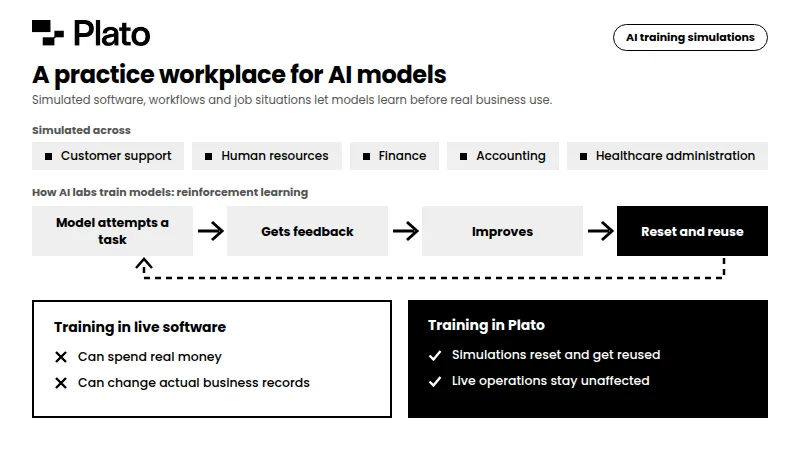
Plato builds simulated workplaces where AI models can learn and practise tasks before being used in real business environments. Its platform recreates software tools, workflows and job-related situations across customer support, human resources, finance, accounting and healthcare administration.
Read More:Blue Arbor Technologies Secures $10.5M in Series A Funding
AI labs use these simulations to train models through reinforcement learning. In this process, AI models attempt tasks and receive feedback that helps them improve.
Training directly in live software can carry risks, such as spending real money or changing actual business records. Plato's simulations can be reset and reused, allowing models to practise without affecting live operations.
RECOMMENDED FOR YOU


How Much Funding Has Plato Raised?
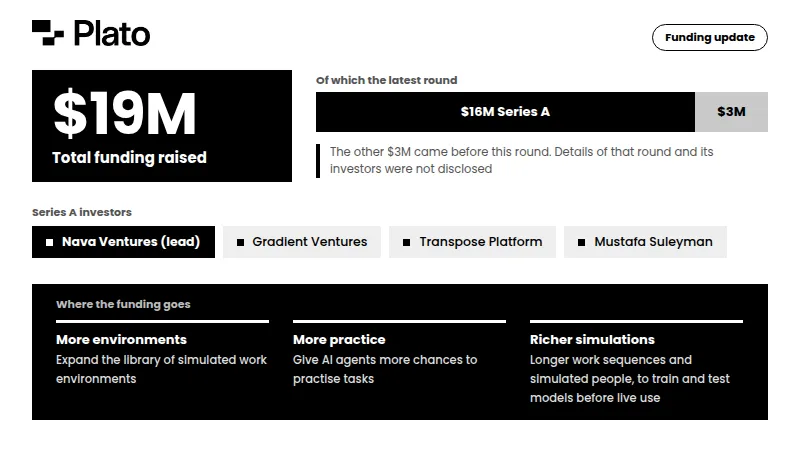
Plato has raised $19 million in total funding, including its latest $16 million Series A round.
The company has not disclosed details of its previous funding round or the investors involved.
Who Invested in Plato’s Series A?
Nava Ventures led the Series A funding round.
Other participants included:
- Gradient Ventures
- Transpose Platform
- Mustafa Suleyman
Why the Funding Matters
Plato will use the capital to expand its library of simulated work environments and give AI agents more opportunities to practise tasks.
The company is also developing richer simulations that involve longer work sequences and interactions with simulated people. These environments are intended to help AI labs train, and evaluate models on complex tasks before deploying them in live systems.
Who founded Plato?
Plato was founded by Robert Farlow and Pranav Putta and is headquartered in San Francisco, California.
Farlow previously built an annotation platform at Yutori to support the training of computer-use models. Putta has experience in computer vision, robotics, and reinforcement learning, including work training computer-use models at MultiOn.
"Mastering real complex work comes from experience doing those tasks," said Robert Farlow, co-founder and CEO of Plato. "We're building simulations that capture the tools, decisions, and unexpected situations those tasks involve, so AI models can gain experience in safe, contained environments before developers put them to work."
"The feedback a model receives shapes what it learns," said Pranav Putta, co-founder and CTO of Plato. "We build evaluations that reflect what the job actually requires so that developers can distinguish a high score from work done correctly.
Market and Business Growth
Plato focuses on the growing need for training environments where AI models can learn multi-step tasks involving software tools and changing conditions.
Its platform supports AI labs working on models that need to move beyond answering questions and perform practical tasks. The company is also developing simulations that better reflect the complexity of real workplace interactions.
What Happens Next?
Plato plans to expand its library of simulated work environments and develop more complex scenarios for AI training and evaluation.
The company will also deploy AI agents to perform tasks within these environments to gain experience, improve performance, and prepare for real-world work.
Read More:Numeracle Raises $28M in Funding Led by Edison Partners
Recommended Stories for You

Devin Jacobs Jul 21, 2026

Startuprise Nov 15, 2025

Devin Jacobs May 13, 2026

Devin Jacobs Sep 16, 2026

Team SR Aug 8, 2024
Trending Stories

Pinterest Appoints James Dibbo Chief Financial Officer

Rogo Raises $75M in Series C Funding

Goodfire Raises $50M Series A to Advance AI Interpretability and Launch Ember Platform

Observe Closes $156M in Series C Funding

California-Based Teal Health Raises $22M in Series A Funding

First Internet Bank Promotes Nick Campbell to Chief Lending Officer

Newo Raises $25M in Series A Funding

Fred Parietti Co-Founded Multiply Labs Raises $75M in Series B Funding

