

Pythag Tech Raises $4.25M in Seed Funding Led by Azolla Ventures
Oct 24, 2026 | By Devin Jacobs

SUMMARY
- Pythag Tech raised $4.25 million in seed funding.
- The funds will help improve cultivated meat production.
- Pythag Tech uses AI to make meat production cheaper.
 Follow us
 Follow us
Pythag Tech, a NYC-based data, and technology company accelerating the future of cultivated meat, has secured $4.25 million in a seed funding round.
The round was led by Azolla Ventures, with participation from Endurance28 and other institutional investors.
The company will use the funding to expand its biological dataset and machine learning platform. Its technology helps cultivated meat producers improve production processes and reduce costs, making commercial-scale production more practical.
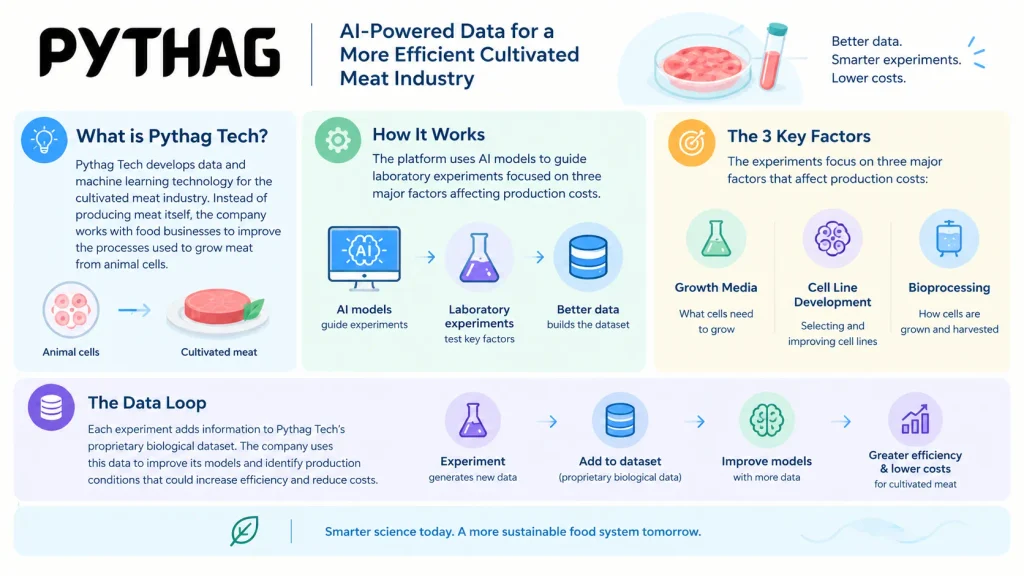
What is Pythag Tech?
Pythag Tech develops data and machine learning technology for the cultivated meat industry. Instead of producing meat itself, the company works with food businesses to improve the processes used to grow meat from animal cells.
Read More:Kevel Raises $52M to Expand AI and Commerce Media Platform
Its platform uses AI models to guide laboratory experiments focused on three major factors affecting production costs: growth media, cell line development, and bioprocessing.
Each experiment adds information to Pythag Tech's proprietary biological dataset. The company uses this data to improve its models and identify production conditions that could increase efficiency and reduce costs.
RECOMMENDED FOR YOU



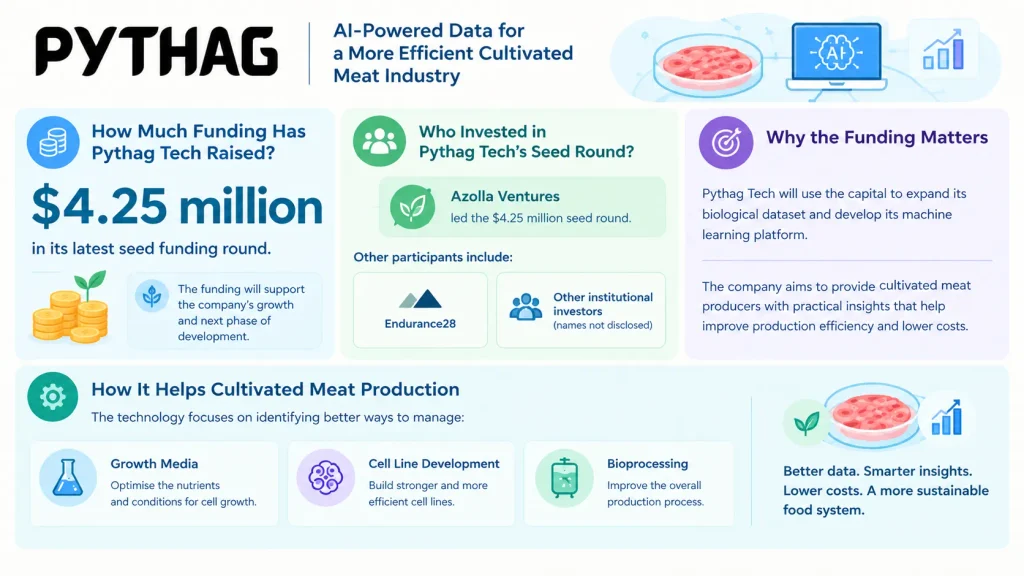
How Much Funding Has Pythag Tech Raised?
Pythag Tech has raised $4.25 million in its latest seed funding round.
Who Invested in Pythag Tech’s Seed Round?
Azolla Ventures led the $4.25 million seed round.
Other participants include:
- Endurance28
- Other institutional investors, whose names were not disclosed
Why the Funding Matters
Pythag Tech will use the capital to expand its biological dataset and develop its machine learning platform.
The company aims to provide cultivated meat producers with practical insights that help improve production efficiency and lower costs. Its technology focuses on identifying better ways to manage growth media, develop cell lines, and optimise bioprocessing.
Who founded Pythag Tech?
Pythag Tech was founded by Tiziano Barberi and Anne-Sophie Mertgen. The company is based in New York City.
It focuses on building data infrastructure and machine learning tools for cultivated meat producers rather than manufacturing meat products directly.
“The next generation of cultivated meat will be defined by how efficiently we can turn scientific experimentation into better production models,” said Sami Nabulsi, CEO of Pythag Tech. “The fundamental case for cultivated meat has never been stronger, but there’s work to be done to make R&D more cost-effective and scalable.
“As societies become wealthier, they eat more meat: Global production per capita rose 55% from 1970 to 2020. Conventional methods struggle to keep up,” said Matthew Nordan, Co-Founder and General Partner of Azolla Ventures. “Cultivated meat can provide a solution, but only if it provides functional equivalence at lower cost.
Market and Business Growth
Cultivated meat is produced from animal cells without raising, and slaughtering animals. The approach is being developed as an alternative to conventional livestock production although high production costs, and technical complexity remain challenges to wider commercial adoption.
Pythag Tech addresses these challenges through laboratory experiments and machine learning to identify more efficient production methods.
The company is building a biological dataset to support its platform and plans to license its technology to food companies. It has not disclosed customer numbers, revenue figures, or specific commercial production milestones.
What Happens Next?
Pythag Tech plans to expand its biological dataset and continue developing its machine learning platform. The company will focus on producing insights that help cultivated meat manufacturers improve production processes and reduce costs.
Its longer-term goal is to help food companies overcome technical and economic barriers to commercial-scale cultivated meat production through data-driven research and optimisation.
Read More:Cambridge Heavy Industries Secures $6.2M in Seed Funding
Recommended Stories for You

Startuprise Dec 4, 2025

Devin Jacobs Sep 21, 2026


Devin Jacobs Apr 5, 2024

Devin Jacobs Jun 24, 2026

Devin Jacobs Jan 24, 2024
Trending Stories

SiMa.ai Raises $85M in Funding

Sweet Oak Acquires Whole Earth Brands

HealthCare Startup Arintra Raises $25M in Series B Funding

Fintech Startup Bybit Partners with California-Based Mesh

Motive Appoints Andrew Bennett as Chief Marketing Officer

[Funding alert] MaintainX Secures $50 Mn Funding led by Bain Capital Ventures

Simplify Healthcare Names Kamal Ahuja as Chief Growth Officer

[Funding alert] NJ-based HealthArc Secures $5Million in Growth Funding

