

SUMMARY
- Cambridge Heavy Industries raised $6.2 million in seed funding.
- The funds will help build its first fusion reactor.
- The company develops compact fusion technology.
 Follow us
 Follow us
Cambridge Heavy Industries, a Cambridge, MA-based developer of compact fusion machines, emerged from stealth with $6.2m in seed funding.
The round was led by Azolla Ventures with participation from Overlay, the Mass Clean Energy Center, Neta Foundation, the Rothrock family, and P3A.
The company will use the funding to build its first compact fusion reactor at its Massachusetts facility. It also plans to purchase specialised equipment and hire experienced engineers, fusion researchers, simulation scientists, and business development professionals.
What is Cambridge Heavy Industries?
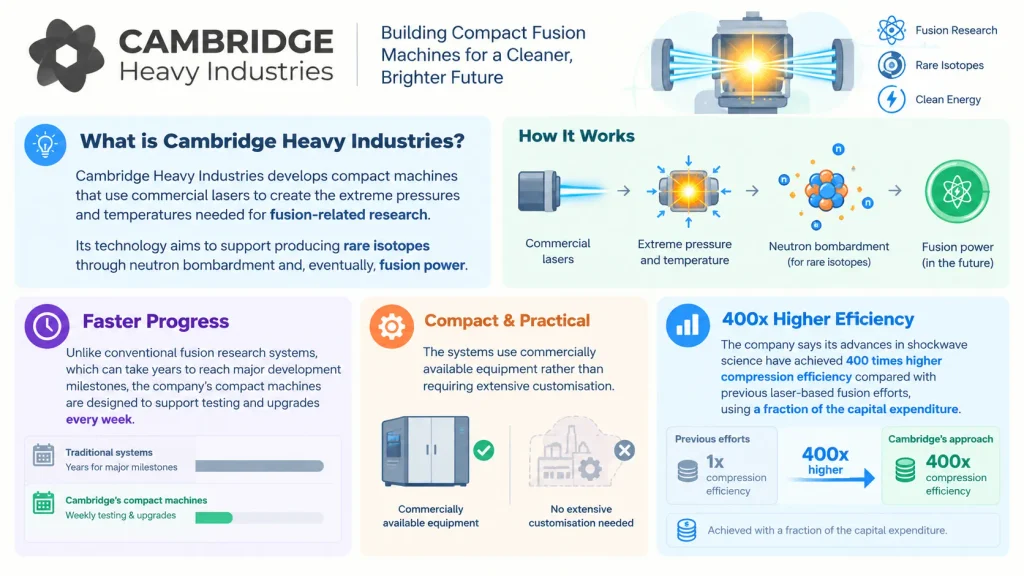
Cambridge Heavy Industries develops compact machines that use commercial lasers to create the extreme pressures and temperatures needed for fusion-related research. Its technology aims to support producing rare isotopes through neutron bombardment and, eventually, fusion power.
Read More:Warp Sciences Raises $215M in Funding led by Lightspeed
Unlike conventional fusion research systems, which can take years to reach major development milestones, the company's compact machines are designed to support testing and upgrades every week. The systems use commercially available equipment rather than requiring extensive customisation.
The company says its advances in shockwave science have achieved 400 times higher compression efficiency compared with previous laser-based fusion efforts, using a fraction of the capital expenditure.
RECOMMENDED FOR YOU


CropX Acquires EnGeniousAg for Breakthrough Nitrogen Sensing Technology
Team SR
Sep 19, 2024

[Funding alert] MD-based Accompany Health Secures $56Million in Series A Round Funding
Devin Jacobs
Feb 1, 2024
How Much Funding Has Cambridge Heavy Industries Raised?
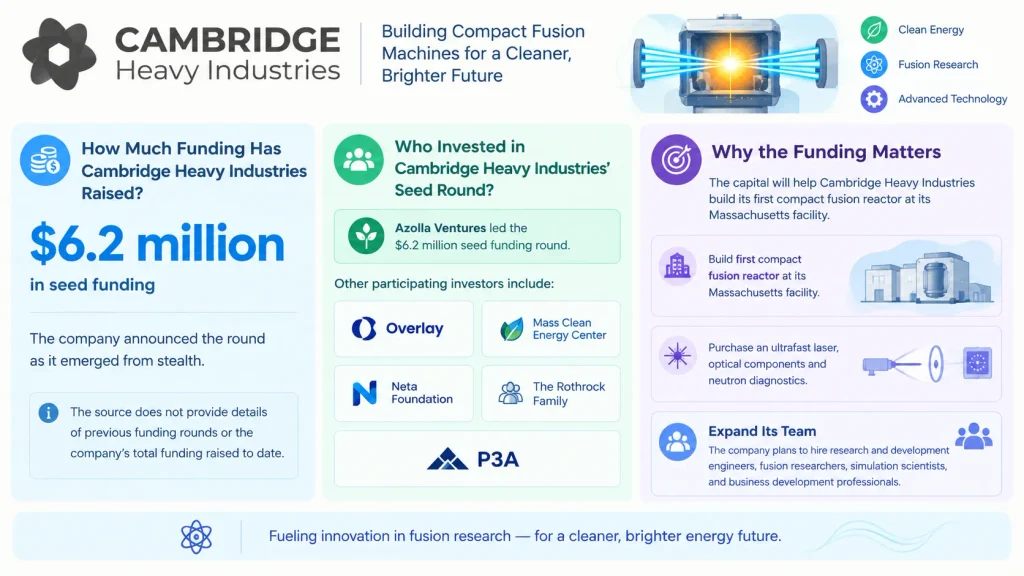
Cambridge Heavy Industries has raised $6.2 million in seed funding. The company announced the round as it emerged from stealth.
The source does not provide details of previous funding rounds or the company's total funding raised to date.
Who Invested in Cambridge Heavy Industries’ Seed Round?
Azolla Ventures led the $6.2 million seed funding round.
Other participating investors include:
- Overlay
- Mass Clean Energy Center
- Neta Foundation
- The Rothrock family
- P3A
Why the Funding Matters
Cambridge Heavy Industries plans to use the capital to build its first compact fusion reactor at its Massachusetts facility.
The funding will also support purchasing an ultrafast laser, optical components, and neutron diagnostics. The company plans to expand its team by hiring research and development engineers, fusion researchers, simulation scientists, and business development professionals.
Who founded Cambridge Heavy Industries?
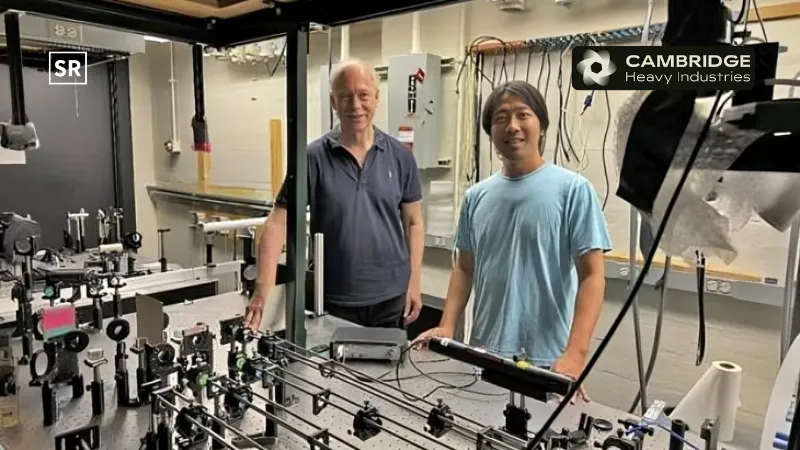
Cambridge Heavy Industries was founded by Yun Kai, Keith Nelson, Steve Kooi, and Raffi Freeman. The company is based in Cambridge, Massachusetts, where it plans to build its first compact fusion reactor.
“Cambridge Heavy Industries was inspired by decades of research and a clear vision for applying novel engineering to the proven science of inertial confinement fusion, making it more compact and efficient,” said Dr. Yun Kai, co-founder and CEO of Cambridge Heavy Industries. “Fusion power leaders have a tritium supply problem that could significantly slow down the sector’s growth.
“Our investment thesis in fusion has focused on reactor designs with fast and inexpensive learning cycles. The world may never see benefits from fusion if it requires multibillion-dollar science projects that take decades to iterate,” said Matthew Nordan, co-founder and General Partner of Azolla Ventures.
Market and Business Growth
Cambridge Heavy Industries plans to initially configure its systems to produce tritium, a rare and radioactive isotope of hydrogen. Tritium is used by most fusion research reactors, and the source estimates its current commercial price at approximately $33 million per kilogram.
The company sees isotope production as an early commercial opportunity while it continues developing fusion power technology.
Other potential applications include material defect engineering and neutron imaging, which use neutron sources for research and industrial purposes.
What Happens Next?
Cambridge Heavy Industries will focus on building its first compact fusion reactor in Massachusetts and acquiring the equipment needed to operate it.
The company also plans to expand its research, engineering, and commercial teams. Its initial systems will focus on tritium production, with future opportunities in isotope production, neutron imaging, material defect engineering, and eventually fusion power.
Read More:Kevel Raises $52M to Expand AI and Commerce Media Platform
Recommended Stories for You

Team SR Aug 8, 2024

Devin Jacobs May 30, 2024

Devin Jacobs Oct 24, 2026

Devin Jacobs May 6, 2026

Devin Jacobs Feb 2, 2024

Devin Jacobs Aug 20, 2026
Trending Stories

SiMa.ai Raises $85M in Funding

Sweet Oak Acquires Whole Earth Brands

HealthCare Startup Arintra Raises $25M in Series B Funding

Fintech Startup Bybit Partners with California-Based Mesh

Motive Appoints Andrew Bennett as Chief Marketing Officer

[Funding alert] MaintainX Secures $50 Mn Funding led by Bain Capital Ventures

Simplify Healthcare Names Kamal Ahuja as Chief Growth Officer

[Funding alert] NJ-based HealthArc Secures $5Million in Growth Funding

