

Starbucks Business Model: How Starbucks Makes Money and Became a Global Coffee Giant
Aug 20, 2026 | By Devin Jacobs
 Follow us
 Follow us
Thinking about coffee? For millions of people around the world, Starbucks is probably one of the first names that comes to mind. But Starbucks is much more than a company that sells coffee.
The brand has built a business around coffee, convenience, customer experience, brand loyalty, and a huge global store network. From the familiar green logo to the atmosphere inside its stores, almost every part of the Starbucks experience is designed to keep customers coming back.
So, what exactly makes the Starbucks business model work?
In this article, we’ll take a closer look at how Starbucks operates, who it serves, how it makes money, what makes its model different, and the strategies that have helped it become a global coffee brand. The analysis below is based on the source material you provided.
What Is the Starbucks Business Model?
The Starbucks business model is built around a simple idea: sell quality beverages and food while creating an experience customers want to return to.
Of course, coffee is at the center of the business. Starbucks sells hot and cold beverages, whole-bean coffee, tea, lattes, fresh juices, Frappuccino drinks, pastries, snacks, and other food products. But the company doesn’t rely on the product alone.
Its stores are also positioned as comfortable places where people can meet friends, study, work, or simply spend some time away from home. That combination of products and experience gives Starbucks a stronger relationship with customers than a traditional grab-and-go coffee shop.
In other words, Starbucks isn’t just selling a cup of coffee. It’s selling the reason to come back for another cup.
About Starbucks
Starbucks is an American multinational coffeehouse company headquartered in Seattle, Washington. It was founded in 1971 by Jerry Baldwin, Gordon Bowker, and Zev Siegl.
The company started at Seattle’s Pike Place Market, initially focusing on roasted coffee beans, tea, and spices. Over time, it evolved into one of the world’s best-known coffeehouse brands.
According to the source material, Starbucks had more than 38,000 locations globally and operated across more than 80 countries, giving the company an enormous international footprint.
That global reach is one of the biggest strengths of its business model.
How Does the Starbucks Business Model Work?
At its core, Starbucks brings together several important elements:
- Company-operated stores
- Licensed stores
- Coffee and beverage sales
- Food and snacks
- Packaged coffee and tea products
- Strong customer relationships
- Brand recognition
- A global supply and distribution network
The model works because these pieces support one another.
A customer may first discover Starbucks through a physical store. They may then become a regular customer because they like the drinks, atmosphere, convenience, or service. Later, they may buy Starbucks packaged coffee from a supermarket or another retail channel.
This creates several opportunities for Starbucks to earn revenue from the same brand relationship.
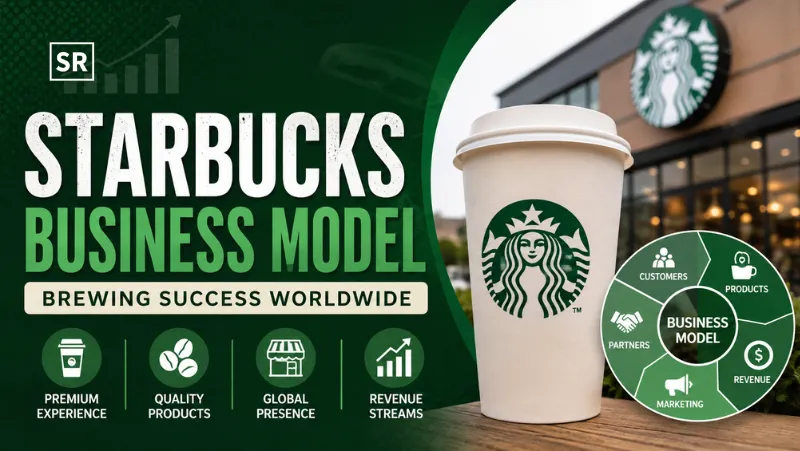
Starbucks Business Model Canvas
The Starbucks business model can be understood through the following major components.
1. Value Proposition
Starbucks’ main value proposition is built around quality, consistency, convenience, and customer experience.
Customers know what to expect when they walk into a Starbucks. The company aims to provide familiar products and a recognizable environment across its locations.
Starbucks stores are well designed to feel welcoming and comfortable, which can encourage customers to stay longer and return more frequently.
2. Customer Segments
Starbucks has a broad customer base, but the source highlights people aged 25–44 as an important target group. Young adults aged 18–24 are another major audience.
These groups are particularly valuable because coffee can become part of their everyday routines—whether that’s grabbing a drink before work, meeting friends, studying, or working from a café.
3. Customer Relationships
Starbucks puts considerable effort into building long-term relationships with its customers.
The relationship isn’t limited to the transaction at the counter. Store atmosphere, customer service, branding, promotions, and familiarity all play a role.
4. Channels
Starbucks reaches its customers through Various channels, such as:
- Its company-operated coffeehouses
- Licensed stores
- Grocery stores
- Specialty stores
- Warehouse clubs
- Online platforms
- Packaged coffee and tea distribution
5. Key Partners
Starbucks depends on a large network of partners to run its operation smoothly.
Some of its Key Partners are:
- Coffee farmers
- Roasters
- Shippers
- Regional suppliers
- Local suppliers
- Licensed-store partners
- Retail and distribution partners
A reliable supply chain is particularly important for a company operating at such a large scale.
6. Key Activities
Starbucks’ key activities are sourcing coffee, making beverages and food, operating stores, managing its supply chain, marketing its brand, and expanding its store network.
Apart from this, it also focuses heavily on maintaining a consistent customer experience.
7. Key Resources
Some of Starbucks’ most important resources aren’t physical.
Its brand name, customer loyalty, store network, recipes, employees, supplier relationships, and global distribution system all contribute to the company’s competitive position.
8. Cost Structure
Running thousands of stores naturally involves high costs.
Some of the Major expenses are:
- Store operations
- Employee wages
- Coffee and food ingredients
- Rent and property costs
- Logistics
- Marketing
- Equipment
- Supply-chain operations
Starbucks therefore needs strong sales volume and efficient operations to make its store network profitable.
How Does Starbucks Make Money?
The Starbucks revenue model is relatively straightforward, but its scale makes it powerful.

RECOMMENDED FOR YOU

PureTalk: Affordable and Flexible Wireless Solutions for Everyone
Devin Jacobs
Mar 30, 2026

Supplement Management Thespoonathletic: Complete Guide to Smart Athletic Nutrition
Devin Jacobs
May 12, 2026

1. Company-Operated Stores
Company-operated stores are the biggest part of Starbucks’ business.
Customers purchase beverages, food, snacks, and other products directly from these stores. Because Starbucks operates the locations itself, it receives the revenue from those sales while also taking responsibility for the operating costs.
This model gives Starbucks considerable control over the customer experience.
2. Licensed Stores
Starbucks also earns money through licensed locations.
Instead of operating every store itself, Starbucks allows partners to operate locations under its brand and sell Starbucks products.
This approach can help the company expand into new markets without carrying all the costs and operational responsibilities associated with owning and running every location itself.
3. Packaged Coffee and Tea
Starbucks isn’t limited to selling drinks inside its cafés.
Its coffee and tea products can also reach customers through grocery stores, specialty retailers, warehouse clubs, and online channels.
This gives the brand a presence inside people’s homes as well as its physical stores.
4. Food and Snacks
Coffee may be the headline product, but Starbucks also sells pastries, cakes, salads, yoghurt, and other food items.
This is important because customers don’t always visit a coffee shop only for coffee. A drink combined with breakfast or a snack can increase the value of each customer visit.
What Makes Starbucks’ Business Model Different?
One of the biggest differences is the importance Starbucks places on experience.
A local café might compete primarily on price or the quality of its coffee. Starbucks competes on several things at once.
The familiar logo, store design, cups, menu, employee interaction, and overall atmosphere all contribute to the brand experience.
The source also highlights Starbucks’ ability to create spaces where customers can socialize, study, work, and attend community events.
That’s a clever part of the model because it gives customers another reason to visit beyond simply buying coffee.
Starbucks’ Customer Loyalty Strategy
Starbucks has built a huge amount of brand recognition over the years.
Its logo is instantly recognizable, and customers often know what kind of experience they are likely to get before entering the store.
The company also benefits from word-of-mouth marketing. Customers who enjoy the brand can naturally introduce it to friends, colleagues, and family members.
Promotional events and branded merchandise also help strengthen awareness and loyalty.
The result is a business that doesn’t have to convince customers what Starbucks is every time they see the logo.
Starbucks’ Marketing Strategy
Starbucks’ marketing is closely connected to its brand identity.
Rather than relying only on traditional advertising, the company uses its stores, packaging, logo, digital content, products, and customer experience to keep the brand visible.
Even something as simple as carrying a Starbucks cup can give additional brand exposure.
It makes a cycle:
Strong brand → customer recognition → store visits → positive experience → repeat purchases → stronger loyalty.
That cycle is one of the most valuable parts of the Starbucks business model.
Starbucks’ Global Expansion Strategy
Starbucks has grown by combining company-operated locations with licensed stores.
This gives the company flexibility when entering different markets.
Some countries may require Starbucks to work closely with local partners who understand local customers, regulations, real estate, and business conditions.
At the same time, Starbucks can maintain important parts of its global identity.
The result is a business model that combines global branding with local market participation.
Starbucks Competitors
Starbucks operates in a highly competitive market.
Some major competitors include:
| Competitor | Known For |
| Dunkin’ | Coffee and donuts |
| Costa Coffee | Coffeehouse chain |
| McCafé | Coffee through McDonald’s |
| Tim Hortons | Coffee and baked goods |
| Peet’s Coffee | Roasted coffee |
| Lavazza | Italian coffee |
| Café Coffee Day | Indian coffeehouse brand |
| Local cafés | Personalized and local experiences |
Starbucks therefore competes against both global corporations and independent neighborhood cafés.
That’s an important challenge. A customer doesn’t necessarily need another international coffee chain to switch brands; they can simply choose a nearby independent café.
Starbucks SWOT Analysis
Strengths
Starbucks has some Strengths:
- Strong global brand recognition
- Large international store network
- Familiar customer experience
- Strong visual identity
- Broad product range
- Loyal customer base
The Starbucks name itself has become an important business asset.
Weaknesses
One obvious weakness is price.
Starbucks products can be more expensive than coffee from local cafés or competing chains. This can make the brand less attractive to price-sensitive customers.
The source also notes that Starbucks has room to strengthen its presence in some emerging markets and respond to growing health-conscious consumer preferences.
Opportunities
Starbucks can continue exploring:
- Smaller cities and towns
- New international markets
- More affordable products
- Tea-based products
- New food categories
- Packaged products
- Digital and online channels
Expanding beyond traditional coffee products could help the company appeal to customers with different tastes.
Threats
Competition remains one of Starbucks’ biggest challenges.
Customers have plenty of alternatives, including fast-food restaurants, other coffee chains, independent cafés, tea companies, and packaged beverages.
Changing consumer preferences can also affect demand.
Why Is the Starbucks Business Model Successful?
The Starbucks model works because the company has managed to turn an everyday product into a recognizable lifestyle brand.
Coffee itself isn’t difficult to find. What Starbucks has done differently is build an ecosystem around coffee.
A customer can:
Discover the brand → visit a store → enjoy the atmosphere → buy a drink → return regularly → try new products → buy packaged products at home.
At the same time, Starbucks can expand through licensed locations and retail partnerships.
That creates multiple revenue opportunities while keeping the brand at the center.
Conclusion
The Starbucks business model is a good example of how a company can transform a simple product into a global business.
Coffee is the main foundation, but Starbucks has built much more around it. Its biggest lesson is perhaps the simplest one: customers don’t always remember every product they buy, but they remember how a brand makes them feel.
That is what Starbucks has worked to turn into a business advantage, and it is a major reason the company remains one of the most recognizable names in the global coffee industry.
FAQs
What is Starbucks’ business model?
What makes Starbucks different from other coffee shops?
Does Starbucks only make money from coffee?
What can businesses learn from the Starbucks business model?
What is the main idea behind the Starbucks business model?
Recommended Stories for You

Devin Jacobs Apr 2, 2026

Devin Jacobs Jan 19, 2026

Devin Jacobs Mar 18, 2026

Devin Jacobs Jul 20, 2026

Devin Jacobs Mar 19, 2026

Devin Jacobs May 26, 2026
Trending Stories

Home Equity Loan Explained: How Loan Against Property Works in India

Best Smart Glasses Brands in 2026: Top AI, AR and XR Companies

Abraham Quiros Villalba: Inspiring Journey of a Forward-Thinking Visionary Innovator

What Is QueekMag com? A Complete Guide to Its Content and Features

Billy Carson Net Worth and Biography

Is Faspeinfo the Right Place to Find Answers, Study Guides and Educational Materials?

Latest FeedBuzzard com: Features, Benefits & Review

PrecoWeb Com Review: Everything You Need to Know in 2026

