


SUMMARY
- Dream raised $17 million in seed funding.
- The funds will support growth.
- Dream develops AI tools for building design.
 Follow us
 Follow us
Dream, a San Francisco, CA-based product and research company that automates the design and engineering of built-world models, has raised $17 million in a seed funding round.
The round saw backers including Andreessen Horowitz (a16z), SV Angel, XYZ, and Zigg Capital, among others.
The company plans to use the funding to expand its operations and product development.
What is Dream?
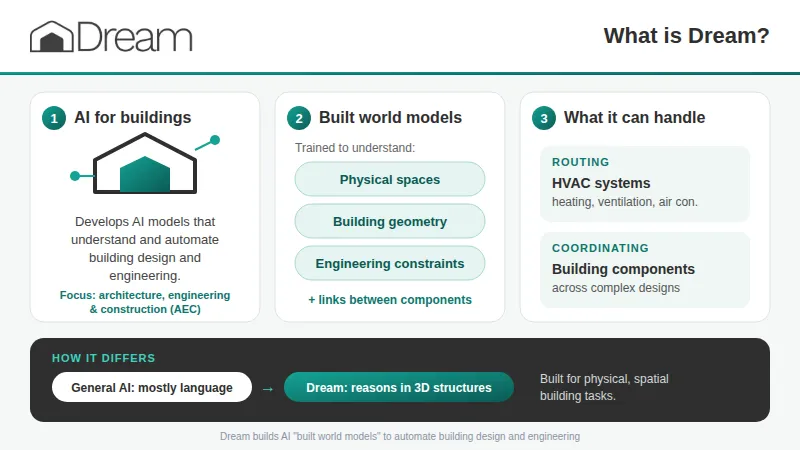
Dream develops AI models designed to understand and automate building design and engineering. The company is initially focusing on the architecture, engineering, and construction (AEC) industry.
Read More:Casap Raises $56M in Series B Funding Led by Base10 Partners
Its technology, called built world models, is trained to understand physical spaces, building geometry, engineering constraints, and relationships between different components.
Unlike general AI models that mainly process language, Dreams models are designed to reason about three dimensional structures. This allows them to handle complex building tasks, such as routing heating, ventilation, and air conditioning (HVAC) systems and coordinating different building components.
RECOMMENDED FOR YOU

Health Care Startup Cencora Appoints Robert Sanchez to Its Board of Directors
Devin Jacobs
Sep 26, 2026


[Funding alert] MD-based ION Storage Systems Secures an Investment from Nova by Saint-Gobain
Devin Jacobs
Dec 23, 2023
How Much Funding Has Dream Raised?
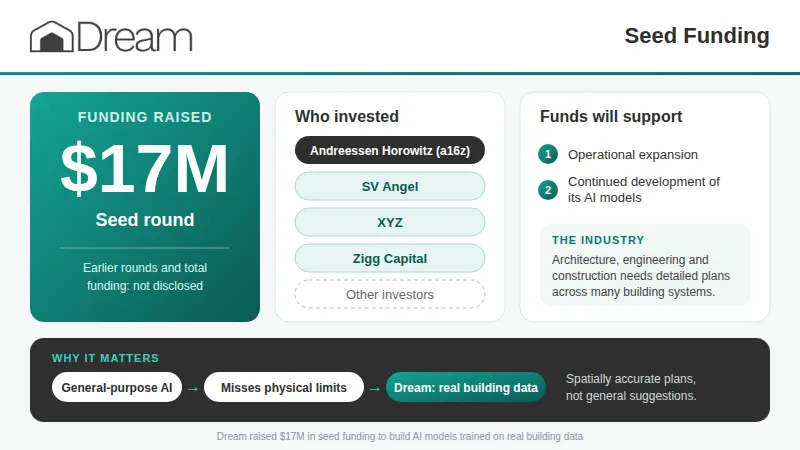
Dream has raised $17 million in its seed funding round. The company has not disclosed details of previous funding rounds or its total funding raised to date.
The latest capital will support its operational expansion and continued development of its AI models.
Who Invested in Dream’s Seed Round?
Dream's $17 million seed round included investments from:
- Andreessen Horowitz (a16z)
- SV Angel
- XYZ
- Zigg Capital
- Other investors
Why the Funding Matters
The architecture, engineering, and construction industry relies on detailed technical plans and coordination between multiple building systems. General-purpose AI models are not specifically designed to understand the physical constraints involved in these tasks.
Dream aims to address this gap by developing AI models trained on real building data. The technology is designed to produce spatially accurate engineering plan's rather than general design suggestions.
Who founded Dream?
Dream was founded by Andy Elder and Arjun Mathur and is based in San Francisco, California.
Both founders bring more than a decade of experience building mission-critical systems at Palantir. Elder led global design teams across defence, intelligence, and commercial sectors, while Mathur built Palantir's manufacturing and supply chain practice.
“There is no room for probabilities when it comes to buildings and infrastructure,” said Andy Elder, co-founder of Dream. “A hallucination in an LLM is a typo. A hallucination in a building is a structural fault, with potentially catastrophic consequences.
“AI that can reason in three dimensions is the next frontier, and Dream is building a model that can actually do it,” said Kimberly Tan, Investing Partner at Andreessen Horowitz. “Their technology has the potential to bring a multitrillion-dollar industry still reliant on software built in 1997 into the AI era.
Market and Business Growth
Dream has trained its AI models on data covering more than 100 million square feet of real, permitted buildings across the United States. The dataset includes commercial properties, apartments, and single-family homes.
Its technology is designed to produce engineering-grade building plans that contractors can use for construction, targeting a sector that has seen less digital transformation than many other industries.
What Happens Next?
Dream plans to expand its operations and continue developing its built world models.
The company will focus on improving AI-driven design and engineering capabilities for the AEC industry, with the goal of producing accurate building plans that can be used in real-world construction projects.
Read More:Opentrons Labworks Secures $40M in Series E Funding
Recommended Stories for You

Kuldeep Jangid Oct 19, 2026

Devin Jacobs Jun 19, 2024

Devin Jacobs Feb 14, 2026


Devin Jacobs Jan 24, 2024

Startuprise Feb 2, 2026
Trending Stories

Goodfire Raises $50M Series A to Advance AI Interpretability and Launch Ember Platform

Observe Closes $156M in Series C Funding

Dental Care Wally Health Secures $25M in Series A Funding

Metcash Announces Expanded Strategic Partnership with Coveo

Siena Raises $17M in Series A Funding Led by York IE

Illinois-Based CDW Completes Acquisition of AI Services Company Lovelytics

Create Wellness Raises $20M in Series B Funding

[Funding alert] CA-based rabbit Secures Additional $10M in Series A Round Funding

