

California-Based Altay Therapeutics Closes $37M Series A Financing
Oct 15, 2026 | By Devin Jacobs
SUMMARY
- Altay Therapeutics raised $37 million in Series A funding.
- The funds will support trials of its FSHD drug.
- Altay Therapeutics develops targeted drug treatments.
 Follow us
 Follow us
Altay Therapeutics, Inc., a San Carlos, CA-based biotechnology company developing novel small molecule inhibitors of transcription factors, has raised $37 million in a Series A financing round.
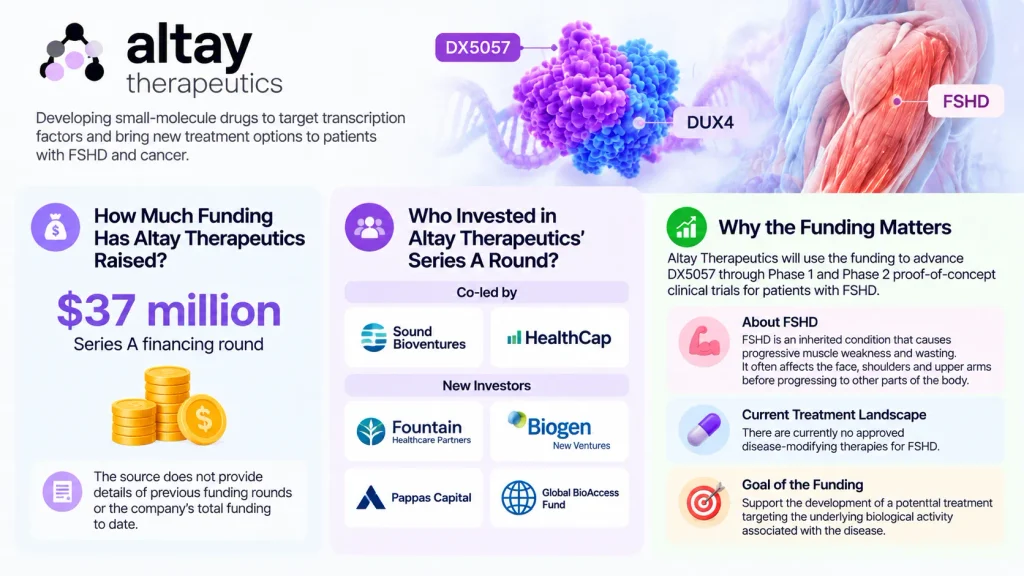
The round was co-led by Sound Bioventures and HealthCap, with participation from new investors including Fountain Healthcare Partners, Biogen New Ventures, Pappas Capital, and Global BioAccess Fund.
The company will use the funding to advance its lead drug candidate, DX5057, through Phase 1 and Phase 2 proof-of-concept clinical trials for facioscapulohumeral muscular dystrophy (FSHD).
What is Altay Therapeutics?
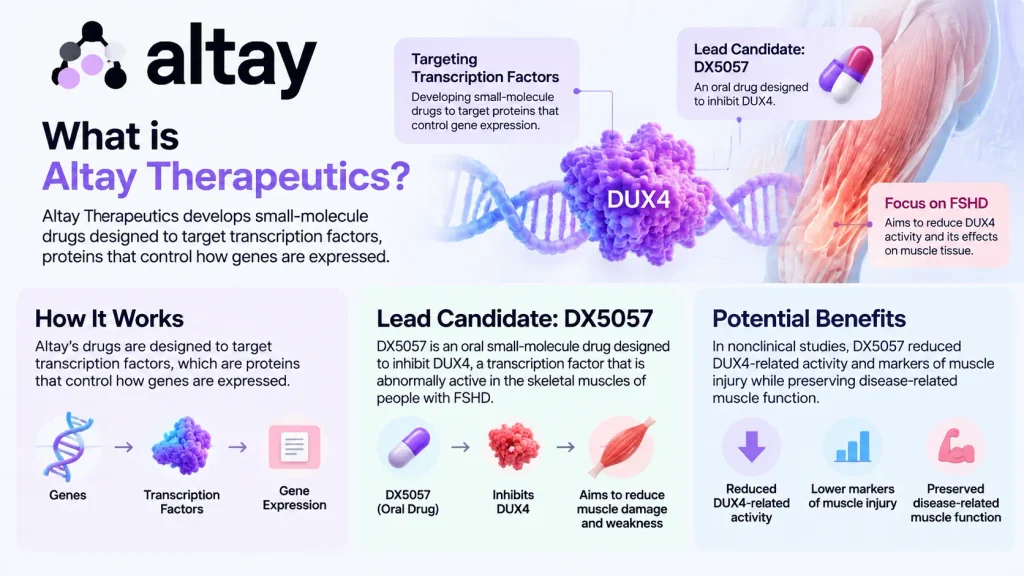
Altay Therapeutics develops small-molecule drugs designed to target transcription factors, proteins that control how genes are expressed.
Read More:AI Startup Marklo Secures $5M in Seed Funding
Its lead candidate, DX5057, is an oral drug designed to inhibit DUX4, a transcription factor that is abnormally active in the skeletal muscles of people with FSHD. This activity is linked to muscle damage, weakness, and progressive loss of muscle function.
The company is developing DX5057 to reduce DUX4 activity and its effects on muscle tissue. In nonclinical studies, the drug reduced DUX4-related activity and markers of muscle injury while preserving disease-related muscle function.
How Much Funding Has Altay Therapeutics Raised?
Altay Therapeutics has closed a $37 million Series A financing round.
The source does not provide details of previous funding rounds or the company's total funding to date.
Who Invested in Altay Therapeutics’ Series A Round?
The $37 million Series A financing was co-led by:
- Sound Bioventures
- HealthCap
New investors participating in the round include:
- Fountain Healthcare Partners
- Biogen New Ventures
- Pappas Capital
- Global BioAccess Fund
Why the Funding Matters
Altay Therapeutics will use the funding to advance DX5057 through Phase 1 and Phase 2 proof-of-concept clinical trials for patients with FSHD.
FSHD is an inherited condition that causes progressive muscle weakness and wasting. It often affects the face, shoulders and upper arms before progressing to other parts of the body. There are currently no approved disease-modifying therapies for the condition.
The funding will support the development of a potential treatment targeting the underlying biological activity associated with the disease.
Who founded Altay Therapeutics?
Altay Therapeutics was founded in 2019 by Osman Nidai Ozes and Ali Ozes. The company is based in San Carlos, California.
"There are no disease-modifying therapies approved for FSHD, and the patient community is in need of a durable, practical solution. DX5057 is an oral medicine that acts systemically to shut down DUX4 at its source,” said James Breitmeyer, M.D., Ph.D., Chief Executive Officer of Altay.
“A small molecule-based, disease-modifying therapy could not only make long-term treatment for FSHD practical, but also suppress DUX4 deeply enough to preserve muscle before loss becomes irreversible,” said Carl Kilander, M.D., Ph.D., of HealthCap.
Market and Business Growth
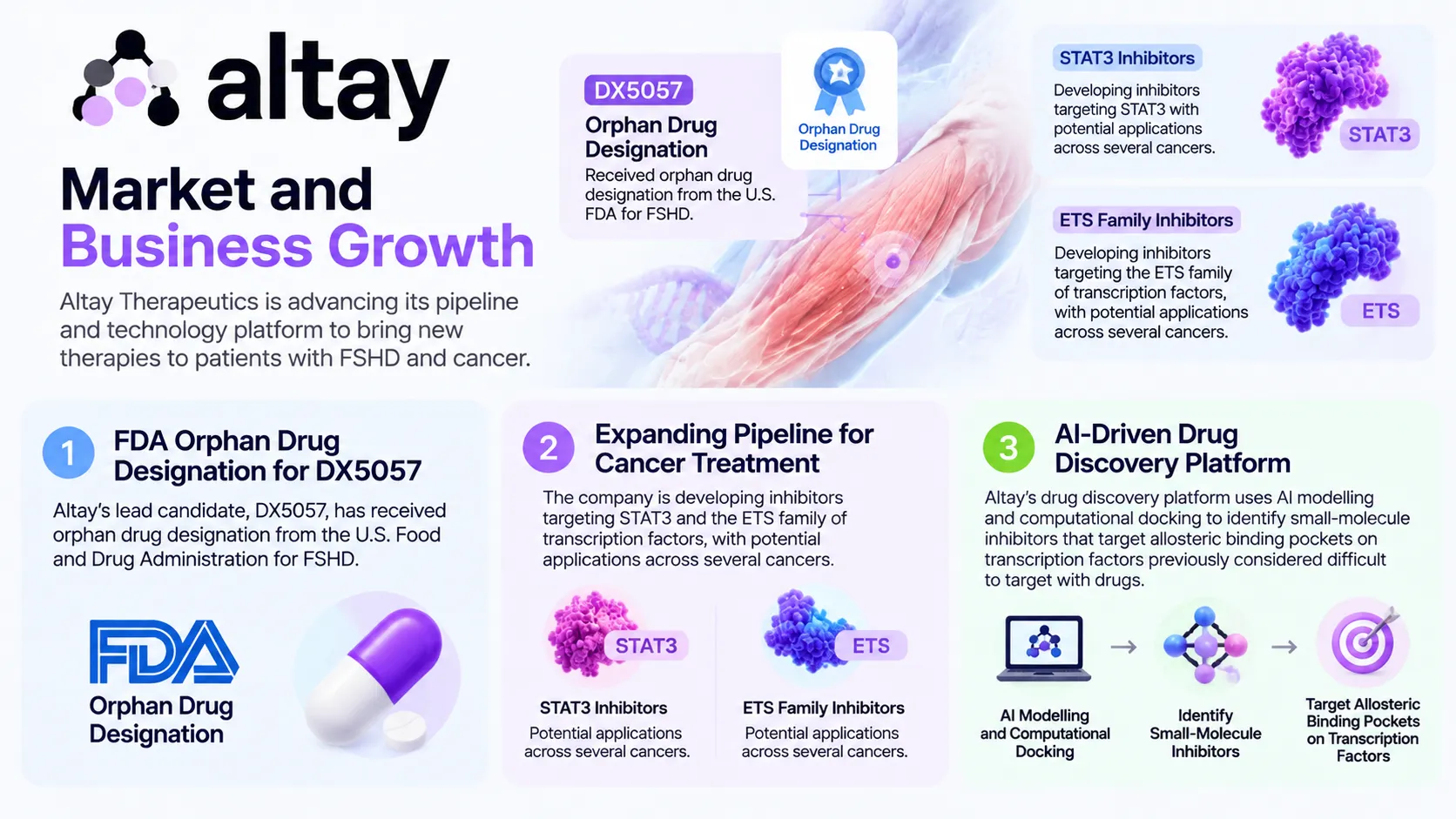
Altay's lead candidate, DX5057, has received orphan drug designation from the U.S. Food and Drug Administration.
The company is also developing inhibitors targeting STAT3 and the ETS family of transcription factors, with potential applications across several cancers.
Its drug discovery platform uses AI modelling and computational docking to identify small-molecule inhibitors that target allosteric binding pockets on transcription factors previously considered difficult to target with drugs.
RECOMMENDED FOR YOU
[Funding alert] CA-based Delivery Collective Secures $3.8Million in Funding
Devin Jacobs
Apr 3, 2024


What Happens Next?
Altay Therapeutics plans to advance DX5057 through Phase 1 and Phase 2 proof-of-concept clinical trials for FSHD.
The company will also continue developing its other drug candidates targeting STAT3 and ETS family transcription factors for potential cancer treatments.
Recommended Stories for You

Devin Jacobs Jul 29, 2026
Devin Jacobs Jan 9, 2024

Startuprise Jul 25, 2025

Startuprise Dec 12, 2025
Devin Jacobs Jul 16, 2026

Devin Jacobs Feb 13, 2024
Trending Stories
Fintech Startup Savvy Wealth Raises $100M in Series C Funding

Telecommunications-Based InfiniG Raises $5.2M in Seed Funding
Colorado-Based American Supercritical Raises $8M in Pre-Seed Funding
Townsend Retirement & Investment Advisors appoints Anthony Schembri as Senior Vice President

US Reviews Shein’s Everlane Buyout Over Security Concerns

Tenn-based Reimagine Care Secures an Investment

Texas-Based Quaise Energy Raises $180M in Series B Funding
Massachusetts-Based Legato Raises $12M in Funding Round

