
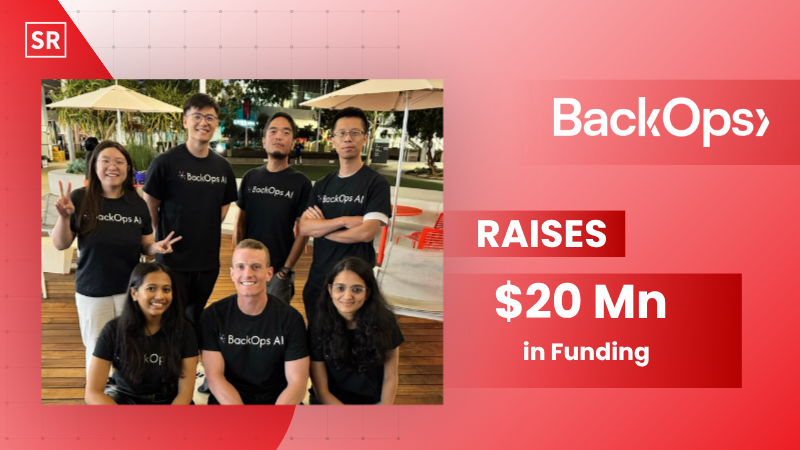
BackOps, a San Francisco, CA-based provider of an AI resolution layer platform for physical goods supply chains, has raised $42 million in a Series B funding round led by Insight Partners.
SUMMARY
- BackOps raised $42M in Series B funding.
- The funding will support AI platform expansion and hiring.
- BackOps builds AI tools for supply chain operations.
 Follow us
 Follow us
The round also saw participation from Theory Ventures, Construct Capital, Gradient Ventures, and 10VC.
The company will use the funding to expand its resolution layer across operations, finance, and customer service, while growing its product, engineering, and go-to-market teams.
What is BackOps?
BackOps provides an AI resolution layer for companies that make or move physical goods. Its platform helps businesses manage complex supply chain processes that involve enterprise systems, internal teams, carriers, suppliers, distributors, customers, and service providers.
RECOMMENDED FOR YOU


[Funding News] IL-based FleetPulse Secures $11Million in Seed Funding
Devin Jacobs
May 9, 2024
Read More:William Layden Co-Founded Rune Raises $40M in Series A Funding
The platform uses prebuilt connections to commonly used carrier systems, resolution patterns learned across implementations, and data from carrier claims to help companies automate operational processes.
BackOps is designed to reduce the manual work involved in gathering information, coordinating decisions, following up, and completing supply chain processes.
How Much Funding Has BackOps Raised?
BackOps has raised $42 million in its latest Series B funding round.
The round was led by Insight Partners, with participation from Theory Ventures, Construct Capital, Gradient Ventures, and 10VC.
The source does not provide details of the company’s previous funding rounds or total funding raised before this round.
Who Invested in BackOps’ Series B?
Insight Partners led BackOps’ $42 million Series B round.
Theory Ventures, Construct Capital, Gradient Ventures, and 10VC also participated.
Why the Funding Matters
BackOps plans to use the new funding to expand its resolution layer to more processes across operations, finance, and customer service.
The company will also invest in its product and engineering teams and expand its go-to-market operations.
BackOps says every completed workflow records the context, decisions, actions, and outcomes involved. Over time, this data can help customers identify recurring patterns and improve their operational processes.
Who founded BackOps?
BackOps was founded in 2024 by Sean McCarthy and Henry Ou.
The company is headquartered in San Francisco, California.
Market and Business Growth
Over the past year, BackOps has been adopted by large enterprises in the grocery, retail, logistics, and distribution sectors. Its processes include carrier claims, chargeback disputes, complex billing, and forecasting.
In one deployment a national parcel platform used BackOps to manage its claim's operation. Since going live in December 2025, the system has processed more than 500,000 claims, and resolved 91% without human involvement.
Monthly claim volume increased 150-fold without additional hiring. The automated resolution rate also increased from 87% at launch to 99% currently.
In another deployment at a retailer operating 13 sites, BackOps reduced the average billing cycle from about 28 hours to 14 minutes. The company estimates this created capacity to handle higher volumes without adding five planned billing specialists and a supervisor, representing approximately $660,000 in projected fully loaded annual costs.
What Happens Next?
BackOps plans to expand its resolution processes across operations, finance, and customer service.
The company also plans to grow its product, engineering, and go-to-market teams as it expands the platform and supports more workflows.
"People have become the middleware between the systems and outside parties that keep supply chains moving," said Sean McCarthy, co-founder and CEO of BackOps. "AI changes what is possible, but companies shouldn't have to spend months building infrastructure before they can start solving real operational problems.
"Supply chains generate operational complexity every day, and much of that complexity is still managed by people doing manual, time-intensive work across disconnected systems," said Kenta Yaegashi, Vice President at Insight Partners.
Read More:California-Based Aristotle Raises $5M in Seed Funding
Recommended Stories for You

Devin Jacobs Jun 16, 2026
Startuprise Oct 15, 2025

Startuprise Nov 6, 2025
Startuprise Dec 15, 2025

Devin Jacobs Feb 3, 2024
Trending Stories

[Funding alert] CA-based Westbound Equity Partners Secures its Second Fund at $100Million
Skan AI Raises $63 Million to Give Enterprise AI the Context It’s Missing

AGent Energy Bags $11M in Series Seed Round
Healthtech Startup TytoCare Lands $25M+ to Expand Remote Care Platform

Ping Zhu Co-Founded CORE Biomedicine Raises $21M in Series A Funding
Timeshifter Raises New Funding Led by Skip Capital
[Funding alert] CA-based Proto Hologram Secures an Investment from Cartan Capital

Omega Holdings acquires Motor Vehicle Manufacturing-Based Wells Vehicle Electronics

