


SUMMARY
- Setara Biosciences raised $90 million in Series A funding.
- The funds will support drug development.
- Setara develops treatments for rare diseases.
 Follow us
 Follow us
Setara Biosciences, a San Diego, CA-based clinical stage biotechnology company leveraging genetics to develop precision medicines for severe rare diseases, has secured $90 million in a Series A funding round.
The round saw backers including Deerfield Management, Canaan, Droia Ventures, EcoR1, Euclidean Capital, Regeneron Ventures, and Jazz Pharmaceuticals.
The company will use the funding to advance its lead drug candidate, STAR-0871, for Charcot-Marie-Tooth disease type 2C (CMT2C) and overactive bladder. It also plans to progress early-stage drug discovery programmes targeting genetic epilepsies and other conditions.
What is Setara Biosciences?
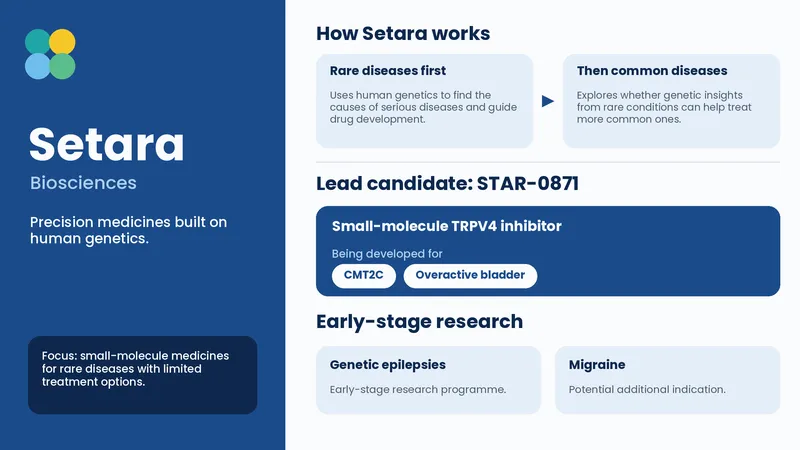
Setara Biosciences develops precision medicines using human genetics to identify the causes of serious diseases and guide drug development.
Read More:SuperMe Raises $20M in Funding Led by Forerunner Ventures
The company focuses on small-molecule medicines for rare diseases with limited treatment options. Its research also explores whether genetic insights from rare conditions can help develop treatments for more common diseases.
Its lead candidate, STAR-0871, is a small-molecule TRPV4 inhibitor being developed for CMT2C and overactive bladder. The company also has early-stage research programmes focused on genetic epilepsies and potential additional indications such as migraine.
RECOMMENDED FOR YOU

[Funding News] TX-based Humanaut Health Secures $8.7Million in Seed Funding
Devin Jacobs
May 8, 2024


[Funding News] CA-based Plume Network Secures $10Million in Seed Funding
Devin Jacobs
May 25, 2024
How Much Funding Has Setara Biosciences Raised?
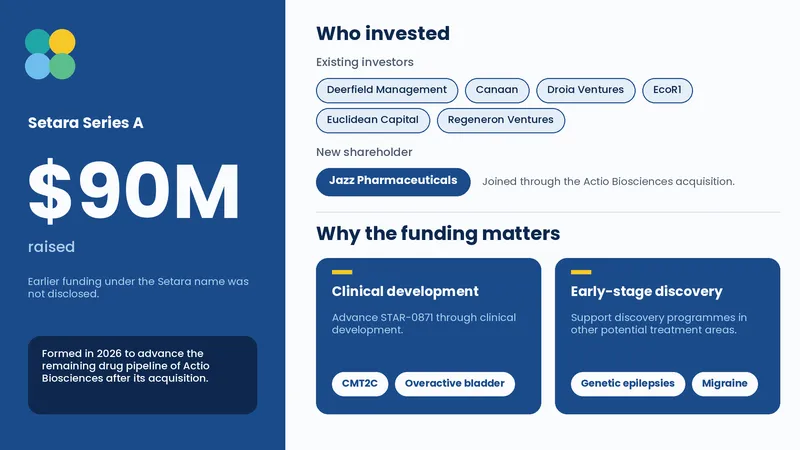
Setara Biosciences has raised $90 million in its Series A funding round. Details of any previous funding raised under the Setara name were not disclosed.
The company was formed in 2026 and is advancing the remaining drug development pipeline of Actio Biosciences following its acquisition.
Who Invested in Setara Biosciences’ Series A?
The funding round included participation from existing investors Deerfield Management, Canaan, Droia Ventures, EcoR1, Euclidean Capital and Regeneron Ventures.
Jazz Pharmaceuticals joined as a new shareholder as part of the Actio Biosciences acquisition.
Why the Funding Matters
Setara will use the capital to advance STAR-0871 through clinical development for CMT2C and overactive bladder.
The funding will also support early-stage discovery programmes targeting genetic epilepsies and other potential treatment areas, including migraine.
Who founded Setara Biosciences?
Setara Biosciences was founded in 2026 by David Goldstein and David Breckenridge. The company is headquartered in San Diego, California.
“With Setara, we have the opportunity to build on a model that has already demonstrated its potential and apply it to severe, rare diseases with significant unmet need today,” said David Goldstein, Ph.D., co-founder, president and executive chair of Setara. “We are incredibly proud of what we built at Actio and that ABS-1230 for KCNT1-related epilepsy now has the opportunity to advance as part of Jazz.
“We believe that Actio’s acquisition by Jazz validates the genetics-driven approach to drug discovery and development that underpins Setara,” said Jason Fuller, Ph.D., Setara board member and Partner at Deerfield Management. “Setara brings together experienced operators, a compelling foundation in human genetics, and a promising pipeline grounded in strong biological rationale.
Market and Business Growth
Setara is building on the genetics-driven drug development approach established at Actio Biosciences.
The company has completed the healthy volunteer portion of a Phase 1 clinical trial of STAR-0871. The drug candidate has received Rare Pediatric Disease, Orphan Drug and Fast Track designations from the US Food and Drug Administration (FDA).
Setara's pipeline includes programmes for rare genetic conditions as well as potential treatments for more common diseases.
What Happens Next?
Setara plans to expand STAR-0871 development into a Phase 1b study, named THERON, involving patients with CMT2C in 2027.
The company also plans to begin a Phase 2a study to evaluate the drug candidate in patients with overactive bladder. Alongside these clinical programmes, it will continue developing its early-stage pipeline for genetic epilepsies and other indications.
Read More:Dulo Raises $130M in Seed Funding for Engineering AI
Recommended Stories for You

Team SR Dec 17, 2024

Devin Jacobs Jun 19, 2026

Startuprise Jul 23, 2025

Startuprise Mar 21, 2026

Devin Jacobs Dec 12, 2023

Devin Jacobs Oct 1, 2026
Trending Stories

[Funding News] Valdera Secures $15 Mn Series A Funding

NavigateAI Raises $25M in Funding Led by Elad Gil

Open Vision Engineering Raises $11M in Funding Round

Arboretum LifeSciences Raises $30M in Series A Funding

Supabase Raises $150M in Funding Led by GIC

Maryland-Based SereNeuro Therapeutics Closes Pre-Seed Funding

Sole Source Capital Appoints Claire Bissot as Chief Human Resources Officer

Selective Insurance Appoints Vaibhav Kalia as Chief Investment Officer

