SUMMARY
- Earthly raised $5.7 million in funding.
- It will use the funds to grow its team.
- Earthly builds software to check code quality.
 Follow us
 Follow us
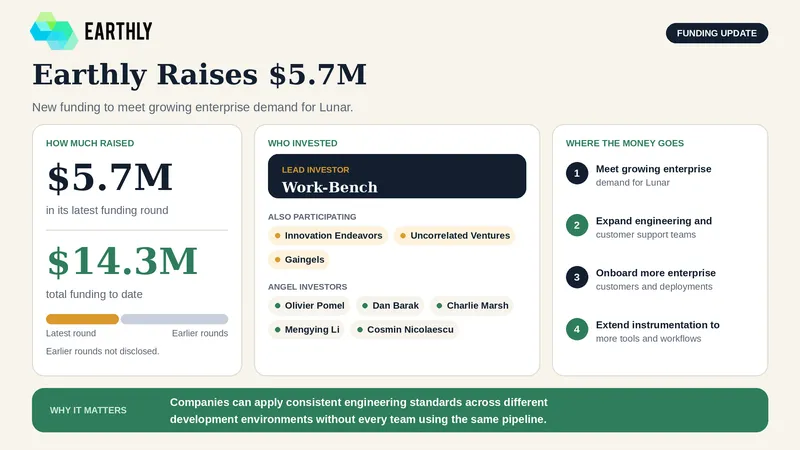
Earthly, a San Francisco, CA-based provider of a guardrails engine platform for human and AI-generated code, has raised $5.7 million in a funding round, bringing the total amount to $14.3 million.
The round was led by Work-Bench, with participation from Innovation Endeavors, Uncorrelated Ventures, Gaingels, and angel investors including Olivier Pomel, Dan Barak, Charlie Marsh, Mengying Li, and Cosmin Nicolaescu.
The company will use the funds to accelerate growth, expand its engineering and customer support teams, and extend its platform across more enterprise tools and workflows.
What is Earthly?
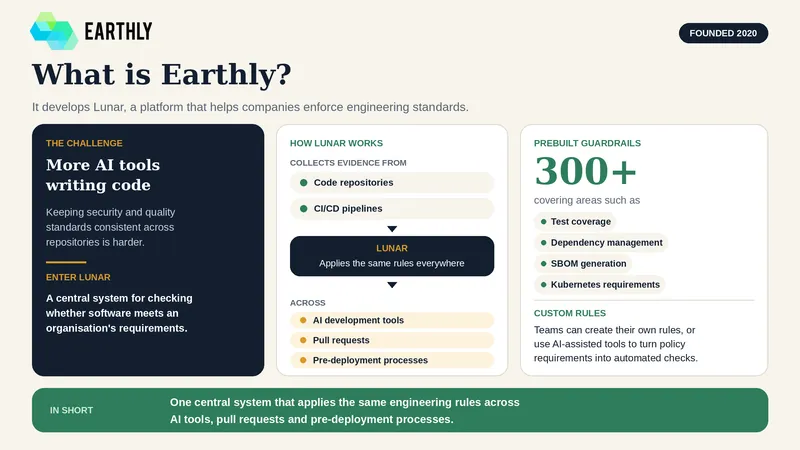
Founded in 2020, Earthly develops Lunar, a platform that helps companies enforce engineering standards across software development workflows.
Read More:Tesorai Raises $5.3M in Seed Funding, Reaches $8M Total
As companies use more AI tools to write code, maintaining consistent security and quality standards across repositories has become more challenging. Lunar provides a central system for checking whether software meets an organisations requirements.
The platform collects and organises evidence from code repositories, and CI/CD pipelines. It then applies the same rules across AI development tools, pull requests, and pre deployment processes.
Lunar includes more than 300 prebuilt guardrails covering areas such as test coverage, dependency management, software bill of materials (SBOM) generation, and Kubernetes requirements. Teams can also create custom rules or use AI assisted tools to turn policy requirement's into automated checks.
RECOMMENDED FOR YOU


How Much Funding Has Earthly Raised?
Earthly has raised $5.7 million in its latest funding round, bringing it's total funding to $14.3 million.
The company has not disclosed details of its previous funding rounds in the announcement.
Who Invested in Earthly’s Funding Round?
Work-Bench led the $5.7 million round.
Other participating investors included Innovation Endeavors, Uncorrelated Ventures and Gaingels.
The round also included angel investors Olivier Pomel, Dan Barak, Charlie Marsh, Mengying Li and Cosmin Nicolaescu.
Why the Funding Matters
The funding will help Earthly meet growing enterprise demand for Lunar. The company plans to expand its engineering, and customer support teams to support existing deployments, and onboard more enterprise customers.
It will also extend the platform’s central instrumentation to additional customer tools, and workflows. This will allow companies to apply consistent engineering standards across different development environments without requiring every team to use the same pipeline.
Who founded Earthly?
Earthly was founded in 2020 by Vlad A. Ionescu. The company is headquartered in San Francisco, California.
“Developer infrastructure earns adoption when it makes a difficult job simpler. Platform teams need to introduce engineering standard's across existing workflows without turning every new requirement into a rollout project for every team. Lunar addresses that problem centrally giving developers room to work while helping the organization keep pace with the changes AI makes possible,” said Mitch Wainer, Co-Founder & Former CMO, DigitalOcean.
Market and Business Growth
Earthly's Lunar platform now covers more than 100,000 repositories across multiple industries.
A global communications company has deployed Lunar across more than 11,000 repositories and made a two-year commitment to the platform. The company uses Lunar as part of its software development processes to maintain consistent standards.
The platform is designed to support developers, platform teams security teams, and site reliability engineering teams. Its automated checks help organisations enforce requirements, and identify violations across their software workflows.
What Happens Next?
Earthly plans to expand it's engineering and customer support teams to serve enterprise customers and support further deployments.
The company will also continue developing Lunar by adding central instrumentation for more customer tools and workflows. Its focus will remain on helping organisations apply consistent standards across software written by both developers, and AI systems.
Recommended Stories for You

Devin Jacobs May 27, 2026

Devin Jacobs May 9, 2024
Devin Jacobs Jan 11, 2024
Devin Jacobs Oct 6, 2026

Devin Jacobs Feb 2, 2024
Devin Jacobs Jun 3, 2024
Trending Stories

Phia Raises $35M in Series A Funding

[Funding alert]OnCusp Therapeutics Raises Oversubscribed $100 Mn Series A Financing

[Funding alert] Berlin-based UltiHash Secures $2.5m in Pre-Seed Funding

[Funding alert] Kyron Learning Secures $14.6m in Series A Funding Round

[Funding News] Nym Raises $47 Mn Growth Investment Led by PSG

Prefix Raises $7.5M in Seed Funding

Valtris Specialty Chemicals Announces New CHRO

[Funding News] Synthpop Secures $5.6M Funding to Revolutionize AI-Driven Healthcare Solution

