
SUMMARY
- Optivolt raised $32 million in Series A funding.
- The funds will support manufacturing and expansion.v
- Optivolt develops technology to improve solar panel performance.
 Follow us
 Follow us
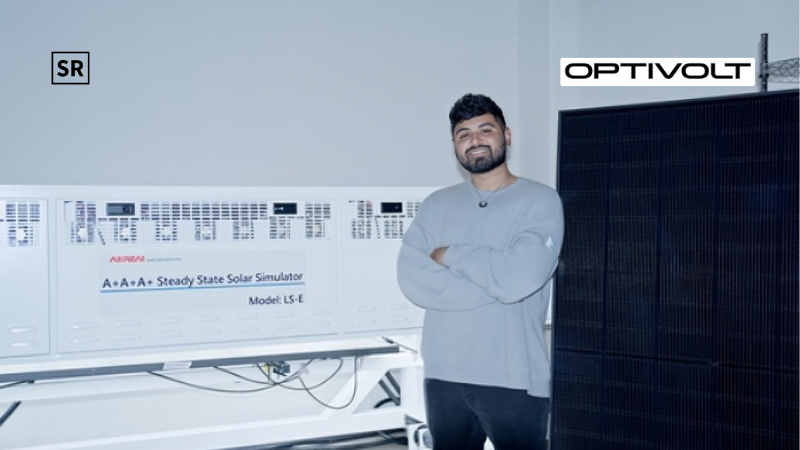
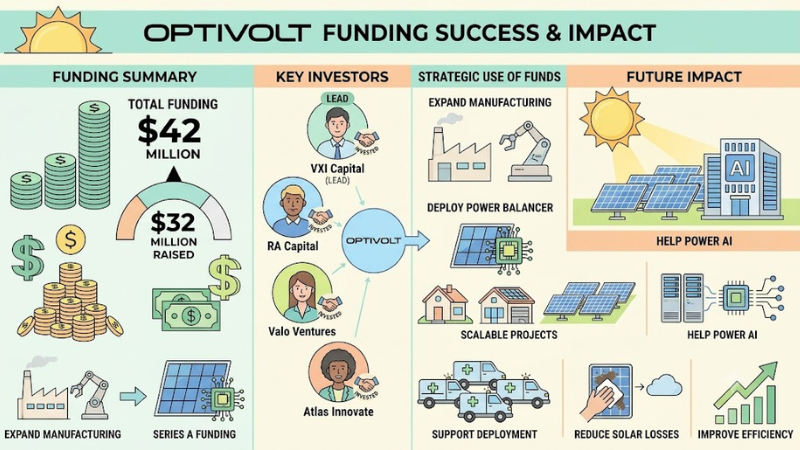
Optivolt, a San Francisco, CA-based power electronics company building the intelligence layer for solar, has raised $32 million in a Series A funding round, bringing the total amount to $42 million.
The round was led by VXI Capital, with participation from RA Capital, Valo Ventures, and Atlas Innovate.
The company will use the funding to expand manufacturing and bring its technology to solar installations ranging from residential systems to utility-scale projects.
What is Optivolt?
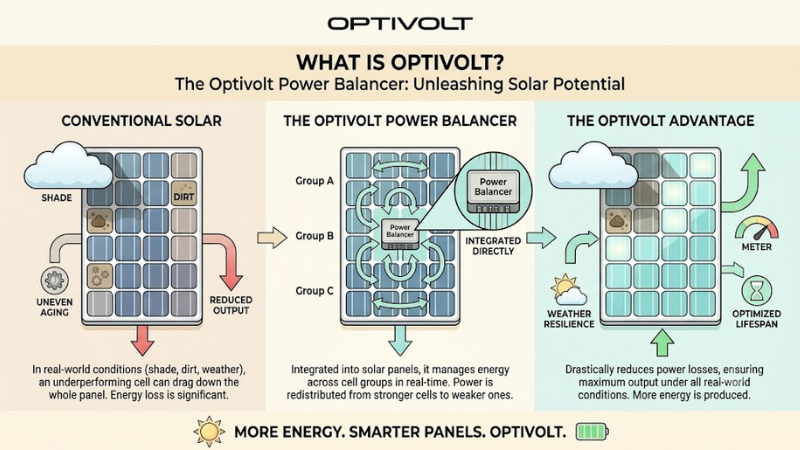
Optivolt develops power electronics that help solar panels produce more energy under real-world conditions. Its main product, the Power Balancer, is integrated directly into solar panels and manages energy across groups of solar cells.
Read More:Minnesota-Based Slingshot Insurance Raises $27M in Seed Funding
Conventional solar panels can lose output when some cells are affected by shade, dirt, weather, or uneven ageing. In these situations, one underperforming cell can reduce the output of a larger section of the panel.
Optivolt's Power Balancer is designed to address these issues by redistributing energy between cell groups in real time. This helps reduce power losses and allows panels to perform more effectively in changing conditions.
RECOMMENDED FOR YOU


How Much Funding Has Optivolt Raised?
Optivolt has raised $32 million in its Series A funding round, taking its total funding to $42 million.
The latest round was led by VXI Capital, with participation from RA Capital, Valo Ventures, and Atlas Innovate.
Who Invested in Optivolt’s Series A?
VXI Capital led Optivolt's $32 million Series A funding round.
The other participating investors were:
- RA Capital
- Valo Ventures
- Atlas Innovate
The funding will support the company's manufacturing expansion and wider deployment of its solar technology.
Why the Funding Matters
Optivolt plans to use the investment to expand manufacturing and bring its Power Balancer technology to more solar installations.
The company is targeting a range of projects, from individual homes to large utility-scale solar systems designed to help power AI data centres.
As solar adoption grows, improving the amount of energy generated under real-world conditions remains an important challenge. Optivolt's technology is designed to reduce losses caused by shading, dirt, and differences in cell performance.
Who founded Optivolt?
Optivolt was founded in 2017 by Rohit Kalyanpur. The company is headquartered in San Francisco, California.
It focuses on developing power electronics that can be integrated into solar panels to improve energy output and simplify the surrounding hardware.
“Solar became cheap enough to compete. I founded Optivolt to make it intelligent enough to power the world,” said Rohit Kalyanpur, founder and CEO of Optivolt. “For nine years, we’ve rebuilt the solar panel from first principles, embedding aerospace-grade power electronics so it can respond to Earth as it actually is, not the ideal conditions of a lab.
“At SunPower, we spent nearly three decades pushing the limits of how efficiently a solar panel could turn sunlight into electricity. Optivolt is attacking the other half of the problem: how much energy that panel actually delivers in the real world once it leaves the factory,” said Tom Werner, former CEO of SunPower and Optivolt investor.
Market and Business Growth
Optivolt has already shipped more than 20,000 solar panels incorporating its Power Balancer technology.
The company holds 19 issued patents and has 27 additional patent applications pending. These cover key elements of its panel-integrated power electronics architecture.
Optivolt has also received UL certifications covering its integrated junction-box enclosure, panel-integrated electronics, rapid-shutdown system, and solar-module safety.
What Happens Next?
Optivolt plans to increase production and expand the use of its Power Balancer across residential and utility-scale solar installations.
The company also aims to support larger solar projects, including installations intended to help meet the growing energy needs of AI data centres.
Read More:IDL Raises $15M in Series A Funding led by Elysian Park Ventures
Recommended Stories for You

Devin Jacobs Apr 17, 2024

Devin Jacobs Jul 2, 2026

Team SR Nov 8, 2024

Devin Jacobs Jun 19, 2026

Team SR Aug 23, 2024

Devin Jacobs May 27, 2026
Trending Stories

Yum! Brands Appoints Steve Bratspies to Board of Directors

Sweet Oak Acquires Whole Earth Brands

AlgoX2 Raises $10M in Seed Extension Funding Led by Fin Capital

Frost & Sullivan Appoints Janesh Janardhanan as Global Partner

NWS Appoints Dr. Louis J. Hutchinson III as Chief Executive Officer

[Funding alert] MaintainX Secures $50 Mn Funding led by Bain Capital Ventures

Electronics Manufacturer Rexel Acquires Illinois-Based GCG

California-Based CScale Raises $145M in Series C Funding

