

SUMMARY
- Xona raised $250 million in Series D funding.
- The funds will support expansion.
- Xona develops satellite navigation technology.
 Follow us
 Follow us
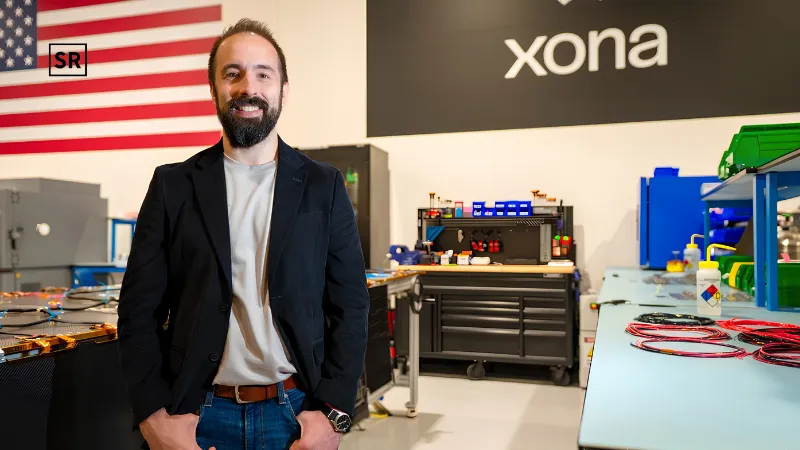
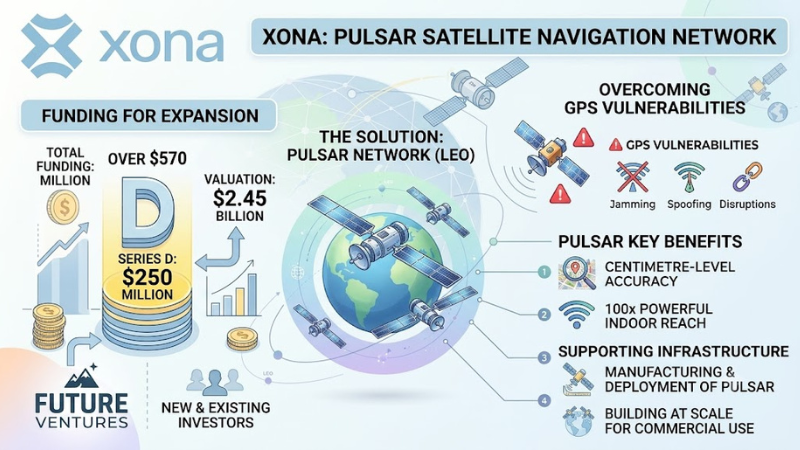
Xona, a Burlingame, CA-based company building global navigation infrastructure in Low Earth Orbit, has raised $250 million in a Series D equity funding round, bringing the total amount to over $570 million, at a $2.45B valuation.
The round was led by Future Ventures, with participation from new and existing investors.
The company will use the funding to launch its commercial navigation service, expand operations, and manufacture and deploy its satellite constellation at scale.
What is Xona?
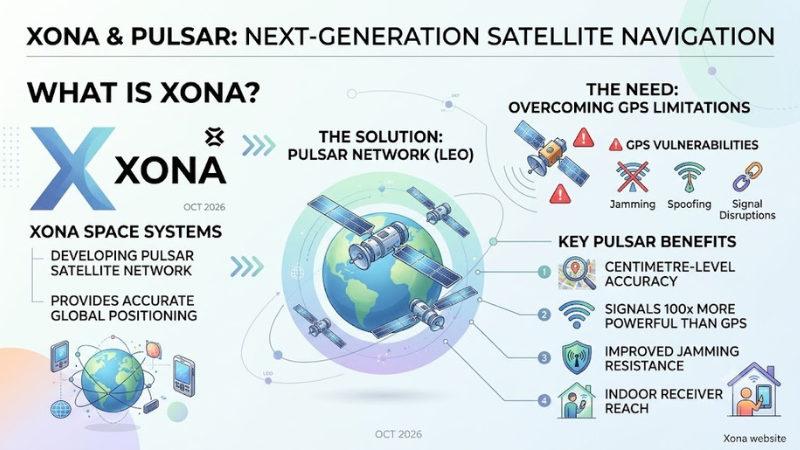
Xona is developing a satellite navigation network called Pulsar to provide accurate positioning services to devices around the world. The system is designed to offer an alternative to traditional GPS infrastructure.
Read More:Whop Raises $200M in Series D Funding at $5.1B Valuation
GPS is widely used in transportation, communications, financial systems, and other critical services. However, its signals can be vulnerable to jamming, spoofing, and other disruptions.
Xona's Pulsar network operates through satellites in Low Earth Orbit. It is designed to provide centimetre-level positioning accuracy, signals up to 100 times more powerful than GPS, and improved resistance to jamming. The company also says its signals can reach receivers indoors.
RECOMMENDED FOR YOU

Baker Hill Launches One-Click Loan Participation Exchange with Participate
Devin Jacobs
Jun 6, 2026

[Funding News] The Picklr Secures Series B Funding with a Valuation of $59 Mn
Team SR
Jun 21, 2024
How Much Funding Has Xona Raised?
Xona has raised $250 million in its Series D equity funding round, taking its total funding to over $570 million.
The latest round values the company at $2.45 billion. Future Ventures led the investment, with participation from new and existing investors.
Who Invested in Xona’s Series D?
Future Ventures led Xona's $250 million Series D funding round.
The round also included participation from new and existing investors. The company did not disclose the names of the other investors.
Why the Funding Matters
Xona plans to use the new capital to deliver its commercial navigation service and increase its operational capacity.
The funding will also support the manufacturing and deployment of its Pulsar satellite constellation. Building satellites at scale is an important step in expanding the network and preparing it for wider commercial use.
The investment comes as Xona moves from technology demonstrations towards deploying its commercial navigation service.
Who founded Xona?
Xona was founded by Brian Manning, Tyler Reid, and Adrien Perkins.
The company is headquartered in Burlingame, California, where it has started expanding its in-house satellite production capabilities.
“The last several years were about proving that a commercial company could build a fundamentally better navigation system. Now we're putting that system into operation,” said Brian Manning, Co-founder and CEO of Xona.
“The pace of innovation at Xona is remarkable,” said Steve Jurvetson, co-founder of Future Ventures. “In just over a year, the company has advanced from a validation mission to deploying the foundation of an entirely new global navigation network.
Market and Business Growth
Over the past year, Xona has moved from an initial technology demonstration to the early deployment of its commercial navigation network.
The company secured the first and only Federal Communications Commission (FCC) authorization for a private navigation constellation operating alongside government global navigation satellite systems.
In October 2026, Xona completed its largest satellite launch to date, deploying six new Pulsar satellites.
Four of the satellites are expected to support initial beta service in multiple countries beginning in early 2027. The other two were designed and manufactured entirely in-house and will be used to validate the architecture needed to scale the full constellation.
What Happens Next?
Xona plans to expand its commercial navigation network, increase satellite production, and prepare for larger-scale deployment.
The four satellites designated for beta service are expected to begin supporting users in multiple countries in early 2027. The company will also use the two internally developed satellites to validate its approach to scaling the constellation.
Read More:California-Based Familiar Therapeutics Raises $5M in Seed Funding
Recommended Stories for You

Devin Jacobs Mar 6, 2026

Devin Jacobs May 11, 2026

Startuprise Jan 15, 2026

Devin Jacobs Aug 21, 2026

Devin Jacobs Jul 14, 2026

Devin Jacobs Jul 7, 2026
Trending Stories

Sweet Oak Acquires Whole Earth Brands

AlgoX2 Raises $10M in Seed Extension Funding Led by Fin Capital

Frost & Sullivan Appoints Janesh Janardhanan as Global Partner

NWS Appoints Dr. Louis J. Hutchinson III as Chief Executive Officer

[Funding alert] MaintainX Secures $50 Mn Funding led by Bain Capital Ventures

Electronics Manufacturer Rexel Acquires Illinois-Based GCG

California-Based CScale Raises $145M in Series C Funding

The Toro Company Elects David Huml to the Board of Directors

