

SUMMARY
- Circularity Fuels raised $7 million in seed funding.
- The funds will support plant construction and expansion.
- Circularity Fuels converts organic waste into renewable fuels.
 Follow us
 Follow us
Circularity Fuels, a Redwood City, CA-based provider of a renewable fuels technology platform, has raised $7 million in a seed funding round, bringing the total amount to $17 million (including grants from ARPA-E and the National Science Foundation).
The round was led by Trucks and DCVC, with participation from Sum Ventures and Automotive Ventures.
The company will use the funding to build a demonstration plant, complete the design of a commercial facility and secure airline fuel contracts.
What is Circularity Fuels?
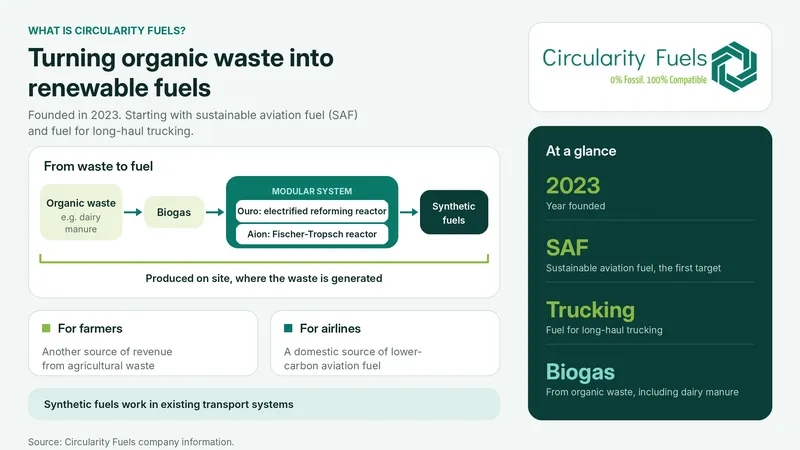
Founded in 2023, Circularity Fuels develops technology that converts waste materials into renewable fuels, starting with sustainable aviation fuel (SAF), and fuel for long haul trucking.
Read More:Zipline Raises $1.5B in Funding at $21.5B Valuation
The company uses biogas produced from organic waste, including dairy manure, as a raw material for making liquid fuels. Its modular systems are designed to produce fuel directly where the waste is generated.
The technology combines two key components: the electrified Ouro reforming reactor, and the Aion Fischer Tropsch synthesis reactor. Together, they convert biogas into synthetic fuels that can be used in existing transport systems.
This approach aims to provide farmers with another source of revenue from agricultural waste while giving airlines access to a domestic source of lower-carbon aviation fuel.
RECOMMENDED FOR YOU


[Fundinga alert] CO-based Synergy Spine Solutions Secures $30Million in Funding
Devin Jacobs
Feb 1, 2024
How Much Funding Has Circularity Fuels Raised?
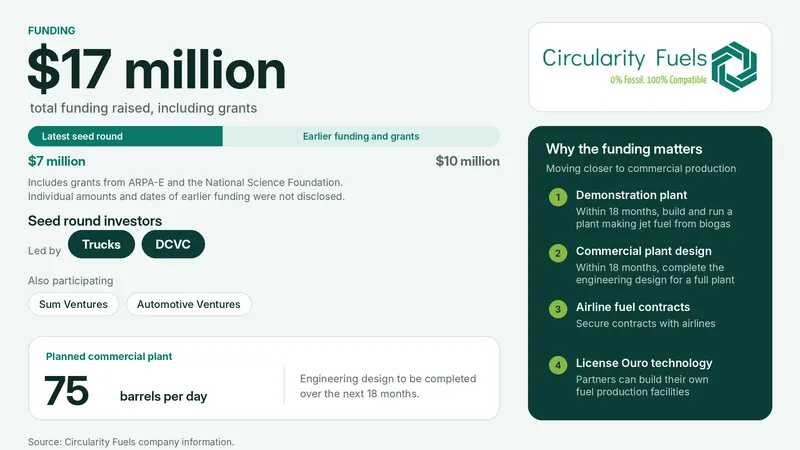
Circularity Fuels has raised $17 million in total funding, including its latest $7 million seed round.
The total also includes grants from ARPA-E and the National Science Foundation. The company has not disclosed the individual amounts or dates of its earlier funding.
Who Invested in Circularity Fuels’ Seed Round?
The seed round was led by Trucks and DCVC.
Other participating investors include Sum Ventures and Automotive Ventures.
Why the Funding Matters
Circularity Fuels will use the funding to move its technology closer to commercial production.
Over the next 18 months, the company plans to build and operate a demonstration plant that produces jet fuel from biogas. It will also complete the engineering design for a commercial plant with a capacity of 75 barrels per day.
The company plans to secure airline fuel contracts and begin licensing its Ouro reactor technology to partners interested in building their own fuel production facilities.
Who founded Circularity Fuels?
Circularity Fuels was founded in 2023 by Stephen Beaton, Fergus Noble and Gaurav Kamat. The company is headquartered in Redwood City, California.
“Every dairy already has the feedstock. What’s been missing is a way to turn it into jet fuel that makes economic sense for the farmer and the airline,” said Dr. Stephen Beaton, Founder and CEO of Circularity Fuels. “This funding lets us run our process at demonstration scale and design our first commercial plant.
Market and Business Growth
In June, Circularity Fuels announced that it had converted raw dairy biogas into jet fuel meeting ASTM D7566 Annex A1 specifications. The result was validated through a six month pilot at a dairy facility near Madera, California.
The company estimates that its commercial plants could have capital costs of around one-fifth of those of jet fuel plants currently under construction in Europe.
Circularity Fuels has also advanced to Phase 2 of the US Department of Agriculture's review process for a loan guarantee under its Section 9003 Biorefinery, Renewable Chemical, and Biobased Product Manufacturing Assistance Program. The program supports commercial biorefineries through federal loan guarantees.
What Happens Next?
Circularity Fuels plans to build and operate its demonstration plant, complete the design of its 75-barrel-per-day commercial facility and secure airline fuel contracts.
It will also begin licensing its Ouro reactor technology to partners as it works to expand the production of renewable fuels from waste materials.
Recommended Stories for You

Devin Jacobs Jul 8, 2026

Devin Jacobs Apr 29, 2026

Devin Jacobs Aug 27, 2026

Devin Jacobs Jan 29, 2024

Devin Jacobs Feb 12, 2026

Startuprise May 17, 2025
Trending Stories

Group 1001 Insurance Appoints George Haj as Chief Communications Officer

Henrico-based At Home Harmony Secures $5M in Funding

Defense Tech Startup Furientis Secures $25M in Seed Funding
EVIDENT Completes Acquisition of CrestOptics

Loyal Raises $100M in Series C Funding

Adaption Labs Raises $50M in Seed Funding

Golden Child Raises $37M in Funding by Redpoint Ventures

[Funding alert] CA-based Encore Consumer Capital Secures Encore Consumer Capital Fund IV at $258M

