


SUMMARY
- Peppermint raised $4.7M in Seed funding.
- Funds will support platform expansion.
- Peppermint automates billing for clinical research teams.
 Follow us
 Follow us
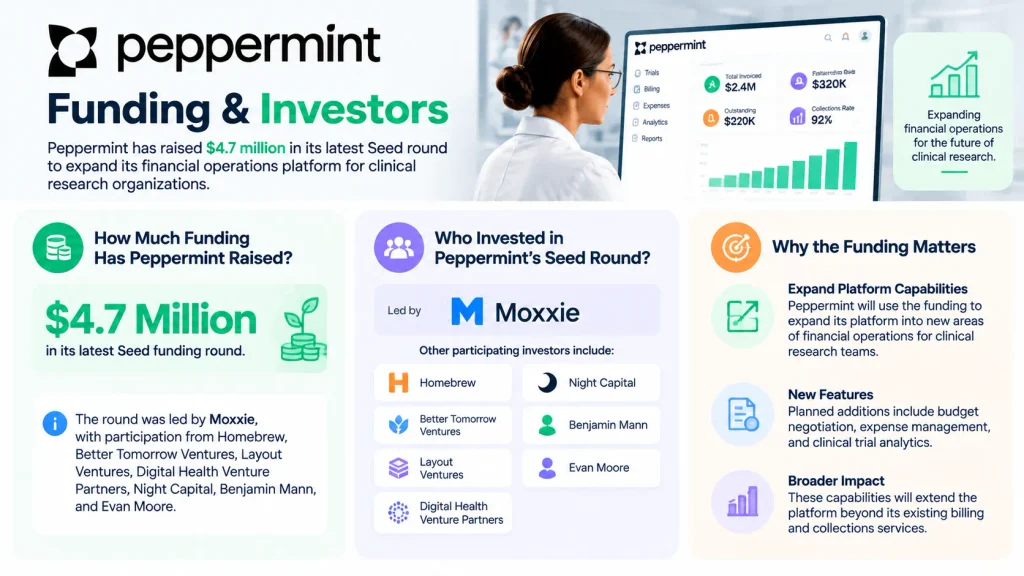
Peppermint, a San Francisco, CA-based provider of an AI-powered financial operations platform for clinical research teams, has raised $4.7 million in a Seed funding round led by Moxxie.
The round also saw participation from Homebrew, Better Tomorrow Ventures, Layout Ventures, Digital Health Venture Partners, Night Capital, Benjamin Mann, and Evan Moore.
The company will use the funding to expand its platform beyond collections into budget negotiation, expense management, and clinical trial analytics.
What is Peppermint?
Peppermint provides an AI-powered financial operations platform designed specifically for clinical research organizations and hospital research teams.
Read More:Tim Heidel Co-Founded Veir Raises $110M in Series C Funding
The platform automates billing and collections by collecting data from clinical trial management software, checking it against trial contracts and payment histories, generating invoices, and following up on outstanding payments.
Peppermint combines AI technology with human billing specialists to reduce manual work and improve invoice accuracy. Its system helps research organizations reduce payment disputes, manage revenue more efficiently, and spend more time conducting clinical trials.

How Much Funding Has Peppermint Raised?
Peppermint has raised $4.7 million in its latest Seed funding round.
The round was led by Moxxie, with participation from Homebrew, Better Tomorrow Ventures, Layout Ventures, Digital Health Venture Partners, Night Capital, Benjamin Mann, and Evan Moore.
Who Invested in Peppermint’s Seed Round?
The $4.7 million Seed round was led by Moxxie.
Other participating investors include:
- Homebrew
- Better Tomorrow Ventures
- Layout Ventures
- Digital Health Venture Partners
- Night Capital
- Benjamin Mann
- Evan Moore
Why the Funding Matters
Peppermint will use the funding to expand its platform into new areas of financial operations for clinical research teams.
Planned additions include budget negotiation, expense management, and clinical trial analytics. These capabilities will extend the platform beyond its existing billing and collections services.
Who founded Peppermint?
Peppermint was founded in 2026 by David Freeman and VJ Thurimella.
The company is headquartered in San Francisco, California. Its founders have experience building payments and reconciliation infrastructure at Robinhood and X1.
“At X1 and Robinhood, we helped build systems designed for precision and scale, to process billions of dollars every year,” said Freeman. “We’re bringing that architecture to clinical research, converting earnings into friction-free collections that also provide CROs and sponsors with cleaner data from the source.”
"There is no standard financial infrastructure for clinical trial billing today — every dollar a site is owed has to be reconstructed by hand from disconnected systems," said Alex Roetter, Managing Director and General Partner at Moxxie.
Market and Business Growth
Peppermint reports that its platform has helped partners collect revenue three times faster and reduce overdue invoices by threefold. It has also helped research organizations reclaim 20% of staff time previously spent on billing.
The number of studies managed through the platform tripled in three months, reflecting growing demand from clinical research teams and hospital systems.
The platform is designed to provide a continuous, auditable record of clinical visits, invoices, and payments owed to research sites.

RECOMMENDED FOR YOU


[Funding news] CA-based ApertureData Secures $8.25Million in Seed Funding
Team SR
Oct 15, 2024

Blue Yonder deaclares an Agreement To Acquire One Network Enterprises
Devin Jacobs
Mar 30, 2024
What Happens Next?
Peppermint plans to expand its platform beyond collections by adding budget negotiation, expense management, and clinical trial analytics.
The company will continue developing its AI-powered financial operations tools to help clinical research organizations automate billing, improve collections, and manage their finances more efficiently.
Recommended Stories for You

Devin Jacobs Feb 5, 2024

Devin Jacobs Sep 1, 2026

Devin Jacobs Jul 8, 2026

Devin Jacobs Jan 10, 2024

Devin Jacobs Aug 20, 2026

Devin Jacobs Jan 29, 2024
Trending Stories

[Funding News] Decagon Secures $100 Mn Series B Funding

California-Based Nex Raises $150M in Funding Round

Haystack Robotics Raises $3.95M in Series A Funding Round

California-Based Prosper Medical Scores $16M in Funding Round

California-Based Opal Therapeutics Receives $1.25M Investment

Fintech Startup TabaPay Raises $155M in Funding

[Funding News] Kailera Therapeutics Launches with $400 Mn Series A Funding
Databricks Closes Over $7 Billion Equity and Debt Financing

