

AGI Explained: How Artificial General Intelligence Could Change AI
Oct 3, 2026 | By Devin Jacobs
 Follow us
 Follow us
Artificial intelligence has become part of everyday life. We use AI to summarize documents, generate content, recognize images, answer questions, and automate many different tasks.
But most of today’s AI systems are still built for particular jobs.
A system that is excellent at understanding language may not know how to operate a robot. A model trained to recognize objects in images cannot automatically build a website or solve an unrelated problem without the right training.
This is where artificial general intelligence, or AGI, comes in.
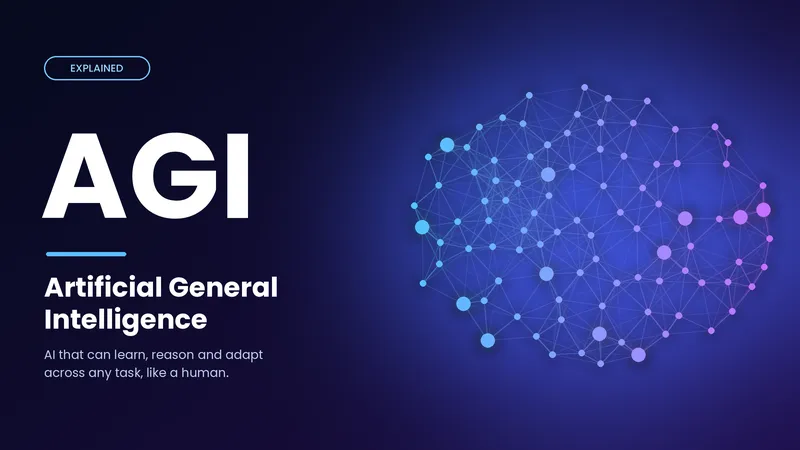
AGI is a theoretical idea of AI that could learn, understand, and solve problems across many different areas in a way that is closer to human intelligence. Instead of being designed for one narrow purpose, an AGI system would be expected to handle unfamiliar tasks, learn new skills, and adapt to situations it was not specifically trained for.
So, what exactly makes AGI different from the AI tools we use today?
What Is Artificial General Intelligence?
Artificial general intelligence is a field of theoretical AI research focused on creating software with broad, human-like intellectual abilities.
The basic idea is simple: instead of building separate AI systems for separate tasks, researchers want to develop a system that can understand and learn across different areas.
For example, today’s AI might be trained specifically to summarize text, generate images, or recognize objects. An AGI system, in theory, could move between these kinds of tasks without needing to be separately developed for each one.
It would also be able to learn new skills and deal with problems that were not part of its original training.
The source describes AGI as a theoretical concept and research goal, meaning human-level AGI has not been established as an existing technology.
How Is AGI Different From Today’s AI?
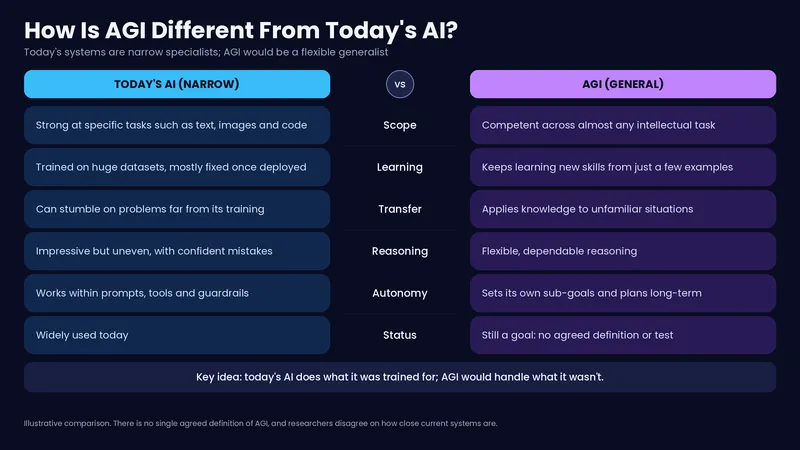
The biggest difference comes down to scope.
Most AI systems are designed around a particular set of capabilities. Even highly advanced models still operate within the limits of their training, architecture, and intended use.
AGI, on the other hand, is intended to work across different domains and handle unfamiliar problems with much less manual intervention.
| Feature | Current AI | AGI |
| Main purpose | Usually designed for specific tasks | Designed for broad, general problem-solving |
| Learning | Often needs relevant training or fine-tuning | Expected to learn new skills more independently |
| Scope | Usually limited to particular domains | Intended to work across many domains |
| Adaptability | Depends on the system and its training | Expected to adapt to unfamiliar situations |
| Status | Widely used today | Theoretical research goal |
Think of it this way: a specialized AI can be an excellent expert in one area, while AGI is imagined as a system capable of becoming competent across many areas.
What Is the Difference Between Narrow AI and AGI?
You may also hear the terms weak AI, narrow AI, and strong AI when AGI is discussed.
Weak or narrow AI refers to systems designed to perform specific tasks. They can be highly capable, but their abilities remain limited to what they were built and trained to do.
For example, an AI system built for image recognition is not automatically capable of performing an unrelated task such as website development.
Strong AI is commonly used to describe a more general form of artificial intelligence, and the source connects this idea with AGI. A strong AI system would be expected to perform tasks at a human cognitive level without requiring extensive task-specific background knowledge.
The difference is therefore not simply about how powerful an AI system is. It is about how broadly that intelligence can be applied.
What Would AGI Be Able to Do?
There is no single confirmed list of capabilities because AGI remains theoretical.
However, the research goal described in the source involves several abilities associated with general human intelligence.
An AGI system would ideally be able to:
- Learn new skills
- Solve unfamiliar problems
- Transfer knowledge between different areas
- Understand different types of information
- Adapt to changing situations
- Work across multiple domains
- Learn without requiring separate development for every new task
The broader goal is to create a system that can operate beyond a narrow set of predefined tasks and apply what it learns in new contexts.
What Approaches Are Researchers Using to Develop AGI?
There is no single agreed path to AGI.
Researchers have explored several theoretical approaches, each based on a different view of how intelligence might be represented and reproduced in machines.
How Does the Symbolic Approach Work?
The symbolic approach represents knowledge using logic and structured relationships.
In simple terms, the idea is to represent concepts and objects through logical systems, often using rules similar to if-then reasoning.
This approach can help machines represent ideas in a structured way, but the source notes that symbolic representation has difficulty reproducing some of the more subtle cognitive abilities associated with human perception.
What Is the Connectionist Approach?
The connectionist approach, sometimes called the emergentist approach, is inspired by the structure of the human brain.
It focuses on neural networks and the idea that complex intelligence can emerge from large networks of interconnected processing units.
AI systems that analyze and comprehend natural language use neural-network techniques, which include large language models.
What Does the Universalist Approach Mean?
Universalist approaches focus on the computational side of intelligence.
Researchers following this direction try to develop theoretical solutions that can potentially be applied more broadly to practical AGI systems.
The goal is to understand intelligence at a level that can be translated into systems capable of handling many different problems.
What Is Whole Organism Architecture?
Whole organism architecture takes a different route.
This method investigates the potential for integrating AI systems with tangible human body models. The theory is that direct interaction with the physical environment may be necessary for certain aspects of intelligence.
Under this view, learning through physical experience could be an important part of achieving broader intelligence.
What Is the Hybrid Approach?
The hybrid approach combines ideas from different methods.
Instead of relying entirely on symbolic reasoning or neural networks, researchers may explore ways of bringing multiple principles together.
The goal is to take advantage of the strengths of different approaches and move beyond the limitations of using just one method.
What Technologies Are Supporting AGI Research?
AGI may still be a distant research goal, but several technologies are contributing to the broader field of AI.
The source highlights deep learning, generative AI, natural language processing, computer vision, and robotics.
How Does Deep Learning Support AGI Research?
Deep learning uses neural networks with multiple layers to identify complex patterns in data.
It can be used to process information such as text, audio, images, and video. These capabilities are important because a more general form of intelligence would need to work with different types of information rather than relying on just one input type.
What Role Does Generative AI Play in AGI?
Generative AI is a branch of deep learning that can create new content based on patterns learned from large datasets.
Modern generative AI systems can produce text, images, audio, and other types of content. Their ability to respond to natural-language instructions has made them an important part of current AI research and development.
Generative AI is not the same thing as AGI, but its growing capabilities are relevant to researchers exploring more general forms of machine intelligence.
Why Is Natural Language Processing Important?
Natural language processing, or NLP, helps computers understand and generate human language.
Language is one of the main ways people communicate ideas, ask questions, explain problems, and share knowledge. Because of that, the ability to process language naturally is an important part of building systems that can interact with people and understand instructions.
How Could Computer Vision Help AGI?
RECOMMENDED FOR YOU



Most Valuable Latin American Brands by Brand Value in 2026
Devin Jacobs
Sep 28, 2026
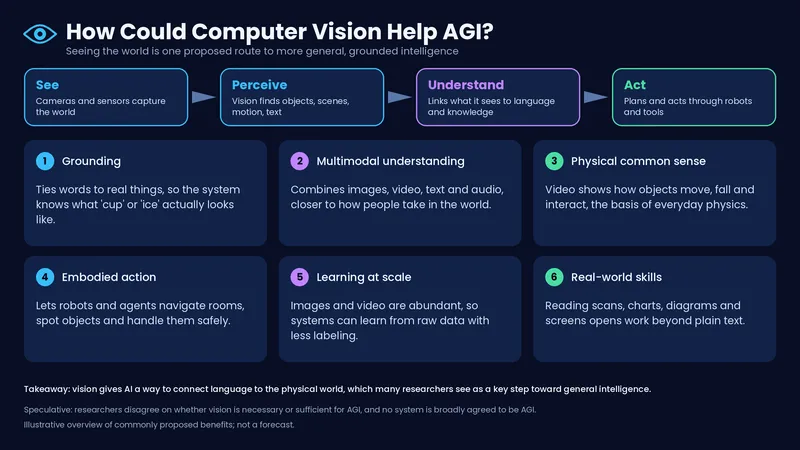
Computer vision allows machines to process and understand information from images and other visual data.
This can involve recognizing objects, analyzing scenes, and interpreting spatial information. Such abilities could become important for an AI system that needs to understand and interact with the real world.
Why Is Robotics Important for AGI?
Robotics gives AI a physical presence.
A robot can sense its environment, move around, manipulate objects, and respond to what is happening around it. The source suggests that robotics could play an important role in giving AGI the ability to perceive and act in the physical world.
For example, a sufficiently advanced intelligent robot might eventually be able to identify an object, understand what needs to be done with it, and carry out a physical task without detailed instructions for every step.
What Are the Biggest Challenges in Building AGI?
Building a machine with broad human-like intelligence is much more difficult than teaching a system to perform one specific task.
Researchers still face major challenges involving reasoning across domains, emotional intelligence, perception, and physical interaction.
Why Is It Difficult for AI to Connect Knowledge Across Different Areas?
Humans regularly take something learned in one situation and apply it somewhere completely different.
For example, an idea from education might be used in game design, or knowledge learned in a classroom might help solve a real-world problem.
Today's AI systems can struggle with this kind of flexible transfer because they often depend heavily on the data and tasks they were trained for.
Creating systems that can reliably connect knowledge across unrelated domains remains a major challenge.
Can AGI Have Emotional Intelligence?
Emotional intelligence is another difficult area.
Humans do not respond to conversations based only on the words being spoken. We also consider tone, context, emotions, social cues, and personal experiences.
The source argues that current deep-learning systems have not demonstrated the full form of creativity and emotional thinking associated with humans.
An AI can generate a convincing response, but producing language that sounds emotional is not necessarily the same as experiencing or understanding emotions in the human sense.
Why Is Human-Like Sensory Perception Difficult?
People understand the world through multiple senses.
We see shapes and colors, hear sounds, feel textures, smell things, and interact with objects physically. Building machines that can reliably combine all of these forms of perception remains challenging.
The source notes that current computer systems still need further advances before they can reproduce human-like understanding of these sensory experiences.
Is AGI Available Today?
AGI, as described in the source, remains a theoretical research goal.
Current AI can perform increasingly impressive tasks, but this should not automatically be treated as proof that a human-level general intelligence has been achieved. The source specifically describes AGI as a concept researchers are still working toward.
That distinction is important because impressive performance in one area is not necessarily the same as broad, adaptable intelligence across many areas.
How Can Businesses Prepare for Advances in AI Research?
Businesses do not need to wait for AGI to benefit from current AI technologies.
Organizations can already use AI for content generation, data analysis, customer support, software development, document processing, image analysis, and many other applications.
The source also points to cloud-based tools such as Amazon Bedrock, Amazon SageMaker JumpStart, and EC2 UltraClusters for organizations developing and scaling AI applications.
The practical approach is to focus on real business problems first and then choose the technology that fits the job.
Conclusion
AGI is one of the most ambitious ideas in artificial intelligence.
Instead of creating separate systems for separate tasks, researchers are exploring whether machines could eventually learn, reason, adapt, and solve problems across many different areas in a more general way.
A great deal of work remains to be done. From neural networks and symbolic reasoning to hybrid systems and physical engagement via robots, researchers are still investigating various strategies.
However, issues Such as emotional intelligence, information transmission, and sensory perception are still unsolved.
FAQs
What is the difference between AI and AGI?
Is AGI available today?
What is narrow AI?
What is strong AI?
What are the main challenges of AGI?
Why is robotics important for AGI?
Can generative AI be considered AGI?
Recommended Stories for You

Devin Jacobs Dec 11, 2025

Devin Jacobs Jul 27, 2026

Devin Jacobs Jun 18, 2026

Devin Jacobs Dec 29, 2023

Devin Jacobs Dec 30, 2025

Devin Jacobs Dec 26, 2025
Trending Stories
Most Valuable Latin American Brands by Brand Value in 2026

How to Set Up a Pet Sitting Business in the U.S. in 2026
Star Google researcher Noam Shazeer joins OpenAI in a coup for ChatGPT creator

History of Artificial Intelligence: From Early Machines to Modern AI

How to Start a Mobile Business in the US
Common Startup Mistakes and How to Avoid Them

How to Stop Apps From Starting Automatically in Windows

How can we tackle AI’s financial risks?

