

Future of AI: How Artificial Intelligence Could Transform the Next 10 Years
Oct 6, 2026 | By Devin Jacobs
 Follow us
 Follow us
Artificial intelligence has already changed the way people work, communicate, learn, and solve problems. But the technology is still developing quickly, and the next 10 years could bring an even bigger shift.
By 2034, AI is expected to become less like a separate tool that people open when they need it and more like something built into everyday technology and business processes. AI is becoming more widely available, powerful, and deeply ingrained in everyday life, from multimodal assistants and AI agents to smaller models, automated systems, and new computing technologies.
At the same time, there will be serious questions around privacy, regulation, energy use, jobs, misinformation, and the reliability of AI-generated information.
Here is what the future of AI could look like over the next decade.
1. Multimodal AI Will Become the Norm
Today’s AI systems are becoming much better at working with different types of information. The next step is broader use of multimodal AI, which can work across text, images, audio, video, and other forms of data.
Instead of communicating with an AI only through written prompts, people may be able to speak naturally, show it an image, share a video, or combine several types of information in one interaction.
This could make AI assistants feel much more natural.
For example, a user could show an AI a technical problem through a photograph, explain the situation verbally, and receive a written explanation along with visual instructions.
The source expects multimodal AI to become much more mature by 2034, creating more intuitive interactions between people and computers.
2. AI Models Will Become Smaller and More Efficient
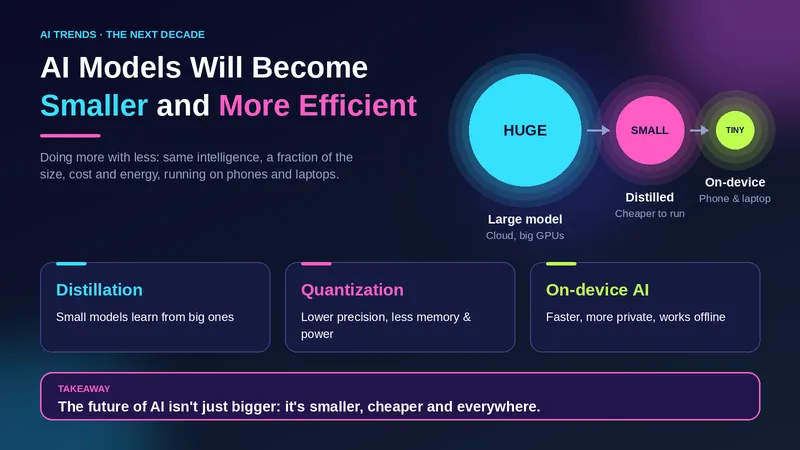
Bigger does not always mean better.
The AI industry is already exploring smaller models that can deliver useful results while requiring fewer computing resources. Smaller models can be cheaper to operate and easier to deploy in specific environments.
This could make AI more practical for businesses that cannot afford enormous computing infrastructure.
Smaller models may also become useful on devices such as smartphones and other connected products, reducing the need to send every request to a large centralized system.
The future may therefore include a mix of very powerful large models and smaller specialized models designed for particular tasks.
3. AI Will Become Easier for Ordinary People to Build
You may not need to be an AI engineer to create an AI-powered application in the future.
No-code and low-code platforms are expected to make AI development more accessible. Users might depend on models, APIs, drag-and-drop components, and guided workflows.
This could open the door for small businesses, educators, entrepreneurs, and individual developers to create their own AI solutions.
For businesses, that could mean developing customized tools for specific departments without building an entire AI team from the ground up.
AutoML and cloud-based AI services are also expected to make model development and deployment easier.
4. AI Agents Could Handle More Complete Tasks
One of the biggest changes may come from agentic AI.
A traditional AI assistant might answer a question or generate content. An AI agent can go further by interacting with systems, using data, making decisions, and completing multiple steps toward a goal.
For example, a customer-support system could classify a customer’s issue, retrieve account information, investigate the problem, and help formulate a solution.
Different specialized agents could handle different parts of a workflow while working alongside a broader AI system.
The source suggests that by 2034, agentic AI could become an important part of business operations and everyday technology.
This could change the way companies think about automation. Instead of automating one isolated task at a time, businesses may be able to automate entire workflows.
5. AI Could Become a Business Decision Partner
AI may also move deeper into management and strategic planning.
Future AI systems could analyze real-time business information, identify patterns, model possible outcomes, and provide recommendations to executives.
For example, an AI system might help a company evaluate financial scenarios, understand customer behavior, or consider different business strategies.
The important difference is that AI would not simply provide a report after being asked. It could continuously monitor information and highlight changes that deserve attention.
The source describes a future in which AI systems could act as strategic partners for executives while supporting planning, prediction, and complex decision-making.
Human leadership would still matter, but AI could provide much more information and analysis to support those decisions.
6. Customized AI Will Become More Important
Not every business needs the same AI system.
A bank, hospital, manufacturer, retailer, and software company all work with different data and have different requirements.
That is why customized AI models are expected to become increasingly important.
Organizations can use their own proprietary data to build or adapt AI systems for specific purposes, such as customer service, content generation, forecasting, or process optimization.
A specialized system with strong knowledge of a company’s own information may be more useful for a particular task than a general-purpose AI model.
However, this also makes data quality increasingly important. Poor-quality data can lead to poor AI results, so organizations will need stronger processes for maintaining reliable and diverse datasets.
7. AI Hardware Will Keep Evolving
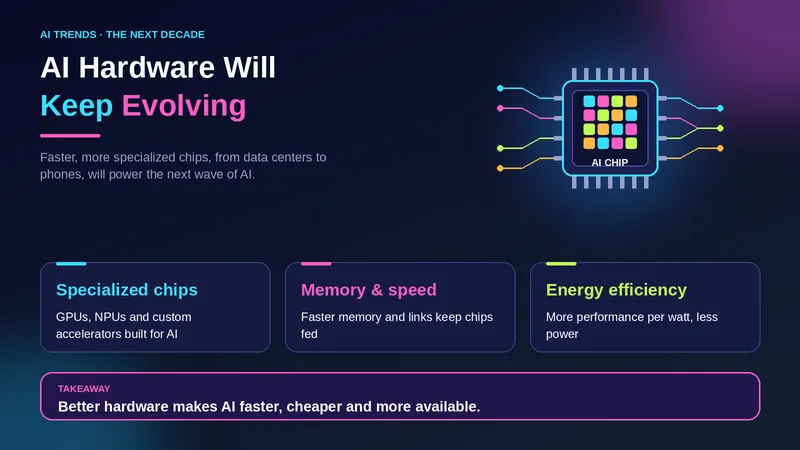
More capable AI requires more computing power.
Training and running large AI models can require enormous amounts of computing resources, energy, and infrastructure. That pressure is encouraging researchers to explore new hardware and computing approaches.
The source discusses several possibilities, including specialized AI hardware, quantum computing, neuromorphic computing, and optical computing.
These technologies are still developing, so their future impact is uncertain. But the underlying challenge is clear: AI systems are becoming increasingly demanding, and conventional computing approaches may not be enough for every future workload.
8. Quantum Computing Could Open New Possibilities
Quantum AI is another area that could become important over the next decade.
Quantum computers work differently from traditional computers and use the properties of quantum systems to approach certain problems in new ways.
The source suggests that quantum AI could eventually help with areas such as complex material simulations, supply-chain optimization, and scientific research.
However, this is a forward-looking possibility rather than a guaranteed outcome. Much of the technology is still being developed.
If quantum computing reaches the level needed for practical AI applications, it could change what kinds of problems researchers can tackle.
9. AI Regulation Will Become More Important
As AI becomes part of more important systems, governments and organizations will need clearer rules.
AI can influence decisions in areas such as healthcare, finance, employment, and critical infrastructure. That creates risks involving bias, privacy, security, transparency, and accountability.
The next decade is therefore likely to bring more detailed AI regulations and governance frameworks.
The source points to approaches such as risk-based regulation, where higher-risk AI systems face stronger requirements for transparency, robustness, cybersecurity, and human oversight.
The goal will be to find a balance between encouraging innovation and protecting people from harmful uses of the technology.
10. AI Will Change the Workplace
AI-powered automation will continue to affect jobs.
Some repetitive tasks may increasingly be handled by software, robots, and AI systems. Data entry, routine customer service, and certain repetitive operational tasks are examples of areas that could experience significant automation.
But automation can also create new roles.
As businesses adopt more AI, they will need people who can develop, maintain, monitor, secure, and govern these systems.
This means the workplace may not simply become a place where humans compete against AI. Instead, many jobs could change as people work alongside AI tools.
Reskilling will become increasingly important as employees learn how to work effectively with new technology.
11. Synthetic Data Could Help Solve Data Challenges
AI models need large amounts of data, but high-quality human-generated data is not unlimited.
One possible solution is synthetic data, which is artificially generated to resemble real-world information.
Businesses and researchers can potentially use synthetic datasets to supplement training data while reducing some of the limitations associated with collecting real-world information.
The source also points toward greater use of data from IoT devices, simulations, and other sources.
At the same time, organizations will need to pay close attention to the quality and reliability of both real and synthetic data.
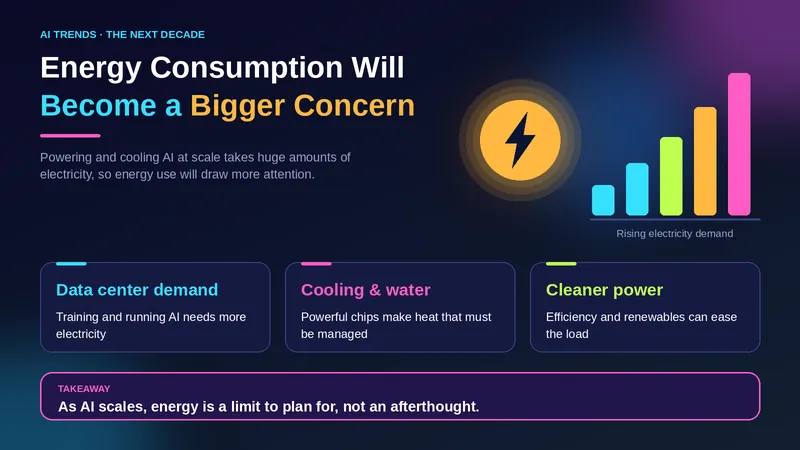
12. Energy Consumption Will Become a Bigger Concern
RECOMMENDED FOR YOU

What Companies Does Bill Gates Own? Complete List of His Investments and Businesses
Devin Jacobs
Jul 27, 2026
AI’s growth comes with an environmental cost.
Training and running large models requires substantial computing power, which means more electricity consumption.
That creates an interesting contradiction: AI can help optimize energy use and support climate-related work, while the infrastructure needed to run AI can itself increase energy demand.
Over the next decade, companies and researchers will likely put greater emphasis on efficient models, specialized hardware, renewable energy, and smarter computing infrastructure.
13. AI Could Become More Distributed
AI may not always depend on centralized data centers.
There is a central location when there is a central location where there is a central location.
For some applications, this strategy might lower latency and enhance privacy.
For example, a device could process sensitive information locally and share only the necessary insights rather than sending the entire dataset elsewhere.
14. Trust Will Become Just as Important as Intelligence
AI systems can be extremely capable and still make mistakes.
Generative AI can produce incorrect information, biased outputs, or misleading content. Deepfakes and AI-generated misinformation could make it harder for people to distinguish genuine information from fabricated material.
The source also discusses the possibility of businesses facing financial and reputational risks from AI hallucinations.
That means future AI development will not be only about making models smarter.
It will also be about making them more reliable, transparent, secure, and easier to supervise.
What Could AI Look Like in 2034?
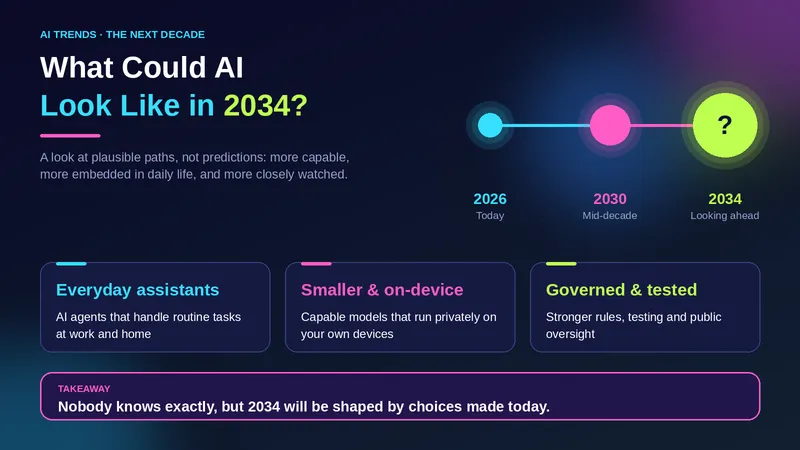
Imagine starting your day with an AI assistant that already understands your schedule, preferences, and immediate needs.
It could help organize your day, manage routine tasks, provide information, and interact with other digital services.
At work, an AI partner could summarize important developments, help with repetitive tasks, search company information, and provide useful insights.
For learning, it could create personalized explanations, tutorials, and other educational material based on how you learn best.
This kind of future may sound ambitious today, but the underlying technologies are already developing. The major question is how quickly they mature and how responsibly they are deployed.
Conclusion
The next 10 years of AI will probably be less about one revolutionary invention and more about many technologies coming together.
Multimodal AI could make interaction more natural. Smaller models could make AI cheaper and easier to deploy. Workflows could be fully automated by AI agents. Businesses could benefit more from customised models, and new hardware could assist get over processing constraints.
At the same time, AI will bring difficult challenges involving jobs, energy consumption, misinformation, privacy, regulation, and trust.
The organizations and individuals that prepare for that change thoughtfully—not simply by adopting every new tool, but by understanding where AI genuinely helps—will be in a much stronger position as the next decade unfolds.
FAQs
What will AI look like in the next 10 years?
What is the future of generative AI?
How will businesses use AI in the future?
What role will multimodal AI play in the future?
Will AI become more personalized?
Recommended Stories for You

Kuldeep Jangid Oct 2, 2026
Devin Jacobs Oct 3, 2026

Devin Jacobs Sep 24, 2026

Devin Jacobs Dec 30, 2025

Devin Jacobs Dec 11, 2025

Devin Jacobs Dec 6, 2025
Trending Stories

How to Set Up a Pet Sitting Business in the U.S. in 2026
History of Artificial Intelligence: From Early Machines to Modern AI
Star Google researcher Noam Shazeer joins OpenAI in a coup for ChatGPT creator

How to Start a Mobile Business in the US
How to Stop Apps From Starting Automatically in Windows
How can we tackle AI’s financial risks?

Common Startup Mistakes and How to Avoid Them
What Companies Does Bill Gates Own? Complete List of His Investments and Businesses

