

SUMMARY
- Vinci raised $250M in Series B funding.
- Funds will support its expansion into new engineering areas.
- Vinci builds AI tools for hardware design.
 Follow us
 Follow us
Vinci, a Palo Alto, CA-based provider of an AI-native computational platform for hardware engineering, has raised $250 million in a Series B funding round at a $1.5B valuation.
The round was co-led by Advent, Temasek and Xora, with participation from AMD Ventures, Eclipse, Khosla Ventures, Madrona and others.
The company plans to use the funding to expand its technology beyond semiconductor physics into more physical phenomena, engineering disciplines and hardware industries.
What is Vinci?
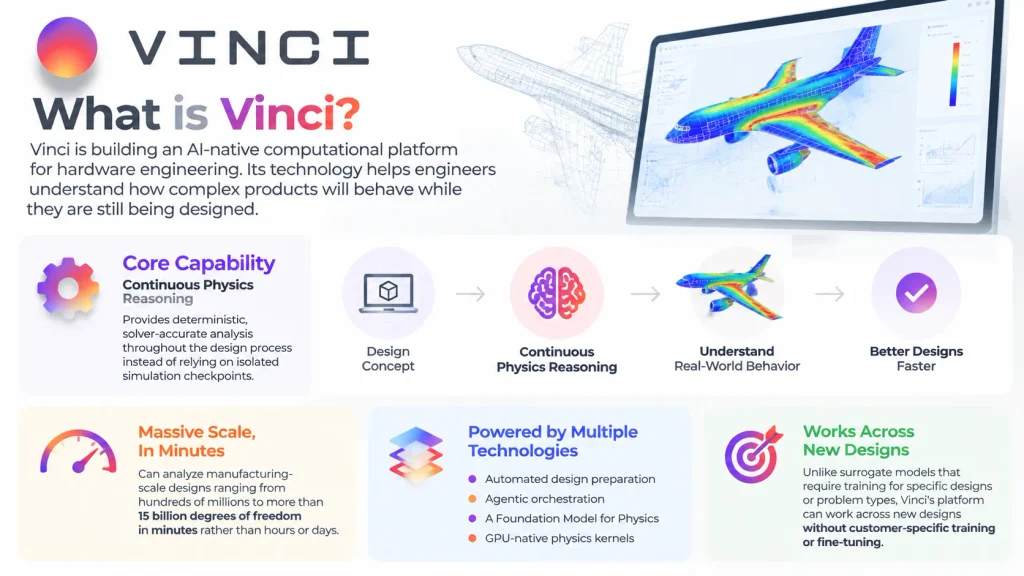
Vinci is building an AI-native computational platform for hardware engineering. Its technology helps engineers understand how complex products will behave while they are still being designed.
Read More:Maryland-Based SereNeuro Therapeutics Closes Pre-Seed Funding
Its core capability, called Continuous Physics Reasoning, provides deterministic, solver-accurate analysis throughout the design process instead of relying on isolated simulation checkpoints.
The platform can analyze manufacturing-scale designs ranging from hundreds of millions to more than 15 billion degrees of freedom in minutes rather than hours or days.
Vinci combines automated design preparation, agentic orchestration, a Foundation Model for Physics and GPU-native physics kernels. Unlike surrogate models that require training for specific designs or problem types, Vinci's platform can work across new designs without customer-specific training or fine-tuning.
How Much Funding Has Vinci Raised?
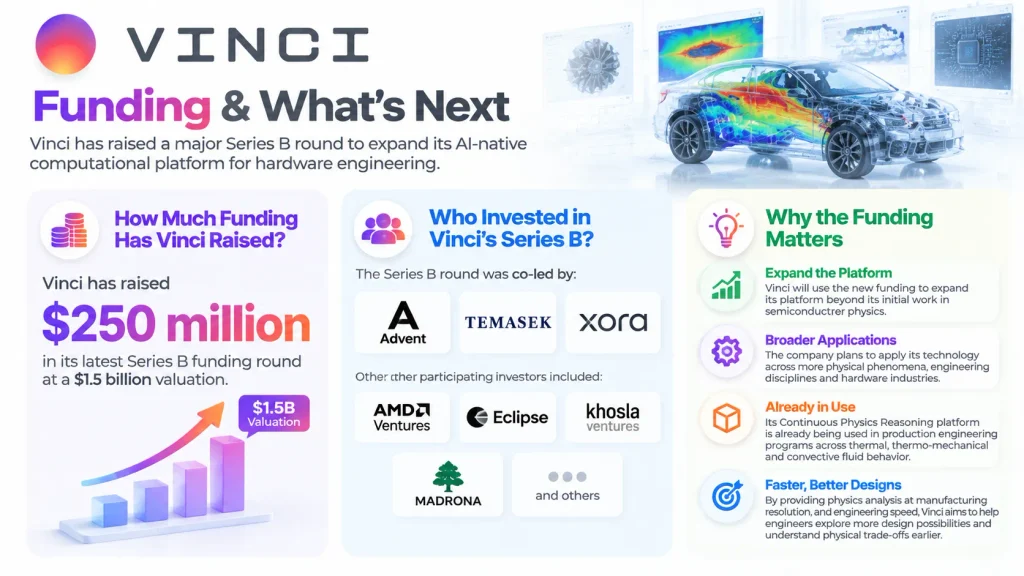
Vinci has raised $250 million in its latest Series B funding round at a $1.5 billion valuation.
The round was co-led by Advent, Temasek and Xora, with participation from AMD Ventures, Eclipse, Khosla Ventures, Madrona and other investors.
The source does not provide details about previous funding rounds or Vinci's total funding raised before this round.
Who Invested in Vinci's Series B?
The Series B round was co-led by:
- Advent
- Temasek
- Xora
Other participating investors included AMD Ventures, Eclipse, Khosla Ventures, Madrona and others.
Why the Funding Matters
Vinci will use the new funding to expand its platform beyond its initial work in semiconductor physics.
The company plans to apply its technology across more physical phenomena, engineering disciplines and hardware industries.
Its Continuous Physics Reasoning platform is already being used in production engineering programs across thermal, thermo-mechanical and convective fluid behavior.
By providing physics analysis at manufacturing resolution, and engineering speed, Vinci aims to help engineers explore more design possibilities and understand physical trade-offs earlier in the development process.
Who founded Vinci?
Vinci was founded in 2023 by Hardik Kabaria and Sarah Osentoski.
The company is headquartered in Palo Alto, California, and is building what it describes as intelligence infrastructure for hardware engineering.
Market and Business Growth
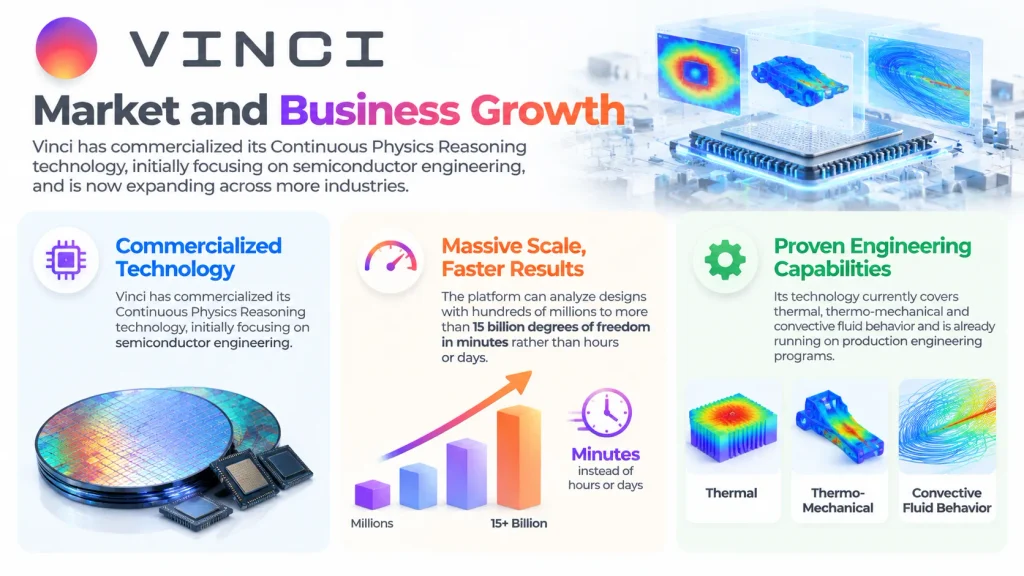
Vinci has commercialized its Continuous Physics Reasoning technology, initially focusing on semiconductor engineering.
The platform can analyze designs with hundreds of millions to more than 15 billion degrees of freedom in minutes rather than hours or days.
Its technology currently covers thermal, thermo-mechanical and convective fluid behavior and is already running on production engineering programs.
RECOMMENDED FOR YOU


Cheryl Sew Hoy Co-Founded Tiny Health Secures $33M in Series B Funding
Devin Jacobs
Sep 30, 2026
What Happens Next?
Vinci plans to expand Continuous Physics Reasoning beyond semiconductor physics and into additional physical phenomena, engineering disciplines and hardware industries.
The company will continue developing its AI-native computational platform to help engineers evaluate more designs and understand how hardware will perform while products are still being developed.
Read More:Reactor Raises Funding to Scale Real-Time Generative Video Platform
Recommended Stories for You

Startuprise Jul 30, 2025
Devin Jacobs Apr 30, 2026
Devin Jacobs May 13, 2026

Devin Jacobs Dec 16, 2023


Devin Jacobs Sep 21, 2026
Trending Stories
Electrical-Based Nexus Power Secures Investment From Madison River Capital

Florida-Based Maximum Scores $30M in Seed Funding

Karan Grover Co-Founded Kanu AI Raises $11.7M in Funding

Ametros appoints Andrea Mills to the Kids’ Chance of America (KCOA) Board of Directors

GeoComm Announces Partnership with California-Based Pulsiam

COEO Solutions Acquires Florida-Based NetWolves, Expanding Network

Christina Johnson Co-Founded Advisar Raises $750K in Pre-Seed Funding
California-Based Aranya Raises $11M in Funding

